QUESTION IMAGE
Question
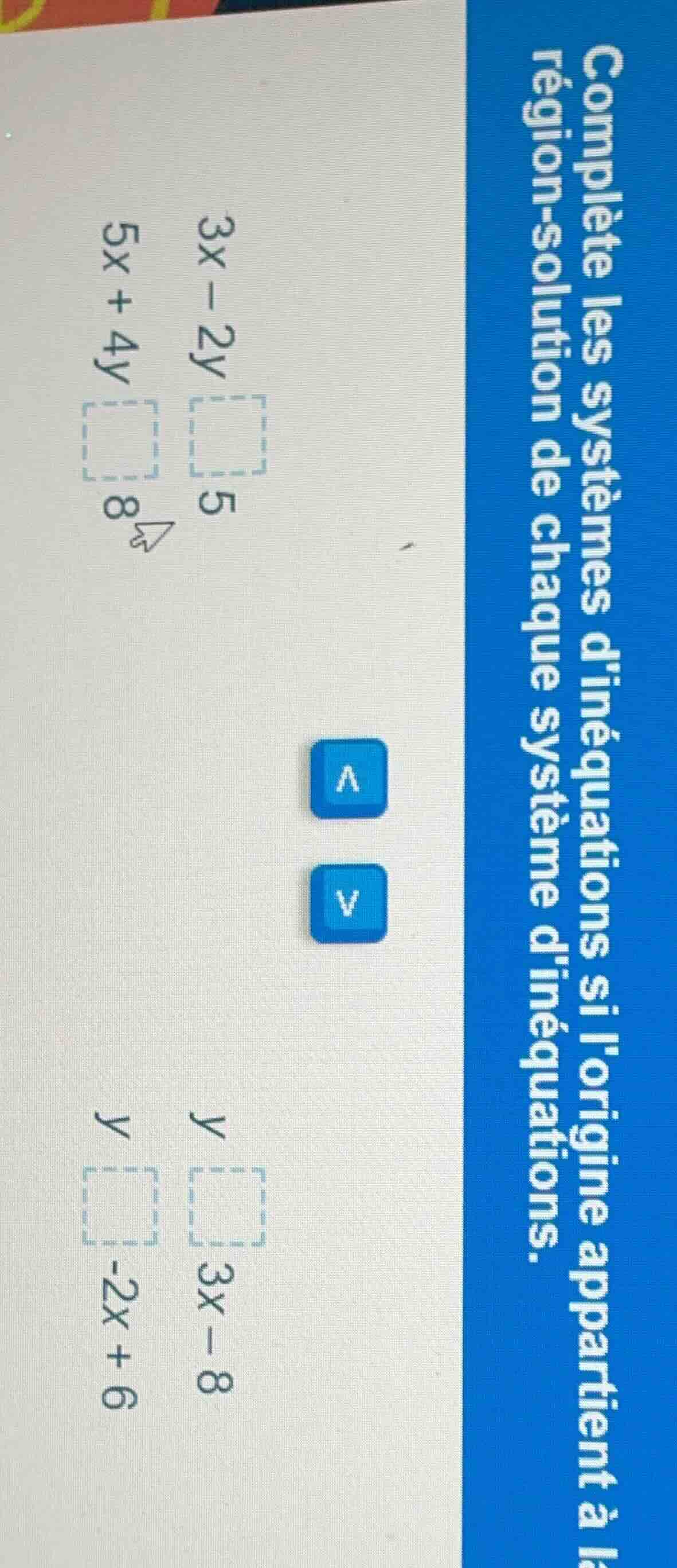
complète les systèmes dinéquations si lorigine appartient à la région-solution de chaque système dinéquations.
3x - 2y
5x + 4y
y
y
3x - 8
-2x + 6
To solve the system of linear inequalities, we first consider the origin \((0,0)\) and check which inequality it satisfies.
Step 1: Check the first inequality \(3x - 2y \square 5\)
Substitute \(x = 0\) and \(y = 0\) into \(3x - 2y\):
\[
3(0) - 2(0) = 0
\]
We compare \(0\) with \(5\). Since \(0 < 5\), the inequality for \(3x - 2y\) should be \(3x - 2y < 5\).
Step 2: Check the second inequality \(5x + 4y \square 8\)
Substitute \(x = 0\) and \(y = 0\) into \(5x + 4y\):
\[
5(0) + 4(0) = 0
\]
We compare \(0\) with \(8\). Since \(0 < 8\), the inequality for \(5x + 4y\) should be \(5x + 4y < 8\).
Step 3: Check the third inequality \(y \square 3x - 8\)
Substitute \(x = 0\) and \(y = 0\) into \(3x - 8\):
\[
3(0) - 8 = -8
\]
We compare \(0\) with \(-8\). Since \(0 > -8\), the inequality for \(y\) and \(3x - 8\) should be \(y > 3x - 8\).
Step 4: Check the fourth inequality \(y \square -2x + 6\)
Substitute \(x = 0\) and \(y = 0\) into \(-2x + 6\):
\[
-2(0) + 6 = 6
\]
We compare \(0\) with \(6\). Since \(0 < 6\), the inequality for \(y\) and \(-2x + 6\) should be \(y < -2x + 6\).
Final Answer
- \(3x - 2y < 5\)
- \(5x + 4y < 8\)
- \(y > 3x - 8\)
- \(y < -2x + 6\)

Snap & solve any problem in the app
Get step-by-step solutions on Sovi AI
Photo-based solutions with guided steps
Explore more problems and detailed explanations
To solve the system of linear inequalities, we first consider the origin \((0,0)\) and check which inequality it satisfies.
Step 1: Check the first inequality \(3x - 2y \square 5\)
Substitute \(x = 0\) and \(y = 0\) into \(3x - 2y\):
\[
3(0) - 2(0) = 0
\]
We compare \(0\) with \(5\). Since \(0 < 5\), the inequality for \(3x - 2y\) should be \(3x - 2y < 5\).
Step 2: Check the second inequality \(5x + 4y \square 8\)
Substitute \(x = 0\) and \(y = 0\) into \(5x + 4y\):
\[
5(0) + 4(0) = 0
\]
We compare \(0\) with \(8\). Since \(0 < 8\), the inequality for \(5x + 4y\) should be \(5x + 4y < 8\).
Step 3: Check the third inequality \(y \square 3x - 8\)
Substitute \(x = 0\) and \(y = 0\) into \(3x - 8\):
\[
3(0) - 8 = -8
\]
We compare \(0\) with \(-8\). Since \(0 > -8\), the inequality for \(y\) and \(3x - 8\) should be \(y > 3x - 8\).
Step 4: Check the fourth inequality \(y \square -2x + 6\)
Substitute \(x = 0\) and \(y = 0\) into \(-2x + 6\):
\[
-2(0) + 6 = 6
\]
We compare \(0\) with \(6\). Since \(0 < 6\), the inequality for \(y\) and \(-2x + 6\) should be \(y < -2x + 6\).
Final Answer
- \(3x - 2y < 5\)
- \(5x + 4y < 8\)
- \(y > 3x - 8\)
- \(y < -2x + 6\)