QUESTION IMAGE
Question
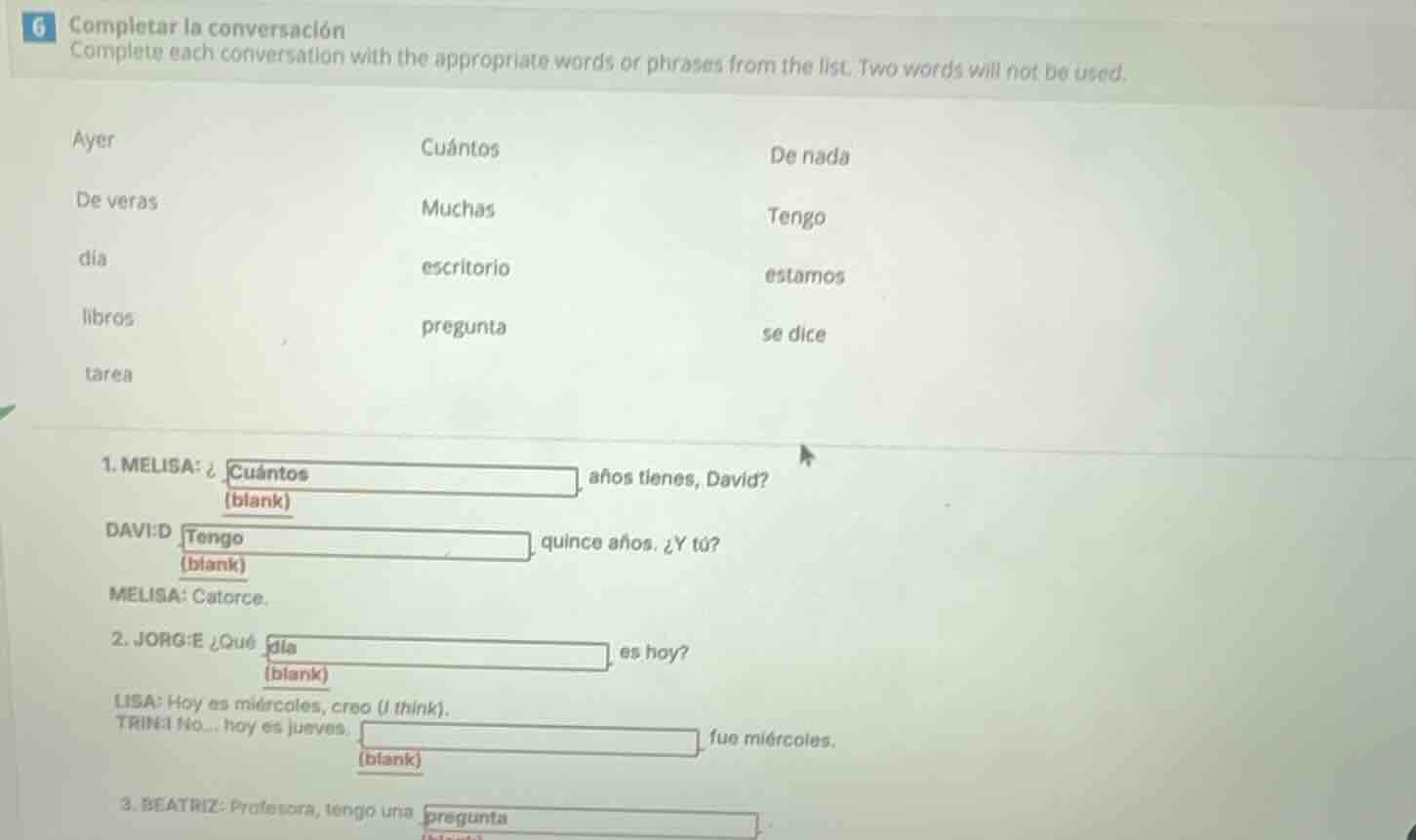
6 completar la conversación
complete each conversation with the appropriate words or phrases from the list. two words will not be used.
ayer
cuántos
de nada
de veras
muchas
tengo
día
escritorio
estamos
libros
pregunta
se dice
tarea
- melisa: ¿cuántos años tienes, david?
david: tengo quince años. ¿y tú?
melisa: catorce.
- jorge: ¿qué día es hoy?
lisa: hoy es miércoles, creo (i think).
trini: no... hoy es jueves. ayer fue miércoles.
- beatriz: profesora, tengo una pregunta.
To solve this fill - in - the - blank exercise for Spanish conversation, we analyze each blank based on the context and the given word list:
1. First blank in Melisa's question
The question is about asking David's age. In Spanish, the phrase “¿Cuántos años tienes?” is a common way to ask “How old are you?”. So we choose “Cuántos” to fill this blank.
2. First blank in David's response
To answer the age - asking question “¿Cuántos años tienes?”, the common response structure in Spanish is “Tengo + number + años”. So here we use “Tengo” to say “I have (quince años - fifteen years)”.
3. Blank in Jorge's question
The question “¿Qué día es hoy?” is used to ask “What day is it today?”. So we select “día” to fill this blank.
4. Blank in Trini's statement
Trini wants to say that yesterday was Wednesday. “Ayer” means “yesterday”, so we use “Ayer” to complete the sentence “Ayer fue miércoles” (Yesterday was Wednesday).
5. Blank in Beatriz's statement
Beatriz is saying to the teacher that she has a “pregunta” (question) doesn't fit here? Wait, no, the sentence is “Profesora, tengo una...”. From the list, “pregunta” is “question”, but wait, maybe a typo? Wait, no, the list has “pregunta” and the context is a student talking to a teacher. But looking at the given filled - in part, Beatriz's blank is filled with “pregunta”? Wait, no, the original filled part for Beatriz: “Profesora, tengo una pregunta” (Teacher, I have a question) is correct. But let's check the blanks:
Wait, the third conversation:
BEATRIZ: Profesora, tengo una [blank].
From the list, “pregunta” is “question”, so we use “pregunta”. But maybe there are other blanks? Wait, the user's image shows some filled, but let's list all the blanks:
- Melisa's blank: Cuántos
- David's blank: Tengo
- Jorge's blank: día
- Trini's blank: Ayer
- Beatriz's blank: pregunta (assuming the sentence is “tengo una pregunta”)
But let's confirm each:
- Melisa: ¿[Cuántos] años tienes, David? (correct, as “cuántos” asks for quantity of years)
- David: [Tengo] quince años. ¿Y tú? (correct, “tengo” is “I have” in the context of age)
- Jorge: ¿Qué [día] es hoy? (correct, “día” for day)
- Trini: No... hoy es jueves. [Ayer] fue miércoles. (correct, “ayer” is yesterday)
- Beatriz: Profesora, tengo una [pregunta]. (correct, “pregunta” is question)
So the answers for the blanks (in order of the numbered conversations and their blanks):
- Cuántos
- Tengo
- día
- Ayer
- pregunta

Snap & solve any problem in the app
Get step-by-step solutions on Sovi AI
Photo-based solutions with guided steps
Explore more problems and detailed explanations
To solve this fill - in - the - blank exercise for Spanish conversation, we analyze each blank based on the context and the given word list:
1. First blank in Melisa's question
The question is about asking David's age. In Spanish, the phrase “¿Cuántos años tienes?” is a common way to ask “How old are you?”. So we choose “Cuántos” to fill this blank.
2. First blank in David's response
To answer the age - asking question “¿Cuántos años tienes?”, the common response structure in Spanish is “Tengo + number + años”. So here we use “Tengo” to say “I have (quince años - fifteen years)”.
3. Blank in Jorge's question
The question “¿Qué día es hoy?” is used to ask “What day is it today?”. So we select “día” to fill this blank.
4. Blank in Trini's statement
Trini wants to say that yesterday was Wednesday. “Ayer” means “yesterday”, so we use “Ayer” to complete the sentence “Ayer fue miércoles” (Yesterday was Wednesday).
5. Blank in Beatriz's statement
Beatriz is saying to the teacher that she has a “pregunta” (question) doesn't fit here? Wait, no, the sentence is “Profesora, tengo una...”. From the list, “pregunta” is “question”, but wait, maybe a typo? Wait, no, the list has “pregunta” and the context is a student talking to a teacher. But looking at the given filled - in part, Beatriz's blank is filled with “pregunta”? Wait, no, the original filled part for Beatriz: “Profesora, tengo una pregunta” (Teacher, I have a question) is correct. But let's check the blanks:
Wait, the third conversation:
BEATRIZ: Profesora, tengo una [blank].
From the list, “pregunta” is “question”, so we use “pregunta”. But maybe there are other blanks? Wait, the user's image shows some filled, but let's list all the blanks:
- Melisa's blank: Cuántos
- David's blank: Tengo
- Jorge's blank: día
- Trini's blank: Ayer
- Beatriz's blank: pregunta (assuming the sentence is “tengo una pregunta”)
But let's confirm each:
- Melisa: ¿[Cuántos] años tienes, David? (correct, as “cuántos” asks for quantity of years)
- David: [Tengo] quince años. ¿Y tú? (correct, “tengo” is “I have” in the context of age)
- Jorge: ¿Qué [día] es hoy? (correct, “día” for day)
- Trini: No... hoy es jueves. [Ayer] fue miércoles. (correct, “ayer” is yesterday)
- Beatriz: Profesora, tengo una [pregunta]. (correct, “pregunta” is question)
So the answers for the blanks (in order of the numbered conversations and their blanks):
- Cuántos
- Tengo
- día
- Ayer
- pregunta