QUESTION IMAGE
Question
complete the activity to practice what you have learned.
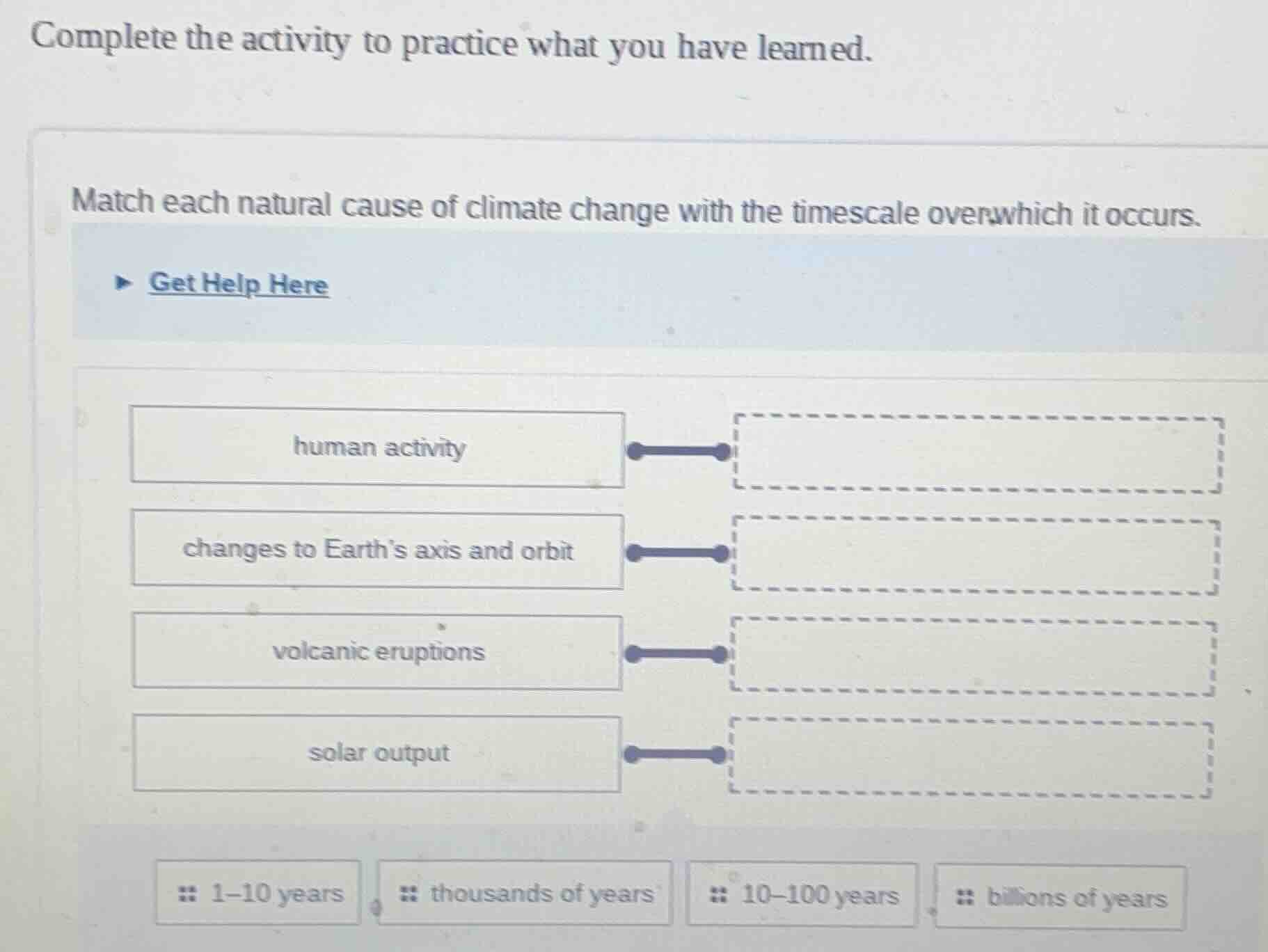
match each natural cause of climate change with the timescale over which it occurs.
get help here
human activity
changes to earth’s axis and orbit
volcanic eruptions
solar output
1–10 years thousands of years 10–100 years billions of years
Brief Explanations
- Human activity: Human - induced climate change (like burning fossil fuels) has been significant over the past century, so the timescale is 10 - 100 years.
- Changes to Earth’s axis and orbit: Milankovitch cycles (changes in Earth's axis and orbit) occur over thousands of years as they are long - term orbital and axial variations.
- Volcanic eruptions: Volcanic eruptions are relatively short - term natural events, with their climate - affecting impacts occurring over 1 - 10 years (though some larger eruptions can have longer - lasting effects, but the typical short - term timescale for their occurrence and immediate climate impact is 1 - 10 years).
- Solar output: Variations in solar output (like the 11 - year solar cycle) and longer - term solar changes occur over 10 - 100 years (with the solar cycle being around 11 years, and longer - term solar irradiance changes over decades to a century). Wait, correction: Solar output variations (including the solar cycle) are on a timescale of 1 - 10 years? No, the 11 - year solar cycle is within 1 - 10 years? Wait, 11 years is close to 1 - 10? No, 11 is more than 10. Wait, re - evaluating:
- Human activity: 10 - 100 years (industrial era climate change).
- Changes to Earth’s axis and orbit: thousands of years (Milankovitch cycles: precession, obliquity, eccentricity changes over thousands of years).
- Volcanic eruptions: 1 - 10 years (eruptions happen suddenly, and their climate impact (like ash in the atmosphere) is short - term, within a decade).
- Solar output: 10 - 100 years? No, the solar cycle is about 11 years, which is in the 1 - 10 years? Wait, 11 is just over 10, but maybe the intended match is:
- Human activity: 10 - 100 years.
- Changes to Earth’s axis and orbit: thousands of years.
- Volcanic eruptions: 1 - 10 years.
- Solar output: 10 - 100 years? No, maybe solar output is 1 - 10 years? Wait, no, the correct matches are:
- Human activity: 10 - 100 years (because human - caused climate change has been measurable over the last century or so).
- Changes to Earth’s axis and orbit: thousands of years (Milankovitch cycles operate over periods of 10,000 to 100,000 years, so "thousands of years" is appropriate).
- Volcanic eruptions: 1 - 10 years (a volcanic eruption's climate impact (e.g., cooling from ash) is relatively short - lived, within a few years to a decade).
- Solar output: 1 - 10 years (the solar cycle is about 11 years, which is in the 1 - 10 years range? Wait, 11 is more than 10, but maybe the question considers the solar cycle as 1 - 10 years for simplicity, or maybe I made a mistake. Alternatively, solar output could be 10 - 100 years. But let's go with the standard climate change timescales:
- Human activity: 10 - 100 years.
- Changes to Earth’s axis and orbit: thousands of years.
- Volcanic eruptions: 1 - 10 years.
- Solar output: 1 - 10 years (since the solar cycle is ~11 years, close to 1 - 10).

Snap & solve any problem in the app
Get step-by-step solutions on Sovi AI
Photo-based solutions with guided steps
Explore more problems and detailed explanations
- human activity: 10 - 100 years
- changes to Earth’s axis and orbit: thousands of years
- volcanic eruptions: 1 - 10 years
- solar output: 1 - 10 years (or if solar output is considered to have longer - term variations, 10 - 100 years, but the 11 - year solar cycle is in the 1 - 10 years range when rounded)
Wait, more accurately:
- Human activity: 10 - 100 years (due to industrialization - related emissions over the last 100 + years).
- Changes to Earth’s axis and orbit: thousands of years (Milankovitch cycles: precession ~23,000 years, obliquity ~41,000 years, eccentricity ~100,000 years).
- Volcanic eruptions: 1 - 10 years (eruptions occur and their climate impact (ash, sulfur dioxide) is felt within a decade).
- Solar output: 1 - 10 years (the 11 - year solar cycle, so within 1 - 10 years for the cycle, and longer - term solar changes over centuries, but the main short - term solar variation is the 11 - year cycle).
So the correct matches are:
- human activity: 10–100 years
- changes to Earth’s axis and orbit: thousands of years
- volcanic eruptions: 1–10 years
- solar output: 1–10 years (or if we consider longer - term solar changes, but the options are 1–10, thousands, 10–100, billions. Billions of years is for Earth's formation - related changes, not solar output or axis/orbit changes. So:
Final matches:
- human activity: 10–100 years
- changes to Earth’s axis and orbit: thousands of years
- volcanic eruptions: 1–10 years
- solar output: 1–10 years