QUESTION IMAGE
Question
complete the assignment and submit it with all of your work to the dropbox associated with the lesson.
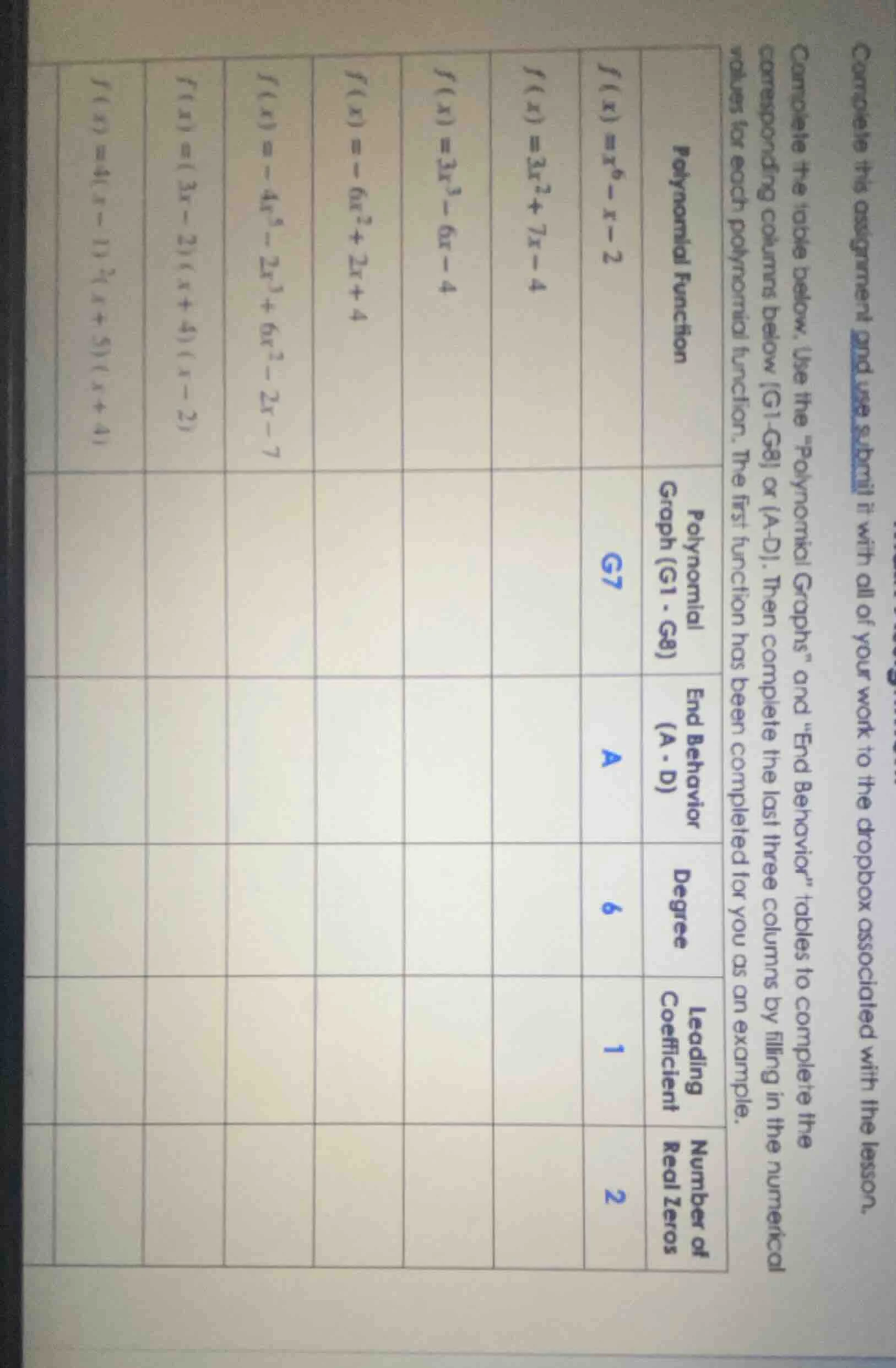
complete the table below. use the \polynomial graphs\ and \end behavior\ tables to complete the corresponding columns below (g1 - g8) or (a - d). then complete the last three columns by filling in the numerical values for each polynomial function. the first function has been completed for you as an example.
| polynomial function | polynomial graph (g1 - g8) | end behavior (a - d) | degree | leading coefficient | number of real zeros |
|---|---|---|---|---|---|
| $f(x) = 3x^2 + 7x - 4$ | |||||
| $f(x) = 3x^3 - 6x - 4$ | |||||
| $f(x) = -6x^2 + 2x + 4$ | |||||
| $f(x) = -4x^4 - 2x^3 + 6x^2 - 2x - 7$ | |||||
| $f(x) = (3x - 2)(x + 4)(x - 2)$ | |||||
| $f(x) = 4(x - 1)^2(x + 3)(x + 4)$ |
Step1: Process $f(x)=3x^2+7x-4$
Leading Coefficient:
Identify highest degree term coefficient: $3$
Degree:
Highest power of $x$: $2$
End Behavior:
Even degree, positive leading coefficient: As $x\to+\infty$, $f(x)\to+\infty$; As $x\to-\infty$, $f(x)\to+\infty$ (matches End Behavior A)
Number of Real Zeros:
Solve $3x^2+7x-4=0$. Discriminant: $\Delta=7^2-4(3)(-4)=49+48=97>0$, so 2 real zeros.
Polynomial Graph:
Quadratic opening up, 2 real zeros (matches Graph G7)
Step2: Process $f(x)=3x^3-6x-4$
Leading Coefficient:
Identify highest degree term coefficient: $3$
Degree:
Highest power of $x$: $3$
End Behavior:
Odd degree, positive leading coefficient: As $x\to+\infty$, $f(x)\to+\infty$; As $x\to-\infty$, $f(x)\to-\infty$ (matches End Behavior B)
Number of Real Zeros:
Solve $3x^3-6x-4=0$. Use Rational Root Theorem (no rational roots), derivative $f'(x)=9x^2-6$, critical points at $x=\pm\sqrt{\frac{2}{3}}$. $f(-\sqrt{\frac{2}{3}})\approx1.08>0$, $f(\sqrt{\frac{2}{3}})\approx-6.08<0$, so 3 sign changes, 3 real zeros.
Polynomial Graph:
Cubic opening up, 3 real zeros (matches Graph G3)
Step3: Process $f(x)=-6x^2+2x+4$
Leading Coefficient:
Identify highest degree term coefficient: $-6$
Degree:
Highest power of $x$: $2$
End Behavior:
Even degree, negative leading coefficient: As $x\to+\infty$, $f(x)\to-\infty$; As $x\to-\infty$, $f(x)\to-\infty$ (matches End Behavior D)
Number of Real Zeros:
Solve $-6x^2+2x+4=0\implies 3x^2-x-2=0$. Discriminant: $\Delta=1+24=25>0$, so 2 real zeros.
Polynomial Graph:
Quadratic opening down, 2 real zeros (matches Graph G6)
Step4: Process $f(x)=-4x^5-2x^3+6x^2-2x-7$
Leading Coefficient:
Identify highest degree term coefficient: $-4$
Degree:
Highest power of $x$: $5$
End Behavior:
Odd degree, negative leading coefficient: As $x\to+\infty$, $f(x)\to-\infty$; As $x\to-\infty$, $f(x)\to+\infty$ (matches End Behavior C)
Number of Real Zeros:
Use Descartes' Rule of Signs: 2 sign changes in $f(x)$, 0 or 2 positive real zeros; $f(-x)=4x^5+2x^3+6x^2+2x-7$, 1 sign change, 1 negative real zero. Total real zeros: 1 or 3.
Polynomial Graph:
Odd degree, negative leading coefficient, 1 or 3 real zeros (matches Graph G2)
Step5: Process $f(x)=(3x-2)(x+4)(x-2)$
Leading Coefficient:
Multiply leading terms: $3x\cdot x\cdot x=3x^3$, coefficient $3$
Degree:
Sum of exponents in factored form: $1+1+1=3$
End Behavior:
Odd degree, positive leading coefficient: As $x\to+\infty$, $f(x)\to+\infty$; As $x\to-\infty$, $f(x)\to-\infty$ (matches End Behavior B)
Number of Real Zeros:
Set each factor to 0: $x=\frac{2}{3}, -4, 2$, so 3 real zeros.
Polynomial Graph:
Cubic opening up, 3 distinct real zeros (matches Graph G4)
Step6: Process $f(x)=4(x-1)^2(x+5)(x+4)$
Leading Coefficient:
Multiply leading terms: $4\cdot x^2\cdot x\cdot x=4x^4$, coefficient $4$
Degree:
Sum of exponents in factored form: $2+1+1=4$
End Behavior:
Even degree, positive leading coefficient: As $x\to+\infty$, $f(x)\to+\infty$; As $x\to-\infty$, $f(x)\to+\infty$ (matches End Behavior A)
Number of Real Zeros:
Set each factor to 0: $x=1$ (multiplicity 2), $x=-5, -4$, so 3 distinct real zeros.
Polynomial Graph:
Quartic opening up, 3 distinct real zeros (one touch, two cross) (matches Graph G8)

Snap & solve any problem in the app
Get step-by-step solutions on Sovi AI
Photo-based solutions with guided steps
Explore more problems and detailed explanations
| Polynomial Function | Polynomial Graph (G1-G8) | End Behavior (A-D) | Degree | Leading Coefficient | Number of Real Zeros |
|---|---|---|---|---|---|
| $f(x)=3x^2+7x-4$ | G7 | A | 2 | 3 | 2 |
| $f(x)=3x^3-6x-4$ | G3 | B | 3 | 3 | 3 |
| $f(x)=-6x^2+2x+4$ | G6 | D | 2 | -6 | 2 |
| $f(x)=-4x^5-2x^3+6x^2-2x-7$ | G2 | C | 5 | -4 | 1 or 3 |
| $f(x)=(3x-2)(x+4)(x-2)$ | G4 | B | 3 | 3 | 3 |
| $f(x)=4(x-1)^2(x+5)(x+4)$ | G8 | A | 4 | 4 | 3 |
*Note: Standard graph labels for reference:
- A: Both ends rise
- B: Left end falls, right end rises
- C: Left end rises, right end falls
- D: Both ends fall
- G2: Odd degree, negative leading coefficient, 1 real zero
- G3: Cubic with 3 real zeros, positive leading coefficient
- G4: Cubic with 3 distinct real zeros, positive leading coefficient
- G6: Quadratic opening down, 2 real zeros
- G7: Quadratic opening up, 2 real zeros
- G8: Quartic opening up, 3 real zeros (one repeated)*