QUESTION IMAGE
Question
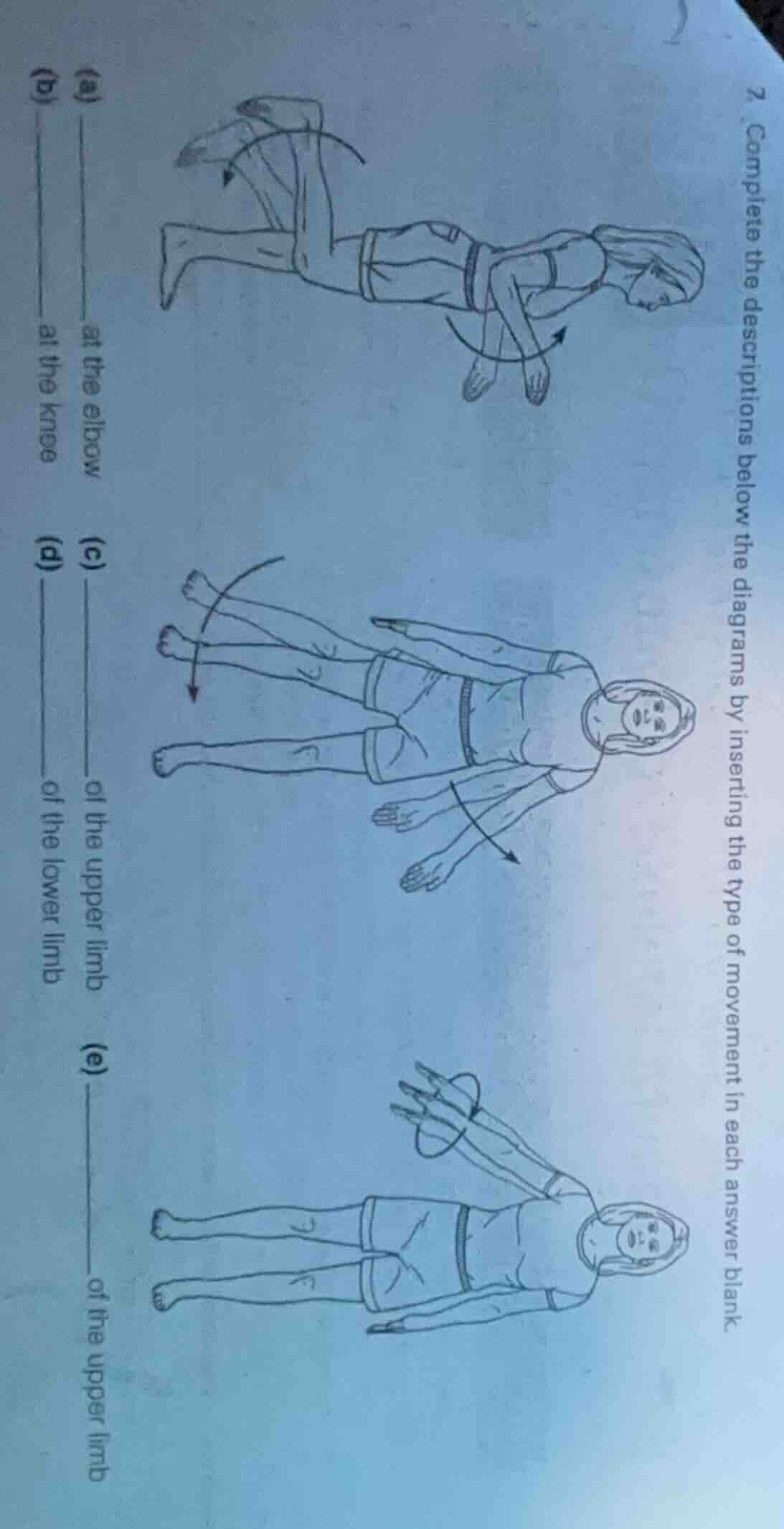
- complete the descriptions below the diagrams by inserting the type of movement in each answer blank.
(a) ______ at the elbow
(b) ______ at the knee
(c) ______ of the upper limb
(d) ______ of the lower limb
(e) ______ of the upper limb
To solve this, we identify joint movements:
- (a) At the elbow, the movement shown is Flexion/Extension (depending on direction, but common for elbow is flexion/extension; here likely Flexion if bending, but also could be rotation? Wait, no—elbow primary is flexion/extension, but the diagram's arm movement: wait, the first diagram's arm (elbow) – maybe Rotation? Wait, no, let's recall:
- (a) Elbow: The movement here (the first diagram, arm at elbow) – maybe Rotation? Wait, no, elbow joint: flexion/extension, or pronation/supination? Wait, the diagram shows the arm rotating at elbow? Wait, maybe (a) is Rotation (like pronation/supination), but more likely:
- (a) At elbow: Rotation (or more precisely, Pronation/Supination but the term for movement at elbow—wait, the first diagram's arm (elbow) movement: the arrows show rotation. So (a) is Rotation? Wait, no, let's check standard joint movements:
- (b) At knee: The leg is moving, so Flexion/Extension (knee joint: flexion is bending, extension straightening). The diagram shows the leg bending, so Flexion.
- (c) Upper limb (arm): The movement is like Flexion/Extension or Rotation? Wait, the second diagram's upper limb (arm) movement: the arrow shows the arm moving, maybe Flexion or Extension? Wait, no, the upper limb (c) – maybe Rotation? No, let's think again.
- (d) Lower limb (leg): The movement is like Abduction/Adduction? No, lower limb (d) – the arrows show the leg moving, maybe Abduction/Adduction (moving away or towards midline). Wait, the lower limb (d) – the diagram shows the leg moving, so Abduction (moving away from midline) or Adduction (towards). Wait, the arrows: one leg is moving, so Abduction?
- (e) Upper limb (arm): The movement is like Circumduction? No, the diagram shows the arm moving in a circular motion? Wait, no, (e) is the upper limb with a circular arrow, so Circumduction? Wait, no, let's correct:
Let's use standard anatomical movements:
- (a) At elbow: The movement is Rotation (pronation/supination) – when the forearm rotates.
- (b) At knee: Flexion (bending the knee).
- (c) Upper limb: Flexion (bending the arm) or Extension? Wait, the arrow direction: if the arm is moving down, maybe Extension? No, let's check the diagrams:
First diagram (a) elbow: rotation (arrows show circular motion at elbow) → Rotation
(b) knee: flexion (leg bending) → Flexion
(c) upper limb: Flexion (arm bending)
(d) lower limb: Abduction (leg moving away from midline)
(e) upper limb: Circumduction (circular movement of the arm)
But more accurately:
- (a) At elbow: Rotation (pronation/supination)
- (b) At knee: Flexion
- (c) Upper limb: Flexion
- (d) Lower limb: Abduction
- (e) Upper limb: Circumduction
But let's confirm:
(a) At elbow: The movement is Rotation (e.g., pronation or supination)
(b) At knee: Flexion (bending the knee)
(c) Upper limb: Flexion (bending the arm at the shoulder or elbow? Wait, upper limb (c) – the arm is moving, so Flexion
(d) Lower limb: Abduction (moving the leg away from the midline)
(e) Upper limb: Circumduction (circular movement of the arm)
But maybe the correct terms are:
(a) Rotation (at elbow: pronation/supination)
(b) Flexion (at knee: bending)
(c) Flexion (upper limb: bending)
(d) Abduction (lower limb: moving away)
(e) Circumduction (upper limb: circular motion)
However, let's adjust:
(a) At elbow: **Rotati…

Snap & solve any problem in the app
Get step-by-step solutions on Sovi AI
Photo-based solutions with guided steps
Explore more problems and detailed explanations
(a) Rotation
(b) Flexion
(c) Flexion
(d) Abduction
(e) Circumduction
(Note: Answers may vary slightly based on diagram interpretation, but these are standard anatomical movement terms.)