QUESTION IMAGE
Question
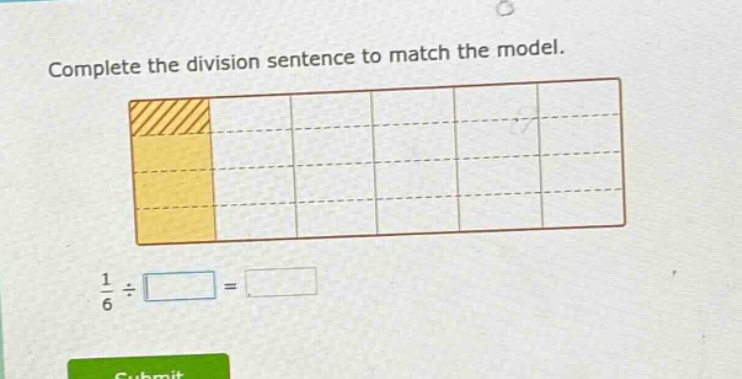
complete the division sentence to match the model.
\\(\frac{1}{6} div square = square\\)
Step1: Analyze the model
The rectangle is divided into 6 columns (so the width is $\frac{1}{6}$ of the whole) and 3 rows. The shaded part (striped and yellow) is 1 column (width $\frac{1}{6}$) and 3 rows? Wait, no, looking at the model: the first column is divided into 3 rows, and the shaded (striped + yellow) is 1 column (so $\frac{1}{6}$ of the whole rectangle) and then divided into 3 parts? Wait, actually, the first column (which is $\frac{1}{6}$ of the big rectangle) is divided into 3 equal parts (rows). So we are dividing $\frac{1}{6}$ by 3? Wait, no, let's think again. The big rectangle: columns are 6, so each column is $\frac{1}{6}$. The first column is divided into 3 rows, so the height is divided into 3. So the operation is $\frac{1}{6} \div 3$? Wait, no, the shaded part (the yellow with stripes) is 1 part of the 3 in the first column. Wait, the first column (width $\frac{1}{6}$) is divided into 3 equal horizontal parts (rows). So we have $\frac{1}{6}$ divided by 3? Wait, no, maybe the number of rows. Wait, the model: the first column has 3 rows, and the shaded area (the striped and yellow) is 1 column (so $\frac{1}{6}$) and 3 rows? No, the striped is 1 row, yellow is 2? Wait, no, the figure: the first column is divided into 3 horizontal sections (rows). The top one is striped, the bottom two are yellow. Wait, maybe the total number of parts in the first column is 3, so we are dividing $\frac{1}{6}$ by 3? Wait, no, the division sentence is $\frac{1}{6} \div \square = \square$. Let's see: the first column is $\frac{1}{6}$ of the whole. Then, within that column, we have 3 rows, so the height is divided into 3. So the operation is $\frac{1}{6} \div 3$? Wait, no, maybe the number of groups. Wait, if we have $\frac{1}{6}$ and we divide it into 3 equal parts, each part is $\frac{1}{18}$. Wait, but let's check: $\frac{1}{6} \div 3 = \frac{1}{6} \times \frac{1}{3} = \frac{1}{18}$. But maybe the divisor is 3, and the quotient is $\frac{1}{18}$? Wait, no, maybe the model is showing that the first column ($\frac{1}{6}$) is divided into 3 rows, so the number of rows is 3, so the divisor is 3, and the quotient is $\frac{1}{18}$? Wait, no, maybe I got it wrong. Wait, the big rectangle: columns are 6, so each column is $\frac{1}{6}$. The first column is divided into 3 equal parts (rows), so each part is $\frac{1}{6} \div 3 = \frac{1}{18}$. But maybe the divisor is 3, and the quotient is $\frac{1}{18}$? Wait, no, let's look at the model again. The first column (width $\frac{1}{6}$) has 3 horizontal lines, so it's divided into 3 equal parts. So the division is $\frac{1}{6} \div 3 = \frac{1}{18}$. Wait, but maybe the divisor is 3, and the quotient is $\frac{1}{18}$? Wait, no, maybe the model is showing that the shaded area (the striped part) is 1 part of the 3 in the first column. So the first column is $\frac{1}{6}$, and we divide it into 3 parts, so each part is $\frac{1}{6} \div 3 = \frac{1}{18}$. So the division sentence is $\frac{1}{6} \div 3 = \frac{1}{18}$? Wait, no, maybe the number of rows is 3, so the divisor is 3, and the quotient is $\frac{1}{18}$. Wait, let's confirm: $\frac{1}{6} \div 3 = \frac{1}{6} \times \frac{1}{3} = \frac{1}{18}$. So the first box (divisor) is 3, the second box (quotient) is $\frac{1}{18}$? Wait, no, maybe I made a mistake. Wait, the first column is $\frac{1}{6}$, and it's divided into 3 equal parts (rows), so each part is $\frac{1}{6} \div 3 = \frac{1}{18}$. So the division sentence is $\frac{1}{6} \div 3 = \frac{1}{18}$. Wait, but let's check the model again. The first column has 3 rows, so the number…

Snap & solve any problem in the app
Get step-by-step solutions on Sovi AI
Photo-based solutions with guided steps
Explore more problems and detailed explanations
The first box (divisor) is 3, the second box (quotient) is $\frac{1}{18}$. So the division sentence is $\frac{1}{6} \div 3 = \frac{1}{18}$.