QUESTION IMAGE
Question
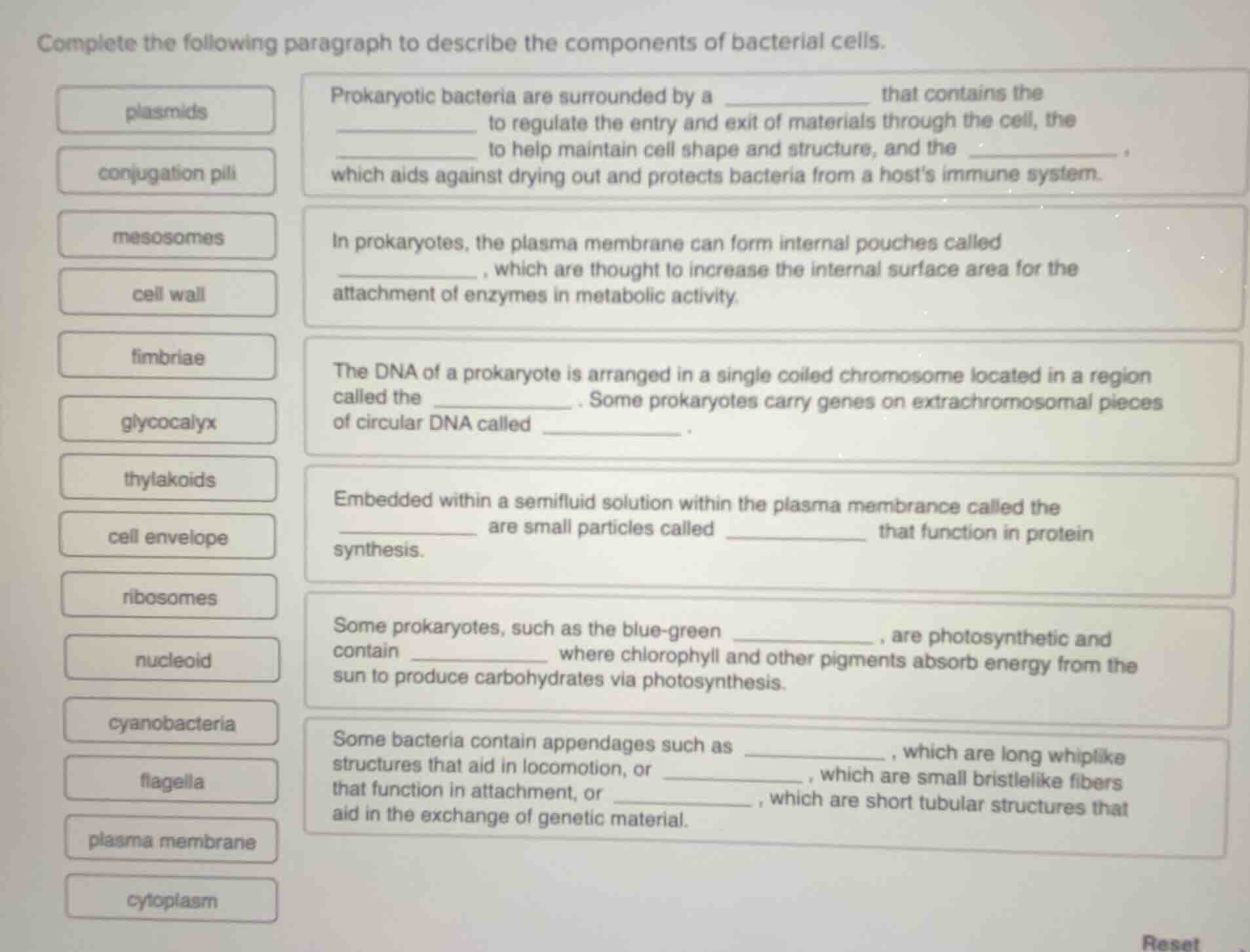
complete the following paragraph to describe the components of bacterial cells. prokaryotic bacteria are surrounded by a ____ that contains the __ to regulate the entry and exit of materials through the cell, the __ to help maintain cell shape and structure, and the __, which aids against drying out and protects bacteria from a hosts immune system. in prokaryotes, the plasma membrane can form internal pouches called __, which are thought to increase the internal surface area for the attachment of enzymes in metabolic activity. the dna of a prokaryote is arranged in a single coiled chromosome located in a region called the __. some prokaryotes carry genes on extrachromosomal pieces of circular dna called __. embedded within a semifluid solution within the plasma membrance called the __ are small particles called __ that function in protein synthesis. some prokaryotes, such as the blue - green __, are photosynthetic and contain __ where chlorophyll and other pigments absorb energy from the sun to produce carbohydrates via photosynthesis. some bacteria contain appendages such as __, which are long whiplike structures that aid in locomotion, or __, which are small bristlelike fibers that function in attachment, or ____, which are short tubular structures that aid in the exchange of genetic material. (options: plasmids, conjugation pili, mesosomes, cell wall, fimbriae, glycocalyx, thylakoids, cell envelope, ribosomes, nucleoid, cyanobacteria, flagella, plasma membrane, cytoplasm)
- For the first blank in the first paragraph: Prokaryotic bacteria are surrounded by a cell envelope (it's the outer structure encompassing other layers). The next blank: the plasma membrane regulates material entry/exit. Then, the cell wall maintains shape. The last in this part: glycocalyx protects from drying and immune system.
- Second paragraph: Plasma membrane internal pouches are mesosomes (increase surface area for enzymes).
- Third paragraph: Prokaryotic DNA region is nucleoid, extrachromosomal circular DNA is plasmids.
- Fourth paragraph: Semifluid in plasma membrane is cytoplasm, particles for protein synthesis are ribosomes.
- Fifth paragraph: Blue - green photosynthetic prokaryotes are cyanobacteria, they have thylakoids for photosynthesis (where pigments are).
- Sixth paragraph: Locomotion appendages are flagella, attachment fibers are fimbriae, genetic exchange structures are conjugation pili.

Snap & solve any problem in the app
Get step-by-step solutions on Sovi AI
Photo-based solutions with guided steps
Explore more problems and detailed explanations
- Prokaryotic bacteria are surrounded by a \(\boldsymbol{\text{cell envelope}}\) that contains the \(\boldsymbol{\text{plasma membrane}}\) to regulate the entry and exit of materials through the cell, the \(\boldsymbol{\text{cell wall}}\) to help maintain cell shape and structure, and the \(\boldsymbol{\text{glycocalyx}}\), which aids against drying out and protects bacteria from a host's immune system.
- In prokaryotes, the plasma membrane can form internal pouches called \(\boldsymbol{\text{mesosomes}}\), which are thought to increase the internal surface area for the attachment of enzymes in metabolic activity.
- The DNA of a prokaryote is arranged in a single coiled chromosome located in a region called the \(\boldsymbol{\text{nucleoid}}\). Some prokaryotes carry genes on extrachromosomal pieces of circular DNA called \(\boldsymbol{\text{plasmids}}\).
- Embedded within a semifluid solution within the plasma membrane called the \(\boldsymbol{\text{cytoplasm}}\) are small particles called \(\boldsymbol{\text{ribosomes}}\) that function in protein synthesis.
- Some prokaryotes, such as the blue - green \(\boldsymbol{\text{cyanobacteria}}\), are photosynthetic and contain \(\boldsymbol{\text{thylakoids}}\) where chlorophyll and other pigments absorb energy from the sun to produce carbohydrates via photosynthesis.
- Some bacteria contain appendages such as \(\boldsymbol{\text{flagella}}\), which are long whiplike structures that aid in locomotion, or \(\boldsymbol{\text{fimbriae}}\), which are small bristlelike fibers that function in attachment, or \(\boldsymbol{\text{conjugation pili}}\), which are short tubular structures that aid in the exchange of genetic material.