QUESTION IMAGE
Question
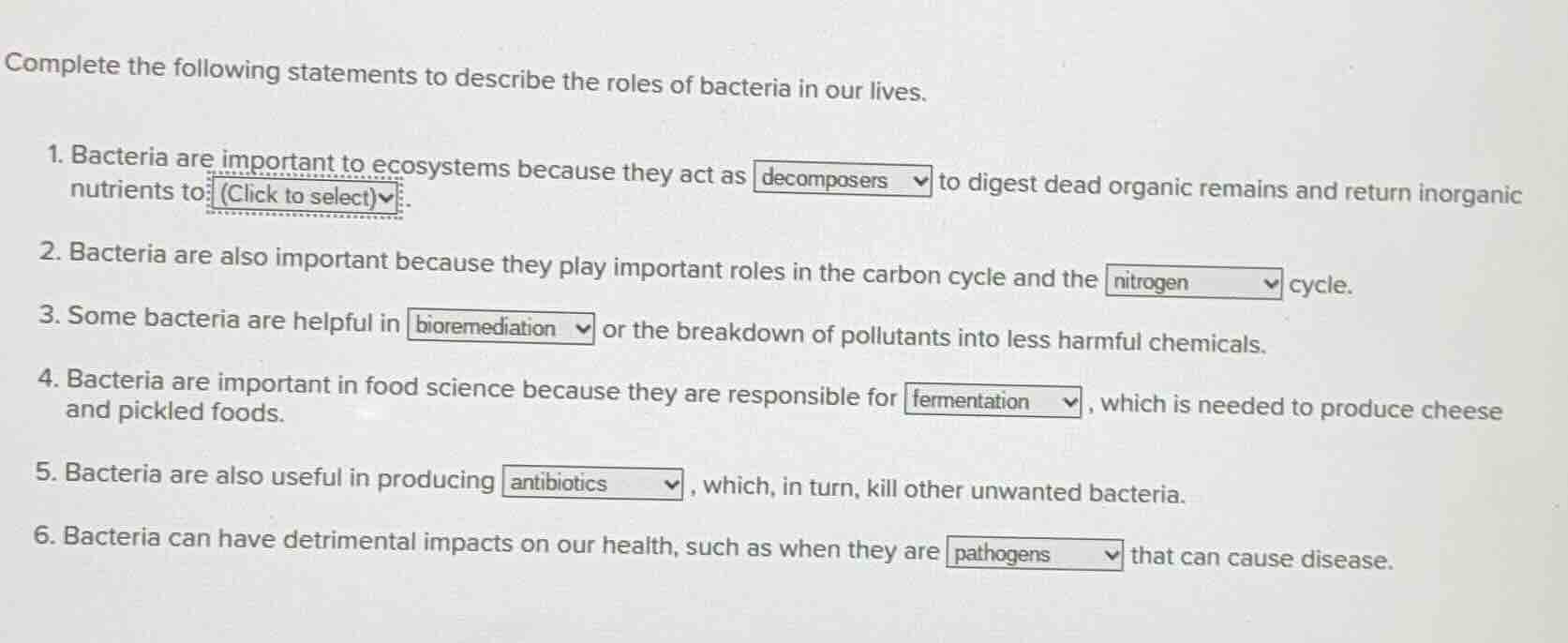
complete the following statements to describe the roles of bacteria in our lives.
- bacteria are important to ecosystems because they act as decomposers to digest dead organic remains and return inorganic nutrients to (click to select).
- bacteria are also important because they play important roles in the carbon cycle and the nitrogen cycle.
- some bacteria are helpful in bioremediation or the breakdown of pollutants into less harmful chemicals.
- bacteria are important in food science because they are responsible for fermentation, which is needed to produce cheese and pickled foods.
- bacteria are also useful in producing antibiotics, which, in turn, kill other unwanted bacteria.
- bacteria can have detrimental impacts on our health, such as when they are pathogens that can cause disease.
Brief Explanations
- Decomposer bacteria break down dead organic matter and release inorganic nutrients back into the environment (like soil, water) for producers to use, so the correct term is the environment/soil/producers, but the standard completion here is the environment (or specifically, the soil/abiotic environment, as this closes the nutrient cycle).
- Bacteria play a key role in both the carbon cycle and nitrogen cycle (e.g., nitrogen fixation, nitrification, denitrification by bacteria).
- Bioremediation is the process where bacteria break down environmental pollutants into less toxic substances.
- Fermentation by bacteria is essential for making foods like cheese, pickles, yogurt, and sauerkraut.
- Many antibiotics (e.g., penicillin, streptomycin) are produced by bacteria (or fungi) to inhibit or kill competing bacteria.
- Pathogenic bacteria are disease-causing organisms that can infect humans, animals, and plants.

Snap & solve any problem in the app
Get step-by-step solutions on Sovi AI
Photo-based solutions with guided steps
Explore more problems and detailed explanations
- Bacteria are important to ecosystems because they act as decomposers to digest dead organic remains and return inorganic nutrients to the environment (or soil/producers).
- Bacteria are also important because they play important roles in the carbon cycle and the nitrogen cycle.
- Some bacteria are helpful in bioremediation or the breakdown of pollutants into less harmful chemicals.
- Bacteria are important in food science because they are responsible for fermentation, which is needed to produce cheese and pickled foods.
- Bacteria are also useful in producing antibiotics, which, in turn, kill other unwanted bacteria.
- Bacteria can have detrimental impacts on our health, such as when they are pathogens that can cause disease.