QUESTION IMAGE
Question
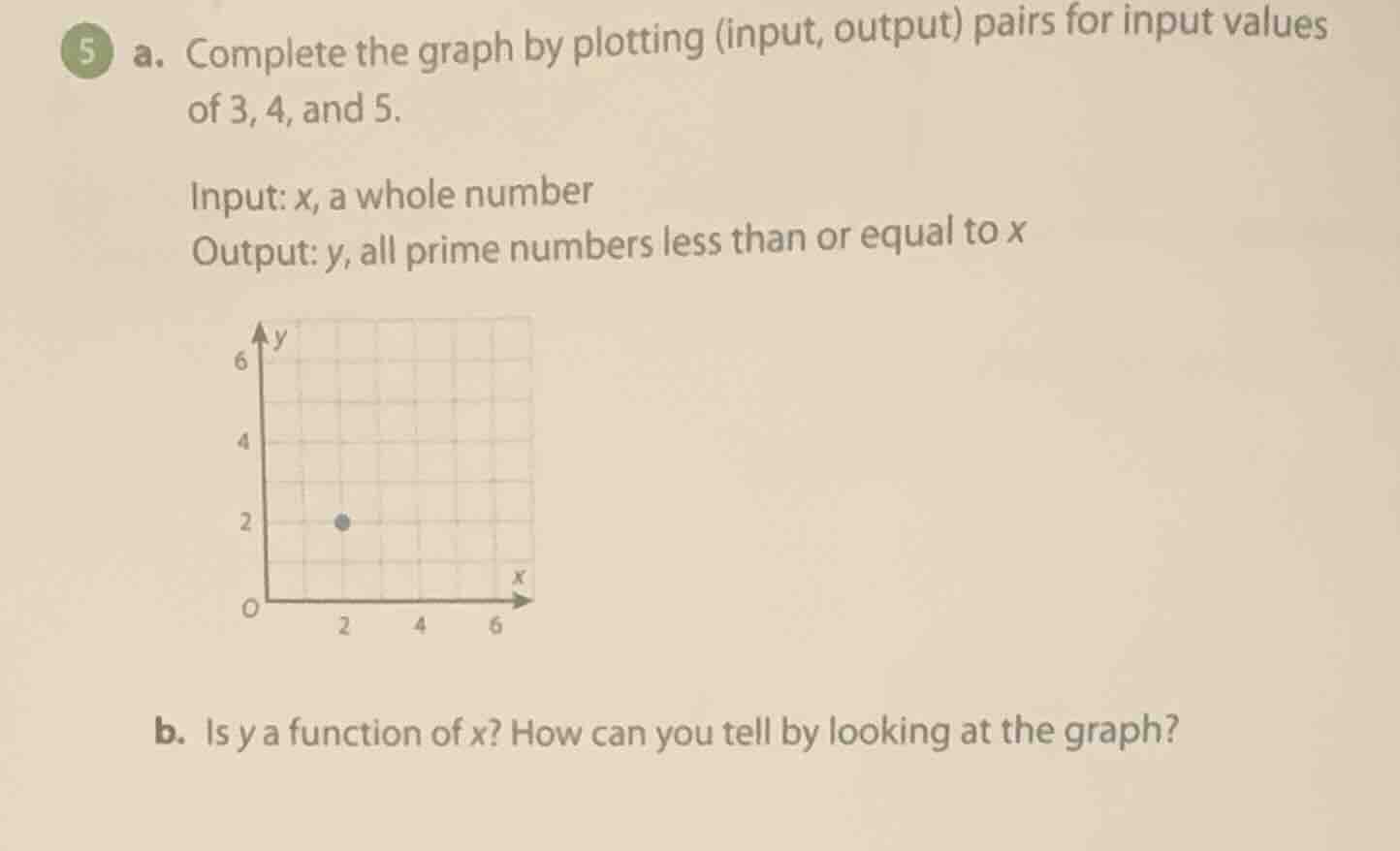
5 a. complete the graph by plotting (input, output) pairs for input values of 3, 4, and 5.
input: x, a whole number
output: y, all prime numbers less than or equal to x
b. is y a function of x? how can you tell by looking at the graph?
Part a
Step 1: Find prime numbers for \( x = 3 \)
Prime numbers less than or equal to 3 are 2, 3. So the number of prime numbers \( y=2 \)? Wait, no, wait: Wait, the output is "all prime numbers less than or equal to \( x \)", but maybe the output is the count? Wait, the graph has \( y \)-axis with 2,4,6. Wait, the existing point is at \( x = 2 \), \( y = 2 \)? Wait, prime numbers less than or equal to 2: 2. So count is 1? Wait, no, the point is at (2,2). Wait, maybe the output is the sum? No, 2 is the only prime ≤2. Wait, maybe the output is the number of prime numbers? No, 1 prime. Wait, maybe the output is the prime numbers themselves, but plotted as a point. Wait, no, the \( y \)-axis is numerical. Wait, let's re-examine:
Input \( x \) (whole number), Output \( y \): all prime numbers less than or equal to \( x \). Wait, maybe \( y \) is the count of prime numbers? Wait, for \( x = 2 \): primes are 2, count is 1. But the point is (2,2). Wait, maybe \( y \) is the sum? 2, sum is 2. For \( x = 3 \): primes are 2, 3, sum is 5? No, the graph's \( y \)-axis is up to 6. Wait, maybe \( y \) is the number of prime numbers? No, 2 primes for \( x=3 \), so \( y=2 \)? Wait, let's check:
- \( x = 2 \): primes ≤2: 2. So if \( y \) is the count, it's 1. But the point is (2,2). So maybe \( y \) is the prime number(s) as a single value? No, that doesn't make sense. Wait, maybe the output is the set of prime numbers, but plotted as a point where \( y \) is the largest prime? For \( x=2 \), largest prime is 2, so (2,2). For \( x=3 \), largest prime is 3, so (3,3). For \( x=4 \), largest prime ≤4 is 3, so (4,3). For \( x=5 \), largest prime ≤5 is 5, so (5,5). Let's check:
- \( x=2 \): largest prime ≤2 is 2 → (2,2) (matches the existing point).
- \( x=3 \): largest prime ≤3 is 3 → (3,3)
- \( x=4 \): largest prime ≤4 is 3 → (4,3)
- \( x=5 \): largest prime ≤5 is 5 → (5,5)
Yes, that makes sense. So:
Step 1: \( x = 3 \)
Largest prime ≤3 is 3 → point (3, 3)
Step 2: \( x = 4 \)
Largest prime ≤4 is 3 → point (4, 3)
Step 3: \( x = 5 \)
Largest prime ≤5 is 5 → point (5, 5)
Now, plot these points: (3,3), (4,3), (5,5) on the graph.
Part b
To determine if \( y \) is a function of \( x \), we use the vertical line test. A vertical line test states that if any vertical line drawn through the graph intersects the graph at more than one point, then \( y \) is not a function of \( x \). For each input \( x \) (a whole number), there is exactly one output \( y \) (the largest prime number ≤\( x \), or the relevant output). When we plot the points, each \( x \)-value (input) has only one corresponding \( y \)-value (output). So, using the vertical line test, since no vertical line will intersect the graph at more than one point, \( y \) is a function of \( x \).

Snap & solve any problem in the app
Get step-by-step solutions on Sovi AI
Photo-based solutions with guided steps
Explore more problems and detailed explanations
s:
a. Plot the points (3, 3), (4, 3), and (5, 5) on the graph.
b. Yes, \( y \) is a function of \( x \). We can tell by the vertical line test: no vertical line intersects the graph at more than one point, meaning each input \( x \) has exactly one output \( y \).