QUESTION IMAGE
Question
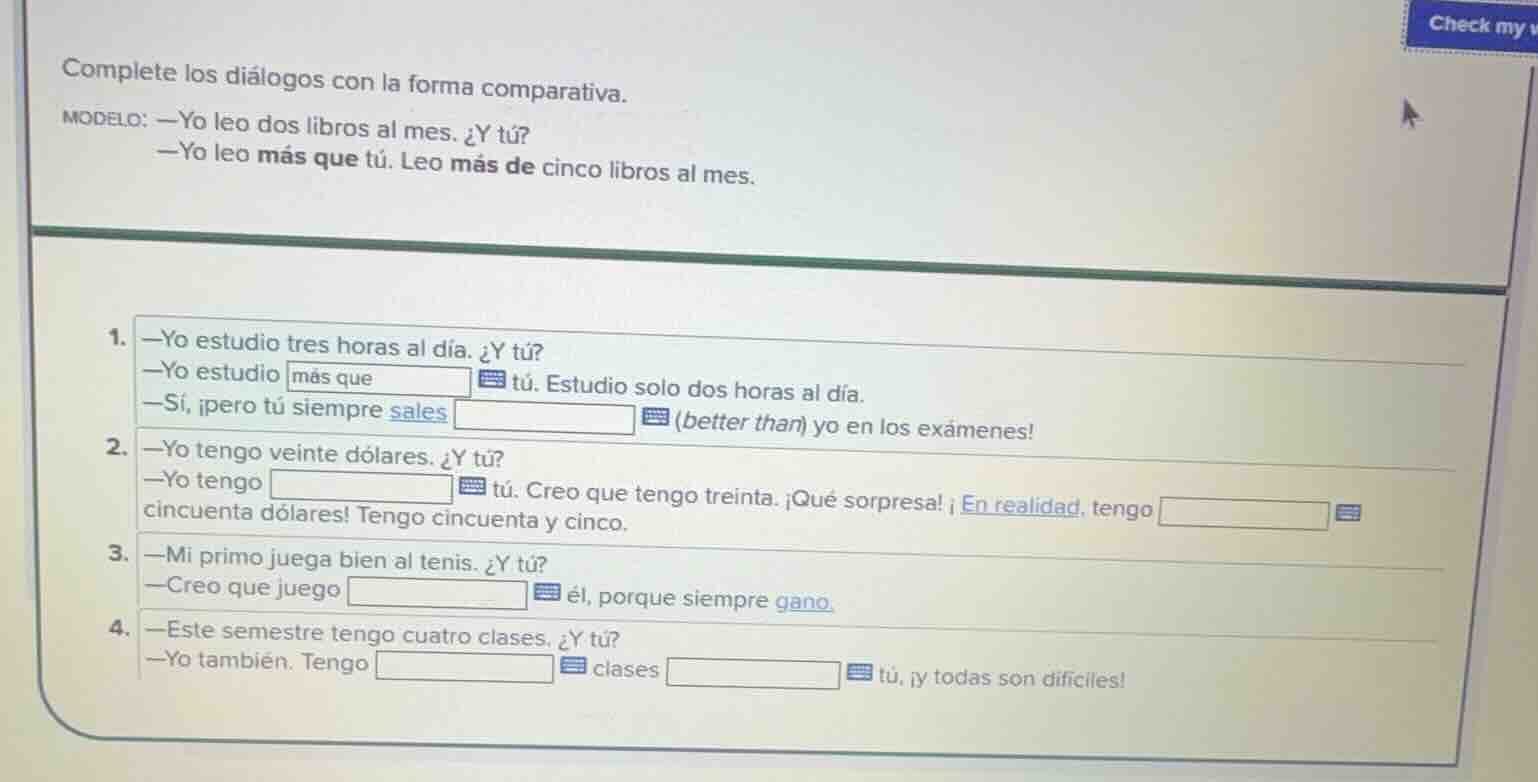
complete los diálogos con la forma comparativa.
modelo: —yo leo dos libros al mes. ¿y tú?
—yo leo más que tú. leo más de cinco libros al mes.
- —yo estudio tres horas al día. ¿y tú?
—yo estudio más que tú. estudio solo dos horas al día.
—sí, ¡pero tú siempre sales (better than) yo en los exámenes!
- —yo tengo veinte dólares. ¿y tú?
—yo tengo tú. creo que tengo treinta. ¡qué sorpresa! ¡en realidad, tengo cincuenta dólares! tengo cincuenta y cinco.
- —mi primo juega bien al tenis. ¿y tú?
—creo que juego él, porque siempre gano.
- —este semestre tengo cuatro clases. ¿y tú?
—yo también. tengo clases tú, ¡y todas son difíciles!
1.
For the first blank in the second line of the first dialogue, since the response is "Estudio solo dos horas al día" (I study only two hours a day) and the first speaker studies three hours, we need a comparative of inferiority. The correct phrase for "less than" in Spanish is "menos que". For the second blank, "better than" in Spanish is "mejor que".
In the first blank, the second speaker initially thinks they have thirty (more than twenty) and finally has fifty - five, so we need a comparative of superiority. "More than" in Spanish is "más que". For the second blank, when they realize they have fifty - five (more than fifty), we also use "más que".
Since the second speaker says "porque siempre gano" (because I always win), they think they play better than their cousin. "Better than" in Spanish is "mejor que".

Snap & solve any problem in the app
Get step-by-step solutions on Sovi AI
Photo-based solutions with guided steps
Explore more problems and detailed explanations
- First blank: menos que
- Second blank: mejor que