QUESTION IMAGE
Question
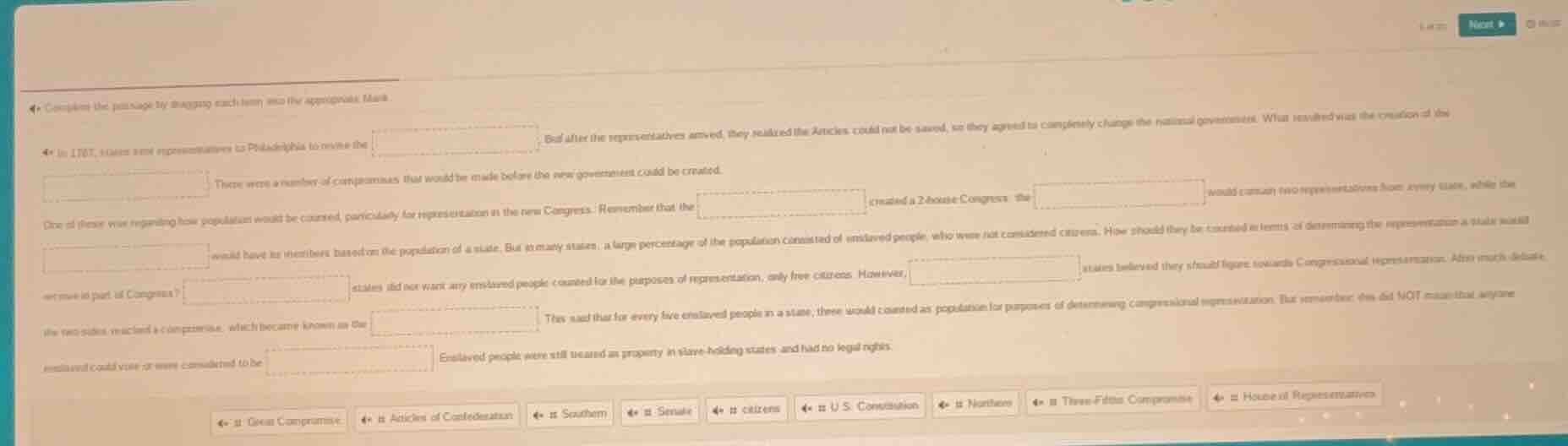
complete the passage by dragging each term into the appropriate blank.in 1787, states sent representatives to philadelphia to revise the ______. but after the representatives arrived, they realized the articles could not be saved, so they agreed to completely change the national government. what resulted was the creation of the ____. there were a number of compromises that would be made before the new government could be created.one of these was regarding how population would be counted, particularly for representation in the new congress: remember that the ____ created a 2-house congress: the ____ would contain two representatives from every state, while the ____ would have its members based on the population of a state. but in many states, a large percentage of the population consisted of enslaved people who were not considered citizens. how should they be counted in terms of determining the representation a state would receive in part of congress?____ states did not want any enslaved people counted for the purposes of representation, only free citizens. however, ____ states believed they should figure towards congressional representation. after much debate, the two sides reached a compromise, which became known as the ____. this said that for every five enslaved people in a state, three would counted as population for purposes of determining congressional representation. but remember: this did not mean that any enslaved could vote or were considered to be ______. enslaved people were still treated as property in slave-holding states and had no legal rights.great compromise, articles of confederation, southern, senate, citizens, u.s. constitution, northern, three-fifths compromise, house of representatives
This passage covers key events and compromises of the U.S. Constitutional Convention. Each blank is filled with the term that matches the historical context:
- The 1787 meeting was initially to revise the existing national governing document.
- The full replacement of that document produced a new foundational charter.
- A major compromise established the bicameral U.S. Congress.
- The upper house of Congress has equal representation per state.
- The lower house of Congress is based on state population.
- Northern states opposed counting enslaved people for representation.
- Southern states wanted enslaved people counted to gain more representation.
- The compromise on counting enslaved people was a specific fractional agreement.
- This compromise did not grant enslaved people the status of voting members of society.

Snap & solve any problem in the app
Get step-by-step solutions on Sovi AI
Photo-based solutions with guided steps
Explore more problems and detailed explanations
- Articles of Confederation
- U.S. Constitution
- Great Compromise
- Senate
- House of Representatives
- Northern
- Southern
- Three-Fifths Compromise
- citizens