QUESTION IMAGE
Question
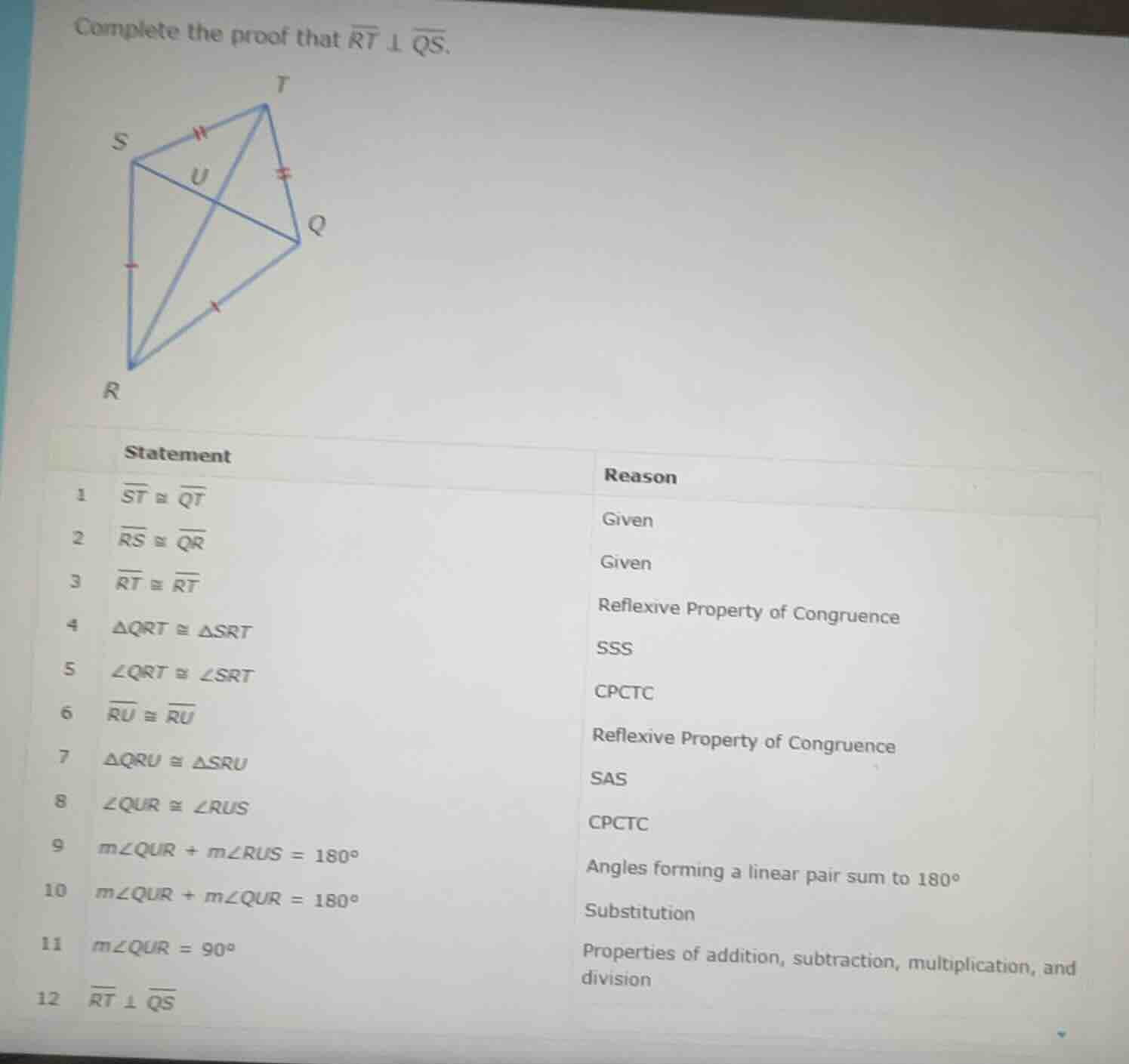
complete the proof that \\(overline{rt} \perp overline{qs}\\).
statement | reason
--- | ---
1 \\(overline{st} \cong overline{qt}\\) | given
2 \\(overline{rs} \cong overline{qr}\\) | given
3 \\(overline{rt} \cong overline{rt}\\) | reflexive property of congruence
4 \\(\triangle qrt \cong \triangle srt\\) | sss
5 \\(angle qrt \cong angle srt\\) | cpctc
6 \\(overline{ru} \cong overline{ru}\\) | reflexive property of congruence
7 \\(\triangle qru \cong \triangle sru\\) | sas
8 \\(angle qur \cong angle rus\\) | cpctc
9 \\(mangle qur + mangle rus = 180^circ\\) | angles forming a linear pair sum to \\(180^circ\\)
10 \\(mangle qur + mangle qur = 180^circ\\) | substitution
11 \\(mangle qur = 90^circ\\) | properties of addition, subtraction, multiplication, and division
12 \\(overline{rt} \perp overline{qs}\\) |
Step1: Recall the definition of perpendicular lines
Two lines are perpendicular if the angle between them is \( 90^\circ \). So we need to show that the angle between \( \overline{RT} \) and \( \overline{QS} \) (i.e., \( \angle QUR \) or \( \angle RUS \)) is \( 90^\circ \).
Step2: Analyze the given proof steps
- From step 8, \( \angle QUR \cong \angle RUS \), so their measures are equal (\( m\angle QUR = m\angle RUS \)).
- From step 9, \( m\angle QUR + m\angle RUS = 180^\circ \) (linear pair).
- Substitute \( m\angle RUS \) with \( m\angle QUR \) (from step 8) into step 9: \( m\angle QUR + m\angle QUR = 180^\circ \) (step 10).
- Simplify: \( 2m\angle QUR = 180^\circ \), so \( m\angle QUR = 90^\circ \) (step 11).
Step3: Conclude perpendicularity
Since \( m\angle QUR = 90^\circ \), by the definition of perpendicular lines, \( \overline{RT} \perp \overline{QS} \) (step 12, reason: If two lines intersect to form a right angle (\( 90^\circ \)), then they are perpendicular).

Snap & solve any problem in the app
Get step-by-step solutions on Sovi AI
Photo-based solutions with guided steps
Explore more problems and detailed explanations
To prove \( \overline{RT} \perp \overline{QS} \), we use the steps:
- From \( \angle QUR \cong \angle RUS \) (CPCTC) and \( m\angle QUR + m\angle RUS = 180^\circ \) (linear pair), substitute to get \( 2m\angle QUR = 180^\circ \).
- Solve: \( m\angle QUR = 90^\circ \).
- By definition of perpendicular lines (intersecting at \( 90^\circ \)), \( \overline{RT} \perp \overline{QS} \).
Thus, the proof is completed as shown, with the final reason for step 12 being "If two lines intersect to form a right angle, then the lines are perpendicular".