QUESTION IMAGE
Question
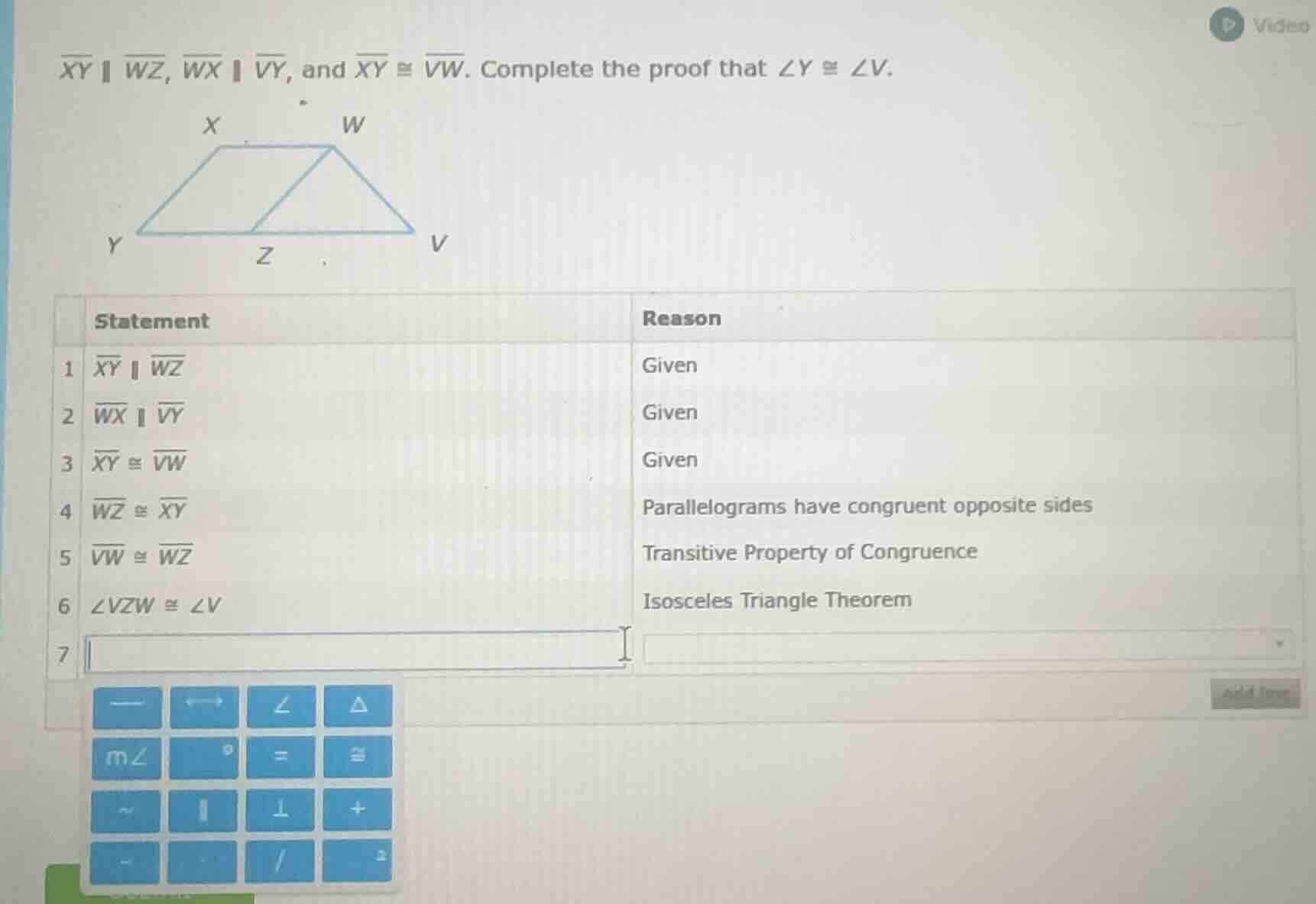
$\overline{xy} \parallel \overline{wz}$, $\overline{wx} \parallel \overline{vy}$, and $\overline{xy} \cong \overline{vw}$. complete the proof that $\angle y \cong \angle v$.
| statement | reason |
|---|---|
| 2 $\overline{wx} \parallel \overline{vy}$ | given |
| 3 $\overline{xy} \cong \overline{vw}$ | given |
| 4 $\overline{wz} \cong \overline{xy}$ | parallelograms have congruent opposite sides |
| 5 $\overline{vw} \cong \overline{wz}$ | transitive property of congruence |
| 6 $\angle vzw \cong \angle v$ | isosceles triangle theorem |
| 7 $\square$ | $\square$ |
Step1: Identify the relationship from parallel lines
Since \(\overline{XY} \parallel \overline{WZ}\) and \(\overline{WX} \parallel \overline{VY}\), quadrilateral \(XYWZ\) is a parallelogram. In a parallelogram, alternate interior angles are congruent. So, \(\angle Y\) and \(\angle VZW\) are alternate interior angles formed by the transversal \(VY\) cutting the parallel lines \(\overline{XY}\) and \(\overline{WZ}\). Thus, \(\angle Y \cong \angle VZW\).
Step2: Use transitive property of congruence
We already have \(\angle VZW \cong \angle V\) (from step 6, Isosceles Triangle Theorem) and \(\angle Y \cong \angle VZW\) (from step 1). By the Transitive Property of Congruence, if \(\angle Y \cong \angle VZW\) and \(\angle VZW \cong \angle V\), then \(\angle Y \cong \angle V\). So the statement for step 7 is \(\angle Y \cong \angle V\) and the reason is Transitive Property of Congruence (or using the two congruences we have).

Snap & solve any problem in the app
Get step-by-step solutions on Sovi AI
Photo-based solutions with guided steps
Explore more problems and detailed explanations
Statement: \(\boldsymbol{\angle Y \cong \angle V}\)
Reason: Transitive Property of Congruence (or Alternate Interior Angles and Transitive Property, but more precisely, since \(\angle Y \cong \angle VZW\) (alternate interior angles from parallelogram) and \(\angle VZW \cong \angle V\) (Isosceles Triangle Theorem), by transitive property, \(\angle Y \cong \angle V\))