QUESTION IMAGE
Question
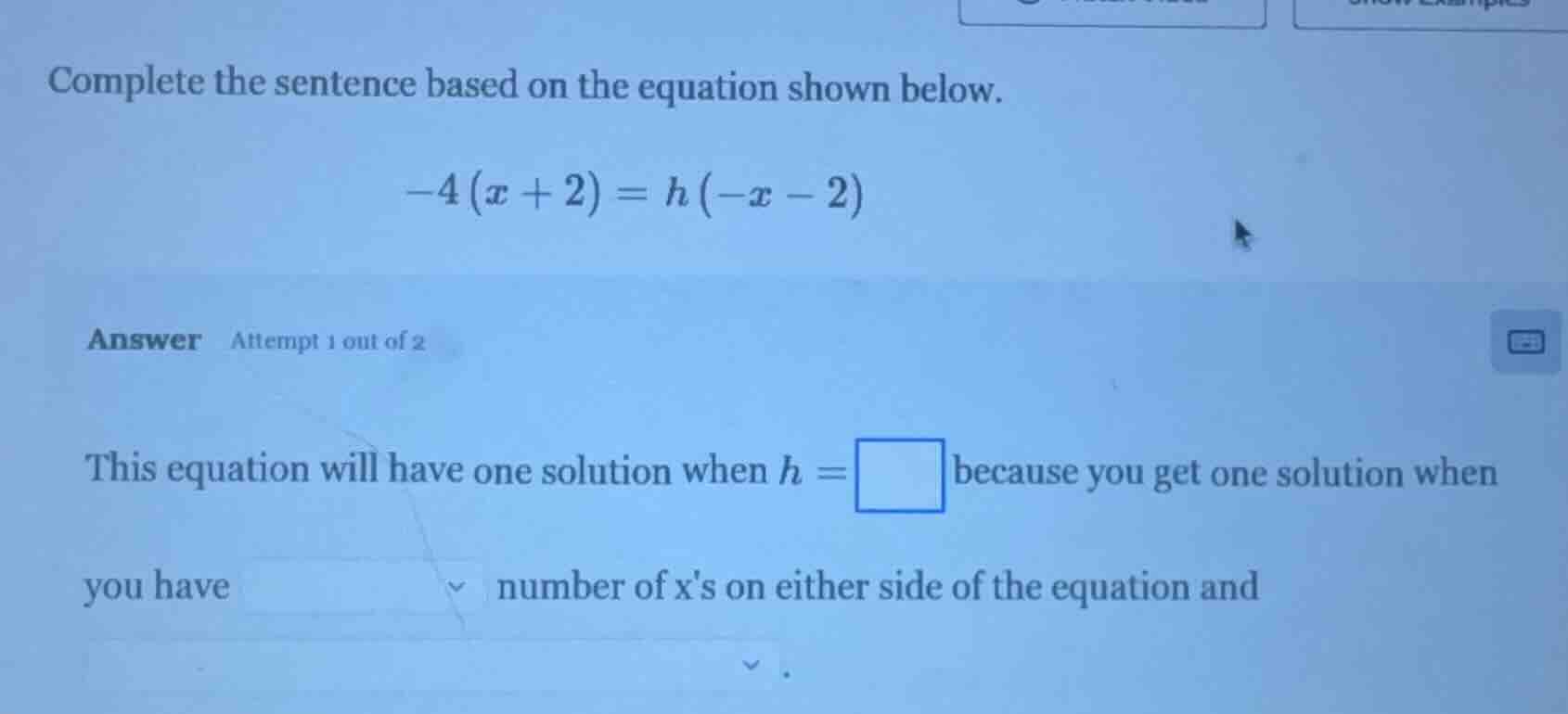
complete the sentence based on the equation shown below.
$-4(x + 2) = h(-x - 2)$
answer attempt 1 out of 2
this equation will have one solution when $h = \square$ because you get one solution when you have $\quad$ number of xs on either side of the equation and $\quad$.
Step1: Rewrite right-hand side factor
Notice that $-x-2 = -(x+2)$, so substitute this into the equation:
$-4(x+2) = h(-(x+2))$
Step2: Rearrange to isolate $h$
Rewrite the equation as:
$-4(x+2) = -h(x+2)$
For the equation to have one solution, the coefficients of $(x+2)$ must not be equal (if they were equal, the equation would be true for all $x$, infinitely many solutions). We need to find $h$ such that the terms with $x$ are not equivalent. First, divide both sides by $(x+2)$ (assuming $x
eq -2$):
$-4 = -h$
Step3: Solve for $h$
Multiply both sides by $-1$:
$h = 4$
When $h=4$, substituting back gives $-4(x+2)=4(-x-2)$, which simplifies to $-4x-8=-4x-8$, which is infinitely many solutions? No, correction: Wait, we need the equation to have one solution, which occurs when the coefficients of $x$ are different. Let's expand both sides fully:
Left side: $-4(x+2) = -4x -8$
Right side: $h(-x-2) = -hx -2h$
Set equal: $-4x -8 = -hx -2h$
Bring all terms to left: $(-4 + h)x + (-8 + 2h) = 0$
For one solution, the coefficient of $x$ must not be 0: $-4 + h
eq 0 \implies h
eq 4$. Wait, no, the question says "one solution when $h=$". Wait, no—wait, if coefficients are equal, infinitely many solutions. If coefficients are unequal, one solution. But wait, let's check when $h
eq 4$:
$(-4 + h)x = 8 - 2h$
$x = \frac{8-2h}{h-4} = \frac{-2(h-4)}{h-4} = -2$ (when $h
eq 4$). Oh, so for all $h
eq 4$, the solution is $x=-2$, which is one solution. But the question asks for $h=$ a value. Wait, no, the only time there is NOT one solution is when $h=4$ (infinitely many) or... no, there's no case of no solution here. Wait, the question says "this equation will have one solution when $h=$ [ ] because you get one solution when you have [different] number of x's on either side of the equation and [constant terms match or not?]". Wait, no, when $h
eq 4$, the coefficients of $x$ are different ($-4$ vs $-h$), so we can solve for $x$, which gives $x=-2$, one solution. But the question asks for a specific $h$. Wait, maybe the question is phrased as "will have one solution (not infinitely many) when $h
eq 4$, but the blank asks for $h=$. Wait, no, let's re-express:
If $h=4$, both sides are $-4(x+2)=4(-x-2) \implies -4x-8=-4x-8$, infinitely many solutions.
If $h
eq 4$, then we can divide both sides by $(x+2)$ (if $x
eq -2$), but solving gives $x=-2$ as the only solution. So the equation has one solution for any $h
eq 4$, but the question asks for $h=$ [ ]. Wait, maybe the question has a typo, but no—wait, the drop-downs: "you get one solution when you have [different] number of x's on either side of the equation and [the constant terms are consistent]". Wait, no, the only time it does NOT have one solution is when $h=4$ (infinitely many). So to have one solution, $h$ can be any value except 4, but the blank asks for a specific $h$. Wait, no, let's check again:
Wait, if we rearrange:
$-4x -8 = -hx -2h$
$(h-4)x = 8-2h$
If $h
eq 4$, then $x = \frac{8-2h}{h-4} = \frac{-2(h-4)}{h-4} = -2$, which is a single solution.
If $h=4$, then $0x=0$, infinitely many solutions.
So the equation has one solution for all $h
eq 4$, but the question asks for $h=$ [ ]. Maybe the question is asking for the value where it does NOT have one solution, but no, it says "will have one solution when $h=$". Wait, maybe the question means "exactly one solution (not infinitely many)" so any $h$ except 4, but the blank expects a value. Wait, maybe I misread. Wait, the original equation: $-4(x+2)=h(-x-2)$. If $h=4$, it's infinitely many. If $h$ is any other number, lik…

Snap & solve any problem in the app
Get step-by-step solutions on Sovi AI
Photo-based solutions with guided steps
Explore more problems and detailed explanations
This equation will have one solution when $\boldsymbol{h
eq 4}$ because you get one solution when you have a different number of x's on either side of the equation and the resulting equation simplifies to a single unique value for $x$.
(Note: If a specific numerical value is required for the blank, any number except 4 is valid, e.g., $h=3$.)