QUESTION IMAGE
Question
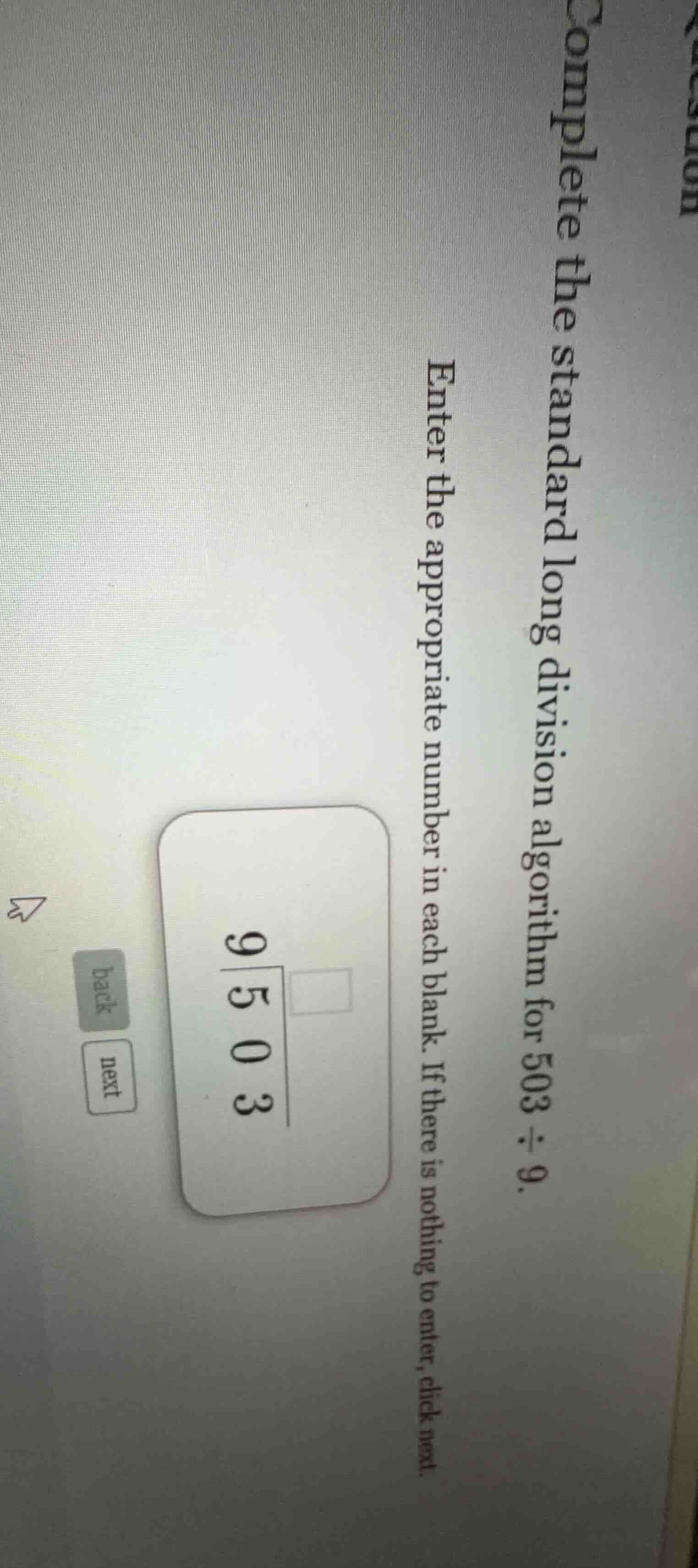
complete the standard long division algorithm for 503 ÷ 9. enter the appropriate number in each blank. if there is nothing to enter, click next.
Step1: Divide 5 by 9 (not possible, so consider 50)
We look at how many times 9 goes into 50. We know that \(9\times5 = 45\) and \(9\times6=54\) (which is too big). So the first digit of the quotient is 5.
Step2: Multiply and subtract
Multiply 9 by 5: \(9\times5 = 45\). Subtract 45 from 50: \(50 - 45=5\). Bring down the next digit (3) to make 53.
Step3: Divide 53 by 9
Now we see how many times 9 goes into 53. \(9\times5 = 45\), \(9\times6 = 54\) (too big). So the next digit of the quotient is 5. Wait, but let's check the initial blank. Wait, the long division setup is for 503 ÷ 9. The first digit of the quotient (when dividing 503 by 9) - let's do 503 ÷ 9. 9*55 = 495, 503 - 495 = 8. Wait, maybe the blank is the first digit of the quotient. Wait, the long division is set as 9 dividing into 503, with the first digit of the quotient. Let's re - express:
When we do long division of 503 by 9:
- We start with the hundreds and tens digit (50). 95 = 45, which is less than 50. So the first digit of the quotient (for the tens place? Wait, no, 503 is a three - digit number. 9 is a one - digit number. So we divide 5 (hundreds place) by 9, which is 0, so we move to 50 (tens and hundreds). 95 = 45, so we write 5 above the 0 (tens place). Then we have a remainder of 5, bring down 3 to make 53. 9*5 = 45, write 5 above the 3 (units place). So the quotient is 55 with a remainder of 8. But the blank in the long division is above the 5 (of 503). Wait, the long division is written as:
    55
  ------
9|503
  45
  ----
   53
   45
  ----
    8
Wait, maybe the blank is the first digit of the quotient. So when we start, we look at 50 (since 5 is less than 9). 9*5 = 45, so the first digit of the quotient (the tens digit) is 5. So the number in the blank should be 5.

Snap & solve any problem in the app
Get step-by-step solutions on Sovi AI
Photo-based solutions with guided steps
Explore more problems and detailed explanations
5