QUESTION IMAGE
Question
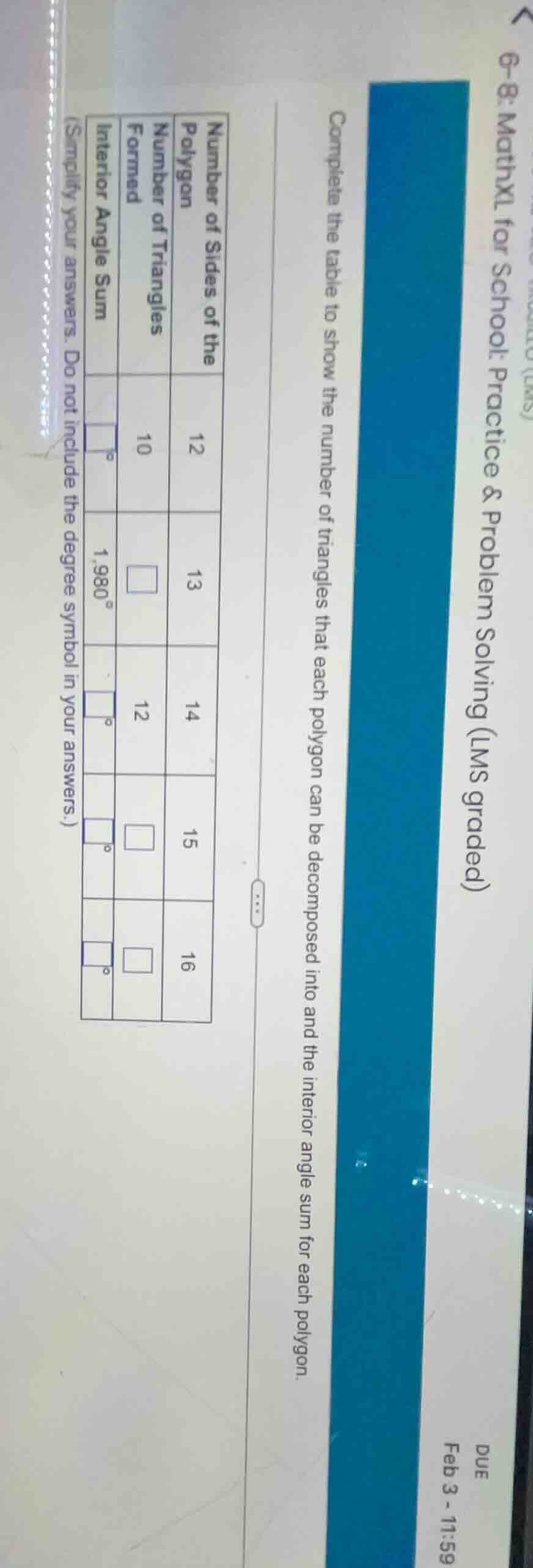
complete the table to show the number of triangles that each polygon can be decomposed into and the interior angle sum for each polygon.
| number of sides of the polygon | number of triangles formed | interior angle sum |
|---|---|---|
| 13 | \\(\square\\) | 1,980\\(^\circ\\) |
| 14 | 12 | \\(\square^\circ\\) |
| 15 | \\(\square\\) | \\(\square^\circ\\) |
| 16 | \\(\square\\) | \\(\square^\circ\\) |
(simplify your answers. do not include the degree symbol in your answers.)
To solve the problem, we use the formulas for the number of triangles formed in a polygon and the interior angle sum of a polygon.
Formula 1: Number of Triangles Formed in a Polygon
For a polygon with \( n \) sides, the number of triangles formed by drawing diagonals from one vertex is \( n - 2 \).
Formula 2: Interior Angle Sum of a Polygon
The interior angle sum of a polygon with \( n \) sides is \( (n - 2) \times 180^\circ \).
Step 1: Polygon with 12 sides
- Number of Triangles Formed: Given as 10 (which matches \( 12 - 2 = 10 \)).
- Interior Angle Sum: \( (12 - 2) \times 180 = 10 \times 180 = 1800 \).
Step 2: Polygon with 13 sides
- Number of Triangles Formed: \( 13 - 2 = 11 \) (matches the interior angle sum \( 1980^\circ \) since \( 11 \times 180 = 1980 \)).
Step 3: Polygon with 14 sides
- Number of Triangles Formed: Given as 12 (which matches \( 14 - 2 = 12 \)).
- Interior Angle Sum: \( 12 \times 180 = 2160 \).
Step 4: Polygon with 15 sides
- Number of Triangles Formed: \( 15 - 2 = 13 \).
- Interior Angle Sum: \( 13 \times 180 = 2340 \).
Step 5: Polygon with 16 sides
- Number of Triangles Formed: \( 16 - 2 = 14 \).
- Interior Angle Sum: \( 14 \times 180 = 2520 \).

Snap & solve any problem in the app
Get step-by-step solutions on Sovi AI
Photo-based solutions with guided steps
Explore more problems and detailed explanations
| Number of Sides of the Polygon | Number of Triangles Formed | Interior Angle Sum |
|---|---|---|
| 13 | 11 | 1980 |
| 14 | 12 | 2160 |
| 15 | 13 | 2340 |
| 16 | 14 | 2520 |