QUESTION IMAGE
Question
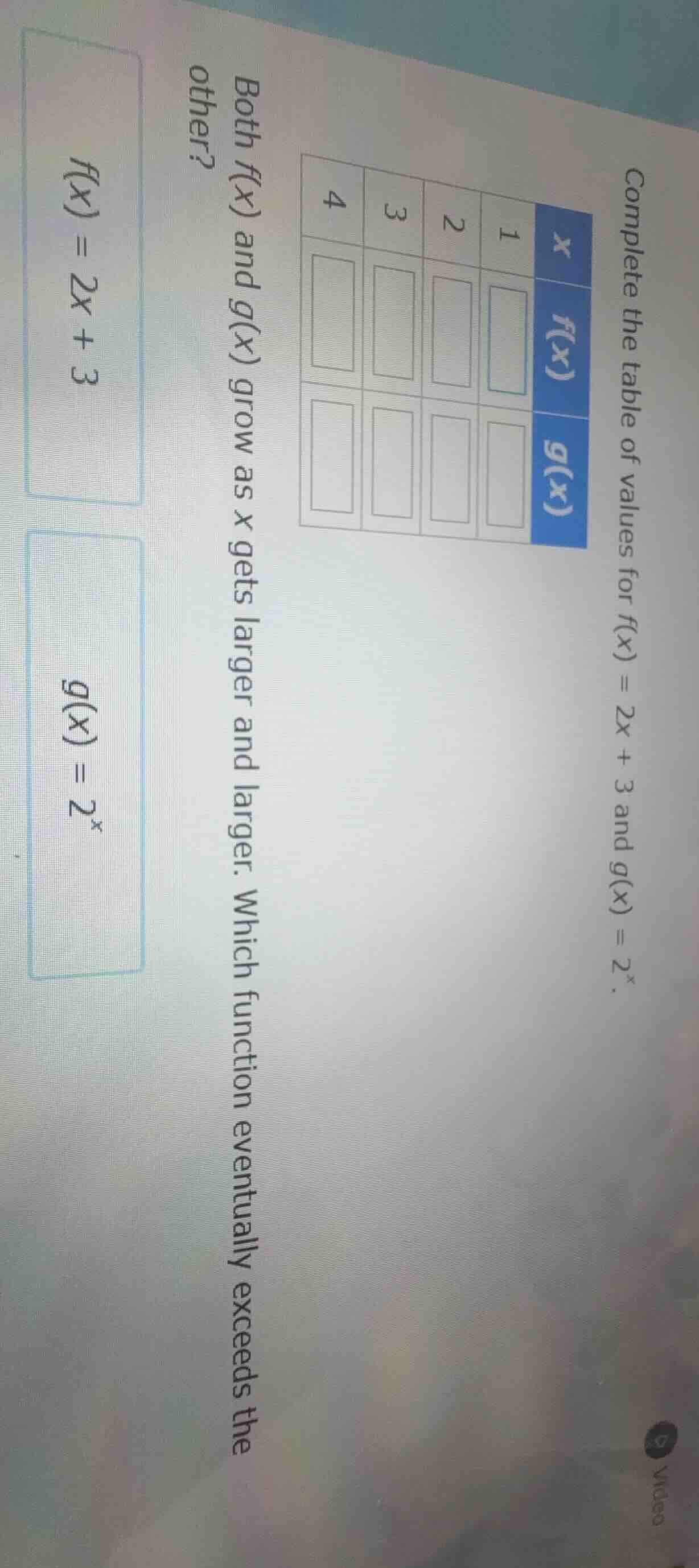
complete the table of values for ( f(x) = 2x + 3 ) and ( g(x) = 2^x ).
| ( x ) | 1 | 2 | 3 | 4 |
|---|---|---|---|---|
| ( g(x) ) |
both ( f(x) ) and ( g(x) ) grow as ( x ) gets larger and larger. which function eventually exceeds the other?
( f(x) = 2x + 3 )
( g(x) = 2^x )
Part 1: Completing the table for \( f(x) = 2x + 3 \) and \( g(x) = 2^x \)
For \( f(x) = 2x + 3 \):
- Step 1: When \( x = 1 \)
Substitute \( x = 1 \) into \( f(x) \):
\( f(1) = 2(1) + 3 = 2 + 3 = 5 \)
- Step 2: When \( x = 2 \)
Substitute \( x = 2 \) into \( f(x) \):
\( f(2) = 2(2) + 3 = 4 + 3 = 7 \)
- Step 3: When \( x = 3 \)
Substitute \( x = 3 \) into \( f(x) \):
\( f(3) = 2(3) + 3 = 6 + 3 = 9 \)
- Step 4: When \( x = 4 \)
Substitute \( x = 4 \) into \( f(x) \):
\( f(4) = 2(4) + 3 = 8 + 3 = 11 \)
For \( g(x) = 2^x \):
- Step 1: When \( x = 1 \)
Substitute \( x = 1 \) into \( g(x) \):
\( g(1) = 2^1 = 2 \)
- Step 2: When \( x = 2 \)
Substitute \( x = 2 \) into \( g(x) \):
\( g(2) = 2^2 = 4 \)
- Step 3: When \( x = 3 \)
Substitute \( x = 3 \) into \( g(x) \):
\( g(3) = 2^3 = 8 \)
- Step 4: When \( x = 4 \)
Substitute \( x = 4 \) into \( g(x) \):
\( g(4) = 2^4 = 16 \)
Part 2: Determining which function eventually exceeds the other
- Step 1: Analyze the growth rates
- \( f(x) = 2x + 3 \) is a linear function with a constant slope of \( 2 \).
- \( g(x) = 2^x \) is an exponential function with a base \( 2 > 1 \), so it grows exponentially.
- Step 2: Compare values for larger \( x \)
For \( x = 1 \): \( f(1) = 5 \), \( g(1) = 2 \) ( \( f > g \) )
For \( x = 2 \): \( f(2) = 7 \), \( g(2) = 4 \) ( \( f > g \) )
For \( x = 3 \): \( f(3) = 9 \), \( g(3) = 8 \) ( \( f > g \) )
For \( x = 4 \): \( f(4) = 11 \), \( g(4) = 16 \) ( \( g > f \) )
As \( x \) becomes very large (e.g., \( x = 5 \): \( f(5) = 13 \), \( g(5) = 32 \); \( x = 10 \): \( f(10) = 23 \), \( g(10) = 1024 \) ), the exponential function \( g(x) = 2^x \) will grow much faster than the linear function \( f(x) = 2x + 3 \).
Completed Table:
| \( x \) | \( f(x) \) | \( g(x) \) |
|---|---|---|
| 2 | 7 | 4 |
| 3 | 9 | 8 |
| 4 | 11 | 16 |

Snap & solve any problem in the app
Get step-by-step solutions on Sovi AI
Photo-based solutions with guided steps
Explore more problems and detailed explanations
for the function that eventually exceeds:
The function \( g(x) = 2^x \) eventually exceeds \( f(x) = 2x + 3 \) as \( x \) becomes larger.