QUESTION IMAGE
Question
completing the chart on paper? using the same color of dough, create a ping - pong ball sized out of your dough. then, into two even parts (somewhat like a tennis ball cut in half). then, create many cells (two rows with eight cells each) out of a different color of dough. roll each of these cells into a thin circular snake. place the snake of dough (like a belt) around the middle of the ball of dough and press the noodles on your dough.
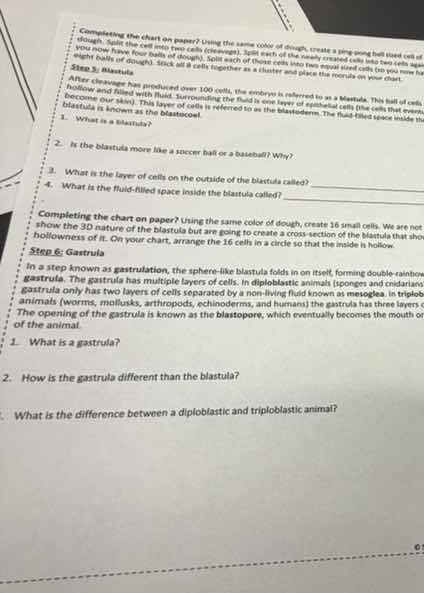
step 6: blastula
after your classmates have gathered over 100 cells, the embryo is referred to as a blastula. this ball of cells (somewhat like a tennis ball) is a single layer of polarized cells (the cells have a distinct \top\ and \bottom\). the outer layer of cells is referred to as the ectoderm. the fluid - filled space inside the blastula is called the blastocoel.
- what is a blastula?
- is the blastula more like a soccer ball or a baseball? why?
- what is the layer of cells on the outside of the blastula called?
- what is the fluid - filled space inside the blastula called?
to show the 3d nature of the blastula but are going to create a cross - section of the blastula that shows the inside (like a tennis ball cut in half). arrange the 16 cells in a circle so that the inside is hollow.
hollo - ball nature of your chart, arrange the 16 cells in a circle so that the inside is hollow.
step 6: gastrula
in a step known as gastrulation, the sphere - like blastula folds in itself, forming double - rainbow - like layers of cells. this new structure is called a gastrula (pronounced gas - tro - la). a diploblastic gastrula only has two layers of cells separated by a non - living fluid (the blastocoel). a triploblastic animals (worms, mollusks, arthropods, echinoderms, and humans) the gastrula has three layers of cells.
the opening of the gastrula is known as the blastopore, which eventually becomes the mouth or anus of the animal.
- what is a gastrula?
- how is the gastrula different than the blastula?
what is the difference between a diploblastic and triploblastic animal?
- For Blastula Questions:
- A blastula is an early embryonic stage, a hollow sphere of cells formed after cleavage of the zygote.
- A blastula is a hollow sphere, so it resembles a basketball (hollow) more than a soccer ball (solid core structure).
- The outer cell layer of the blastula is called the trophoblast (or blastoderm in some contexts), which forms the outer covering.
- The fluid-filled space inside the blastula is the blastocoel; it provides a cavity for subsequent embryonic folding and movement of cells during gastrulation.
- For Gastrula Questions:
- A gastrula is an embryonic stage formed after gastrulation, where the blastula folds in on itself to form layers of cells (germ layers) and an opening called the blastopore.
- Unlike the single-layered hollow blastula, the gastrula has multiple germ cell layers (2 or 3) and an invaginated structure with a blastopore, and it is no longer a simple hollow sphere.
- Diploblastic animals have only two germ layers (ectoderm and endoderm, separated by a non-living mesoglea), while triploblastic animals have three germ layers (ectoderm, mesoderm, and endoderm), with the mesoderm allowing for more complex organ development.

Snap & solve any problem in the app
Get step-by-step solutions on Sovi AI
Photo-based solutions with guided steps
Explore more problems and detailed explanations
Blastula Section
- A blastula is a hollow, sphere-shaped early embryonic stage formed by repeated cell division (cleavage) of the zygote, consisting of a single layer of cells surrounding a fluid-filled cavity.
- A blastula is more like a basketball. Because a blastula is a hollow sphere, similar to the hollow structure of a basketball, while a soccer ball has a solid inner core.
- The layer of cells on the outside of the blastula is called the trophoblast (or blastoderm).
- The fluid-filled space inside the blastula is the blastocoel.
Gastrula Section
- A gastrula is an embryonic stage formed by gastrulation, where the blastula invaginates to form two or three distinct germ cell layers, with an opening called the blastopore.
- The gastrula has multiple germ cell layers (2 or 3) and an invaginated structure with a blastopore, while the blastula is a simple hollow sphere made of a single cell layer with no such invagination or multiple layers.
- Diploblastic animals have only two germ layers (ectoderm and endoderm, with a non-living mesoglea between them), while triploblastic animals have three germ layers (ectoderm, mesoderm, and endoderm), where the mesoderm develops into most internal organs and tissues.