QUESTION IMAGE
Question
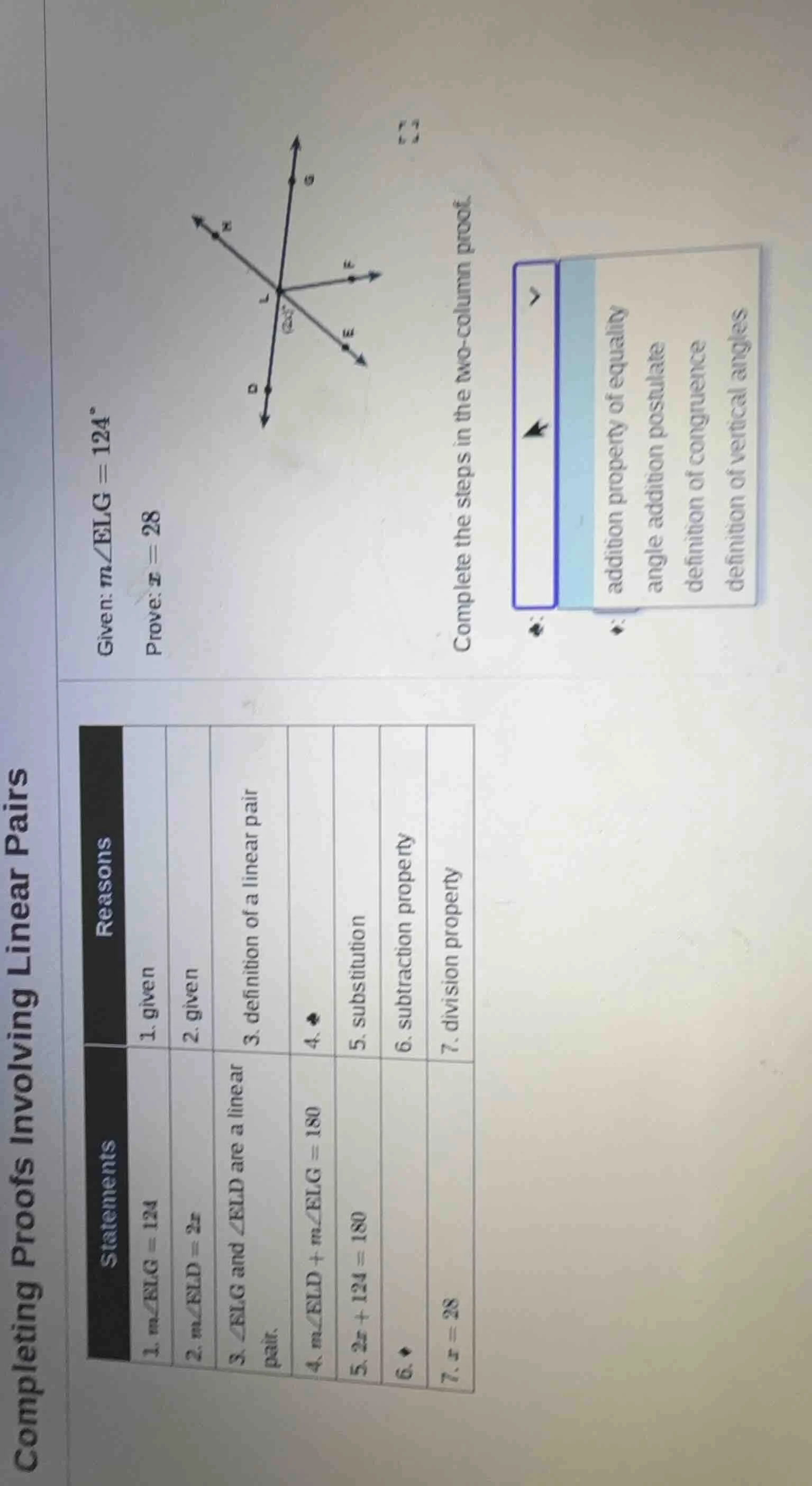
completing proofs involving linear pairs
given: ( mangle elg = 124^circ )
prove: ( x = 28 )
| statements | reasons |
|---|---|
| 2. ( mangle eld = 2x ) | 2. given |
| 3. ( angle elg ) and ( angle eld ) are a linear pair. | 3. definition of a linear pair |
| 4. ( mangle eld + mangle elg = 180 ) | 4. |
| 5. ( 2x + 124 = 180 ) | 5. substitution |
| 6. | 6. subtraction property |
| 7. ( x = 28 ) | 7. division property |
complete the steps in the two - column proof.
options for step 4 reason: addition property of equality, angle addition postulate, definition of congruence, definition of vertical angles
Step-by-Step Explanation for Step 4 (Reason):
Step 1: Recall Linear Pair Postulate
A linear pair of angles is supplementary, meaning their measures add up to \(180^\circ\). So if \(\angle ELG\) and \(\angle ELD\) are a linear pair, then \(m\angle ELD + m\angle ELG = 180^\circ\). This is the angle addition postulate for supplementary angles (linear pair postulate).
Step 2: Identify the Reason for Step 4
In step 4, the statement is \(m\angle ELD + m\angle ELG = 180\), which follows from the definition of a linear pair (step 3) and the angle addition postulate (which states that if two angles form a linear pair, their measures sum to \(180^\circ\)). So the reason for step 4 is the angle addition postulate.
Step-by-Step Explanation for Step 6 (Statement):
Step 1: Start with the Equation from Step 5
From step 5, we have \(2x + 124 = 180\).
Step 2: Apply Subtraction Property
Using the subtraction property of equality (subtract 124 from both sides), we get \(2x + 124 - 124 = 180 - 124\), which simplifies to \(2x = 56\). So the statement for step 6 is \(2x = 56\).
Final Answers for the Blanks:
- Step 4 (Reason): angle addition postulate
- Step 6 (Statement): \(2x = 56\)
(For the two - column proof blanks:
- The reason for step 4 is "angle addition postulate".
- The statement for step 6 is \(2x = 56\))

Snap & solve any problem in the app
Get step-by-step solutions on Sovi AI
Photo-based solutions with guided steps
Explore more problems and detailed explanations
Step-by-Step Explanation for Step 4 (Reason):
Step 1: Recall Linear Pair Postulate
A linear pair of angles is supplementary, meaning their measures add up to \(180^\circ\). So if \(\angle ELG\) and \(\angle ELD\) are a linear pair, then \(m\angle ELD + m\angle ELG = 180^\circ\). This is the angle addition postulate for supplementary angles (linear pair postulate).
Step 2: Identify the Reason for Step 4
In step 4, the statement is \(m\angle ELD + m\angle ELG = 180\), which follows from the definition of a linear pair (step 3) and the angle addition postulate (which states that if two angles form a linear pair, their measures sum to \(180^\circ\)). So the reason for step 4 is the angle addition postulate.
Step-by-Step Explanation for Step 6 (Statement):
Step 1: Start with the Equation from Step 5
From step 5, we have \(2x + 124 = 180\).
Step 2: Apply Subtraction Property
Using the subtraction property of equality (subtract 124 from both sides), we get \(2x + 124 - 124 = 180 - 124\), which simplifies to \(2x = 56\). So the statement for step 6 is \(2x = 56\).
Final Answers for the Blanks:
- Step 4 (Reason): angle addition postulate
- Step 6 (Statement): \(2x = 56\)
(For the two - column proof blanks:
- The reason for step 4 is "angle addition postulate".
- The statement for step 6 is \(2x = 56\))