QUESTION IMAGE
Question
completing the square
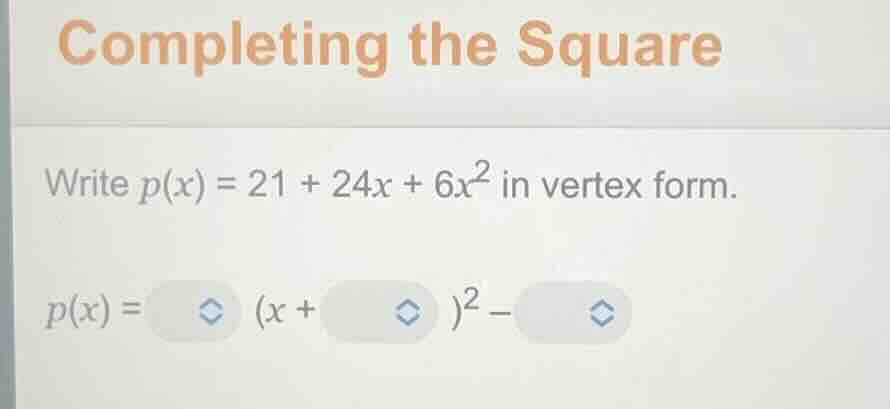
write p(x) = 21 + 24x + 6x² in vertex form.
p(x) = (x + )² −
Step1: Rewrite the quadratic function
First, we rewrite the given quadratic function \( p(x) = 6x^{2}+24x + 21\) in the standard form \(ax^{2}+bx + c\). Here, \(a = 6\), \(b = 24\), and \(c = 21\). We factor out the coefficient of \(x^{2}\) from the first two terms:
\(p(x)=6(x^{2}+4x)+21\)
Step2: Complete the square inside the parentheses
To complete the square for the expression \(x^{2}+4x\), we take half of the coefficient of \(x\) (which is \(4\)), square it, and add and subtract it inside the parentheses. Half of \(4\) is \(2\), and squaring \(2\) gives \(4\). So we have:
\(p(x)=6(x^{2}+4x + 4-4)+21\)
We can rewrite \(x^{2}+4x + 4\) as \((x + 2)^{2}\), so the expression becomes:
\(p(x)=6((x + 2)^{2}-4)+21\)
Step3: Distribute and simplify
Now we distribute the \(6\) across the terms inside the parentheses:
\(p(x)=6(x + 2)^{2}-6\times4+21\)
Calculating \(6\times4 = 24\), we get:
\(p(x)=6(x + 2)^{2}-24 + 21\)
Simplifying \(-24 + 21=-3\), we have:
\(p(x)=6(x + 2)^{2}-3\)

Snap & solve any problem in the app
Get step-by-step solutions on Sovi AI
Photo-based solutions with guided steps
Explore more problems and detailed explanations
\(p(x)=\boldsymbol{6}(x+\boldsymbol{2})^{2}-\boldsymbol{3}\)