QUESTION IMAGE
Question
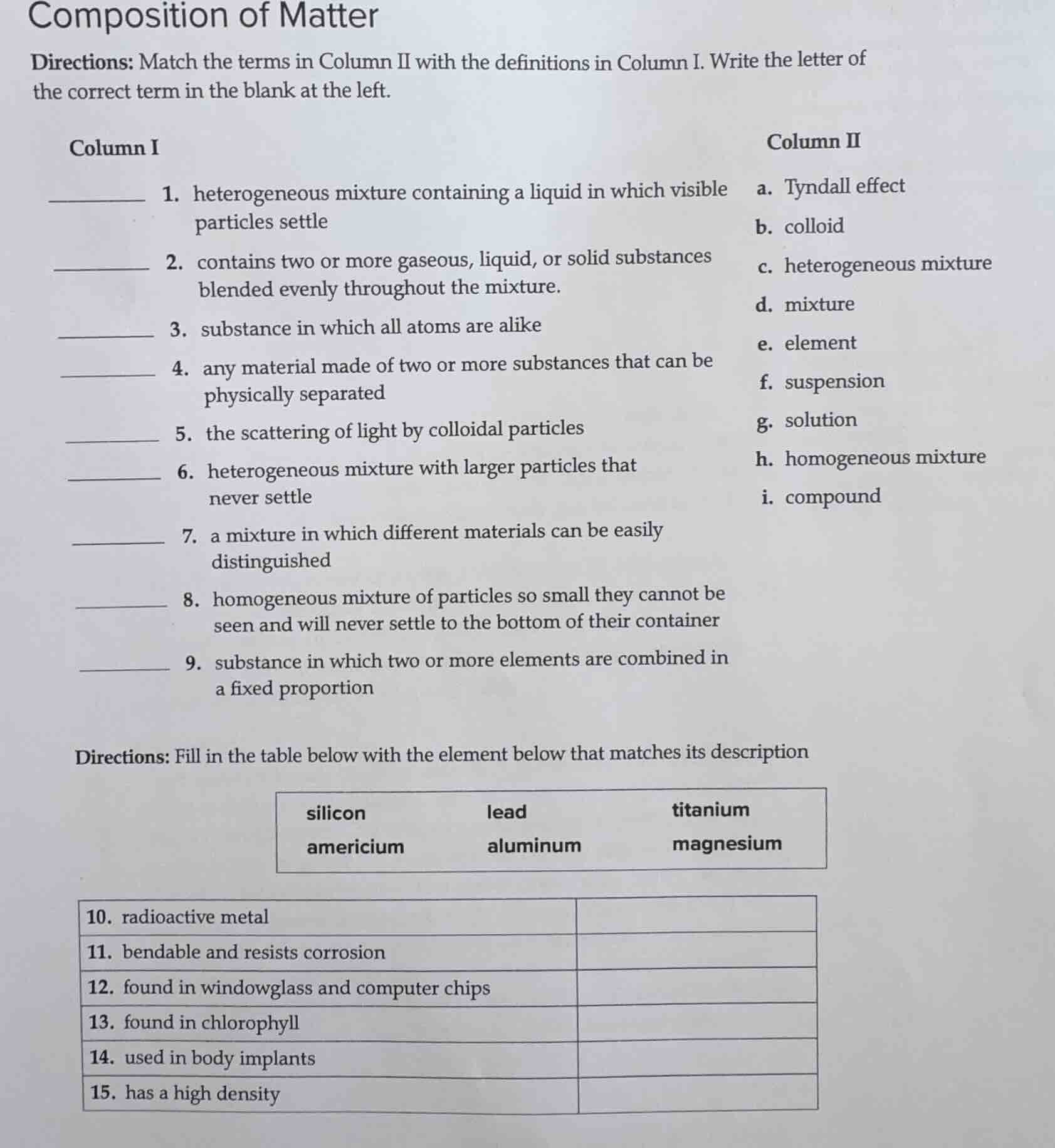
composition of matter
directions: match the terms in column ii with the definitions in column i. write the letter of
the correct term in the blank at the left.
column i\t\t\t\t\t\tcolumn ii
______ 1. heterogeneous mixture containing a liquid in which visible \t a. tyndall effect
\t\t\tparticles settle\t\t\t\t\tb. colloid
______ 2. contains two or more gaseous, liquid, or solid substances \t c. heterogeneous mixture
\t\t\tblended evenly throughout the mixture.\t\t\td. mixture
______ 3. substance in which all atoms are alike\t\t\t\te. element
______ 4. any material made of two or more substances that can be \t f. suspension
\t\t\tphysically separated\t\t\t\t
g. solution
______ 5. the scattering of light by colloidal particles\t\t\th. homogeneous mixture
______ 6. heterogeneous mixture with larger particles that \t\t i. compound
\t\t\tnever settle
______ 7. a mixture in which different materials can be easily
\t\t\tdistinguished
______ 8. homogeneous mixture of particles so small they cannot be
\t\t\tseen and will never settle to the bottom of their container
______ 9. substance in which two or more elements are combined in
\t\t\ta fixed proportion
directions: fill in the table below with the element below that matches its description
\t\tsilicon\t\t\tlead\t\t\ttitanium
\t\tamericium\t\taluminum\t\tmagnesium
- radioactive metal\t\t\t\t
- bendable and resists corrosion\t\t\t
- found in windowglass and computer chips\t\t
- found in chlorophyll\t\t\t\t
- used in body implants\t\t\t\t
- has a high density\t\t\t\t
Matching Terms (Questions 1 - 9)
- Question 1: A suspension is a heterogeneous mixture with a liquid where visible particles settle. So match with f.
- Question 2: A solution (homogeneous mixture) has substances blended evenly. Wait, no—wait, a homogeneous mixture (h) has uniform composition, but the definition here is two or more substances blended evenly. Wait, a solution (g) is a homogeneous mixture of solute and solvent. Wait, the definition: "contains two or more gaseous, liquid, or solid substances blended evenly throughout the mixture"—that's a homogeneous mixture (h) or solution (g)? Wait, a solution is a type of homogeneous mixture. But the options: h is homogeneous mixture, g is solution. Wait, the definition for 2: "blended evenly throughout"—so homogeneous mixture (h) or solution (g)? Wait, let's check the options. Option h: homogeneous mixture; option g: solution. A solution is a homogeneous mixture, so maybe h? Wait, no—wait, the definition for 2: "contains two or more... blended evenly"—that's a homogeneous mixture (h). Wait, but option g is solution. Wait, maybe the answer is h? Wait, no, let's check the other definitions. Let's proceed.
- Question 3: An element (e) is a substance with all atoms alike. So match with e.
- Question 4: A mixture (d) is made of two or more substances that can be physically separated. So match with d.
- Question 5: Tyndall effect (a) is the scattering of light by colloidal particles. So match with a.
- Question 6: A colloid (b) is a heterogeneous mixture with larger particles that never settle. So match with b.
- Question 7: A heterogeneous mixture (c) has different materials easily distinguished. So match with c.
- Question 8: A solution (g) is a homogeneous mixture with particles too small to see and never settle. So match with g.
- Question 9: A compound (i) is two or more elements combined in fixed proportion. So match with i.
Filling the Table (Questions 10 - 15)
- Radioactive metal: Americium (americium) is radioactive. So americium.
- Bendable and resists corrosion: Aluminum is bendable and resists corrosion. So aluminum.
- Found in window glass and computer chips: Silicon is used in computer chips and window glass (silica is in glass). So silicon.
- Found in chlorophyll: Magnesium is a central atom in chlorophyll. So magnesium.
- Used in body implants: Titanium is used in body implants (biocompatible). So titanium.
- Has a high density: Lead has a high density. So lead.

Snap & solve any problem in the app
Get step-by-step solutions on Sovi AI
Photo-based solutions with guided steps
Explore more problems and detailed explanations
s:
- f
- h
- e
- d
- a
- b
- c
- g
- i
- americium
- aluminum
- silicon
- magnesium
- titanium
- lead