QUESTION IMAGE
Question
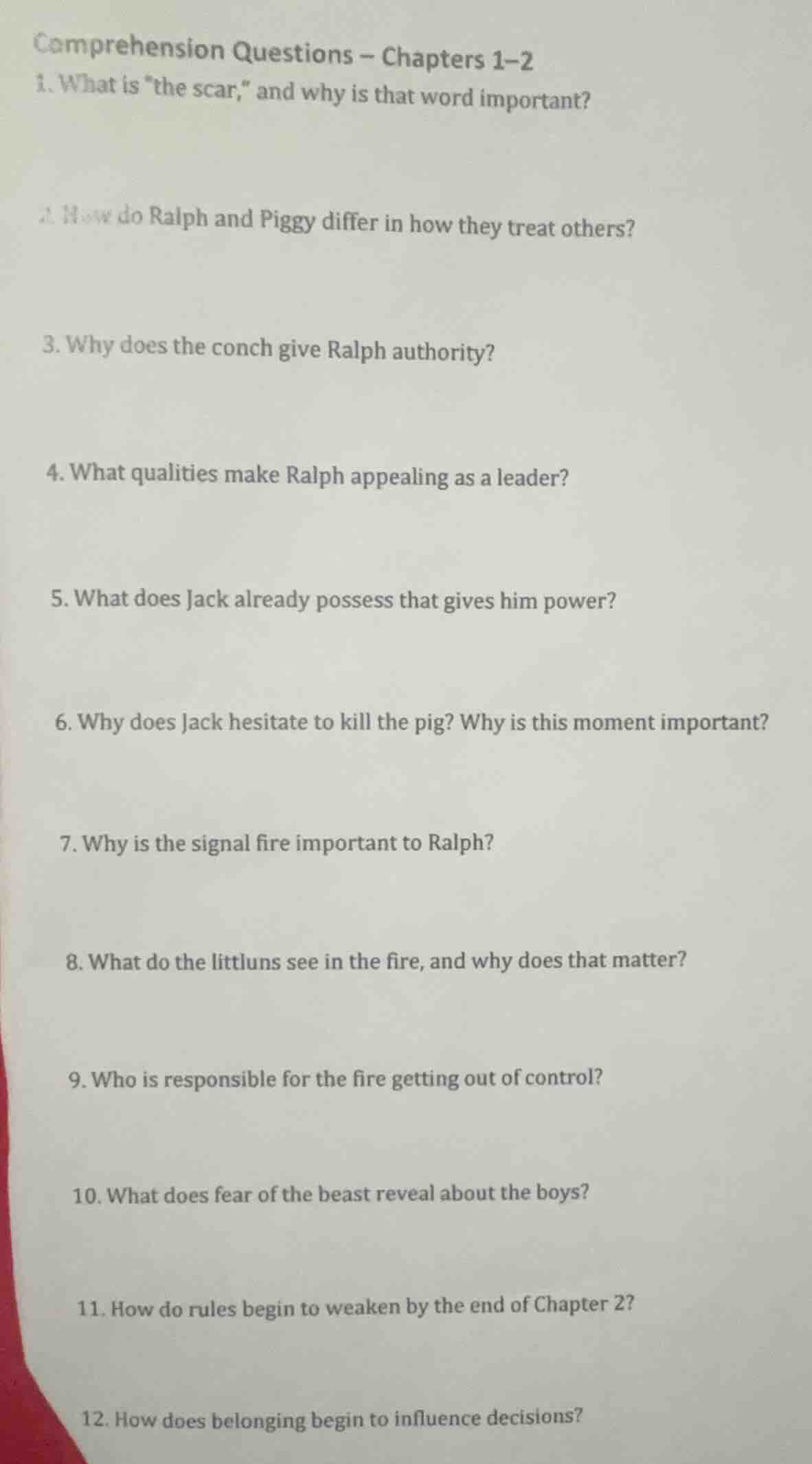
comprehension questions – chapters 1–2
- what is \the scar,\ and why is that word important?
- how do ralph and piggy differ in how they treat others?
- why does the conch give ralph authority?
- what qualities make ralph appealing as a leader?
- what does jack already possess that gives him power?
- why does jack hesitate to kill the pig? why is this moment important?
- why is the signal fire important to ralph?
- what do the littluns see in the fire, and why does that matter?
- who is responsible for the fire getting out of control?
- what does fear of the beast reveal about the boys?
- how do rules begin to weaken by the end of chapter 2?
- how does belonging begin to influence decisions?
Brief Explanations
- "The scar" is the gash in the jungle left by the plane that crashed, bringing the boys to the island. It is important because it marks the boys' violent arrival, symbolizes the intrusion of the adult, war-torn world into the island, and is the first sign of the destruction that will unfold.
- Ralph is friendly and inclusive, trying to connect with all the boys and build a community; Piggy is blunt, socially awkward, and often critical, which makes him alienate others instead of bonding with them.
- The conch is a physical symbol of order and democracy the boys agree to: whoever holds it gets to speak. Ralph is the one who first finds and uses it to gather the group, so it becomes tied to his legitimate, agreed-upon authority.
- Ralph is calm, rational, focused on rescue (a shared, practical goal), physically capable, and willing to listen to others (like Piggy's ideas), which makes him seem reliable and fair to the boys.
- Jack already has authority as the leader of the choir, and he has a fierce, domineering personality that makes some boys instinctively follow him; he also has a knife, a physical tool of power.
- Jack hesitates because his remaining civilized instincts (taught by adults that killing is wrong) hold him back. This moment is important because it shows the first crack between his civilized self and the savage impulses that will take over later.
- The signal fire is Ralph's top priority because it is the only way the boys can be spotted and rescued; it represents his commitment to maintaining civilization and returning to the adult world.
- The littluns see a "beast" (a figure made by shadows and their fear) in the fire's smoke. This matters because it reveals the group's growing irrational fear, which will be exploited to undermine order later.
- The boys assigned to tend the fire (Jack's choir members) abandoned their post to hunt with Jack, so they are responsible for the fire getting out of control.
- The fear of the beast reveals that the boys are deeply anxious about the unknown, and they are starting to lose their grip on rationality; it also shows their underlying fear of their own savage impulses, which they project onto the "beast."
- Rules weaken because some boys (like those who abandoned the fire) prioritize their own desires (hunting, play) over the group's agreed-upon rules, and there are no real consequences for breaking them.
- Belonging starts to influence decisions as boys choose to follow Jack's hunting group for camaraderie and excitement, even if it means neglecting important tasks like tending the fire, rather than sticking to Ralph's more practical but less thrilling rules.

Snap & solve any problem in the app
Get step-by-step solutions on Sovi AI
Photo-based solutions with guided steps
Explore more problems and detailed explanations
- "The scar" is the plane's crash site gash in the jungle. It symbolizes the adult war world's intrusion and the island's first destruction.
- Ralph is inclusive/kind; Piggy is blunt/awkward, alienating others.
- It symbolizes agreed-upon order/democracy; Ralph used it to gather the group, tying it to his authority.
- He is calm, rational, focused on rescue, fair, and physically capable.
- He leads the choir, has a domineering personality, and owns a knife.
- Civilized instincts hold him back; it foreshadows his eventual descent into savagery.
- It is the only chance for the boys to be rescued, representing his commitment to civilization.
- They see a "beast" (shadow/fear-fueled figure); it reveals growing irrational fear in the group.
- Jack's choir members, who abandoned the fire to hunt.
- It reveals their anxiety of the unknown, fading rationality, and projection of their own savage impulses.
- Boys prioritize personal desires over rules, with no consequences for disobedience.
- Boys choose Jack's group for camaraderie over Ralph's practical rules, putting belonging above group survival tasks.