QUESTION IMAGE
Question
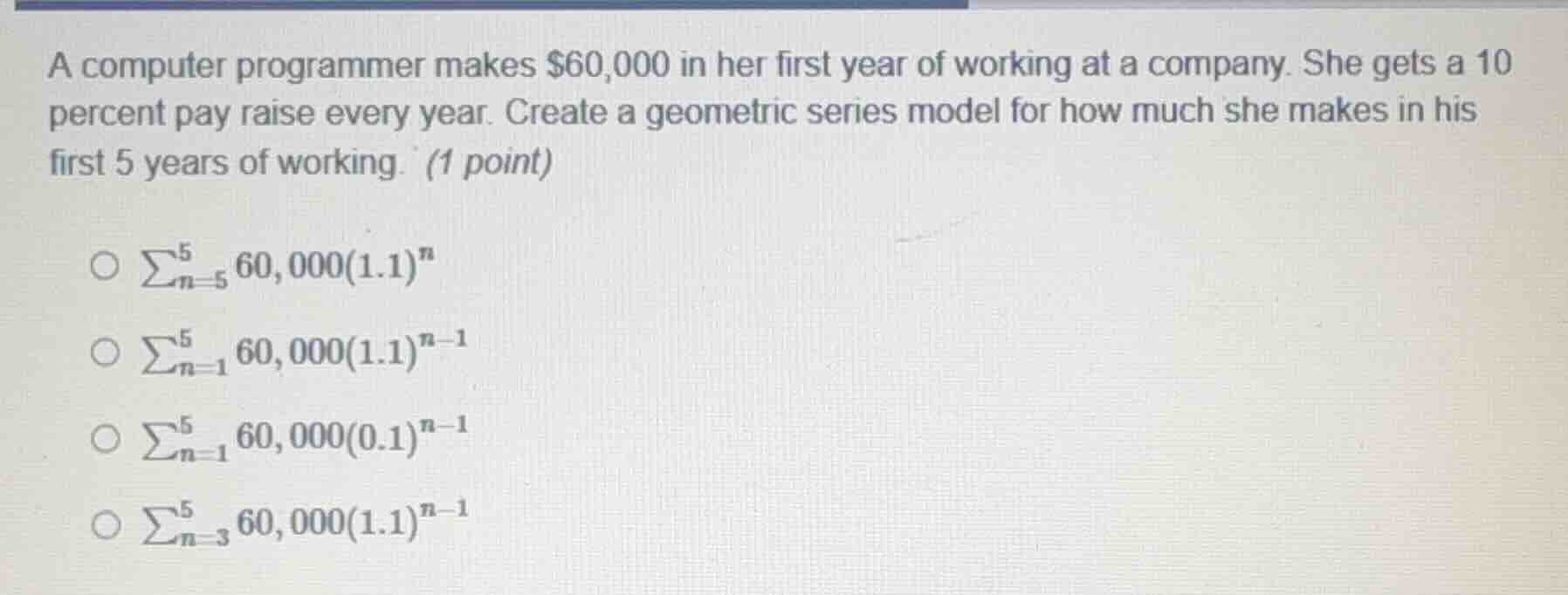
a computer programmer makes $60,000 in her first year of working at a company. she gets a 10 percent pay raise every year. create a geometric series model for how much she makes in his first 5 years of working. (1 point)\\(\sum_{n=5}^5 60,000(1.1)^n\\)\\(\sum_{n=1}^5 60,000(1.1)^{n - 1}\\)\\(\sum_{n=1}^5 60,000(0.1)^{n - 1}\\)\\(\sum_{n=3}^5 60,000(1.1)^{n - 1}\\)
Step1: Recall Geometric Series Formula
A geometric series is of the form $\sum_{n = 1}^{k}a(r)^{n - 1}$, where $a$ is the first term, $r$ is the common ratio, and $k$ is the number of terms.
Here, the first year's salary ($a$) is $60,000$. The pay raise is 10% per year, so the common ratio $r=1 + 0.1=1.1$. We need to model the first 5 years, so $k = 5$.
Step2: Match with the Formula
The general form for the sum of the first $n$ terms of a geometric series is $\sum_{n = 1}^{N}a(r)^{n - 1}$. Substituting $a = 60000$, $r = 1.1$, and $N=5$, we get $\sum_{n = 1}^{5}60000(1.1)^{n - 1}$.
Let's check the other options:
- $\sum_{n = 5}^{5}60000(1.1)^{n}$: This starts at $n = 5$ and has only one term, which is incorrect.
- $\sum_{n = 1}^{5}60000(0.1)^{n - 1}$: The common ratio here is $0.1$ (a 90% decrease), which is wrong as the salary is increasing.
- $\sum_{n = 3}^{5}60000(1.1)^{n - 1}$: This starts at $n = 3$, missing the first two years, so incorrect.

Snap & solve any problem in the app
Get step-by-step solutions on Sovi AI
Photo-based solutions with guided steps
Explore more problems and detailed explanations
$\sum_{n = 1}^{5}60,000(1.1)^{n - 1}$ (the second option)