QUESTION IMAGE
Question
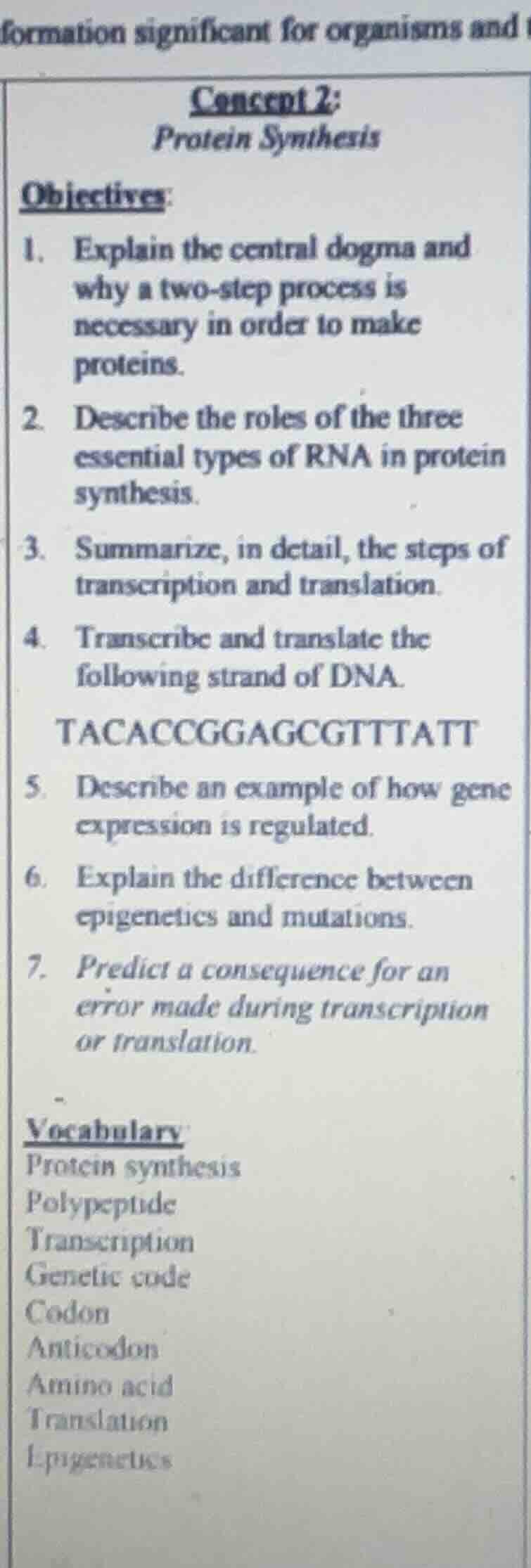
concept 2: protein synthesis objectives: 1. explain the central dogma and why a two - step process is necessary in order to make proteins. 2. describe the roles of the three essential types of rna in protein synthesis. 3. summarize, in detail, the steps of transcription and translation. 4. transcribe and translate the following strand of dna. tacaccggagcgtttatt 5. describe an example of how gene expression is regulated. 6. explain the difference between epigenetics and mutations. 7. predict a consequence for an error made during transcription or translation. vocabulary protein synthesis polypeptide transcription genetic code codon anticodon amino acid translation epigenetics
To solve the problem of transcribing and translating the given DNA strand \( \text{TACACCGGAGCGTTTATT} \), we follow these steps:
Step 1: Transcription (DNA to mRNA)
During transcription, RNA polymerase synthesizes a complementary mRNA strand from the DNA template. The base - pairing rules for transcription are: \( \text{A (DNA)}
ightarrow \text{U (mRNA)} \), \( \text{T (DNA)}
ightarrow \text{A (mRNA)} \), \( \text{C (DNA)}
ightarrow \text{G (mRNA)} \), and \( \text{G (DNA)}
ightarrow \text{C (mRNA)} \).
Given the DNA strand: \( \text{TACACCGGAGCGTTTATT} \)
We substitute each DNA base with its complementary mRNA base:
- \( \text{T} \) becomes \( \text{A} \)
- \( \text{A} \) becomes \( \text{U} \)
- \( \text{C} \) becomes \( \text{G} \)
- \( \text{G} \) becomes \( \text{C} \)
So the mRNA strand is: \( \text{AUGUGGCCUCGCAAAUAA} \)
Step 2: Translation (mRNA to Protein)
Translation occurs in the ribosome, and tRNA molecules with anticodons bring the corresponding amino acids. The mRNA is read in groups of three nucleotides called codons. We use the genetic code table to find the amino acid corresponding to each codon.
Let's break the mRNA strand \( \text{AUGUGGCCUCGCAAAUAA} \) into codons:
- \( \text{AUG} \): The codon \( \text{AUG} \) codes for the amino acid Methionine (Met) and also serves as the start codon.
- \( \text{UGG} \): This codon codes for Tryptophan (Trp).
- \( \text{CCU} \): This codon codes for Proline (Pro).
- \( \text{CGC} \): This codon codes for Arginine (Arg).
- \( \text{AAA} \): This codon codes for Lysine (Lys).
- \( \text{UAA} \): This is a stop codon, which signals the end of translation.
So the sequence of amino acids (the polypeptide chain) is: Met - Trp - Pro - Arg - Lys

Snap & solve any problem in the app
Get step-by-step solutions on Sovi AI
Photo-based solutions with guided steps
Explore more problems and detailed explanations
- Transcription: \( \boldsymbol{\text{mRNA: AUGUGGCCUCGCAAAUAA}} \)
- Translation: \( \boldsymbol{\text{Polypeptide: Met - Trp - Pro - Arg - Lys}} \)