QUESTION IMAGE
Question
congruence in right triangles
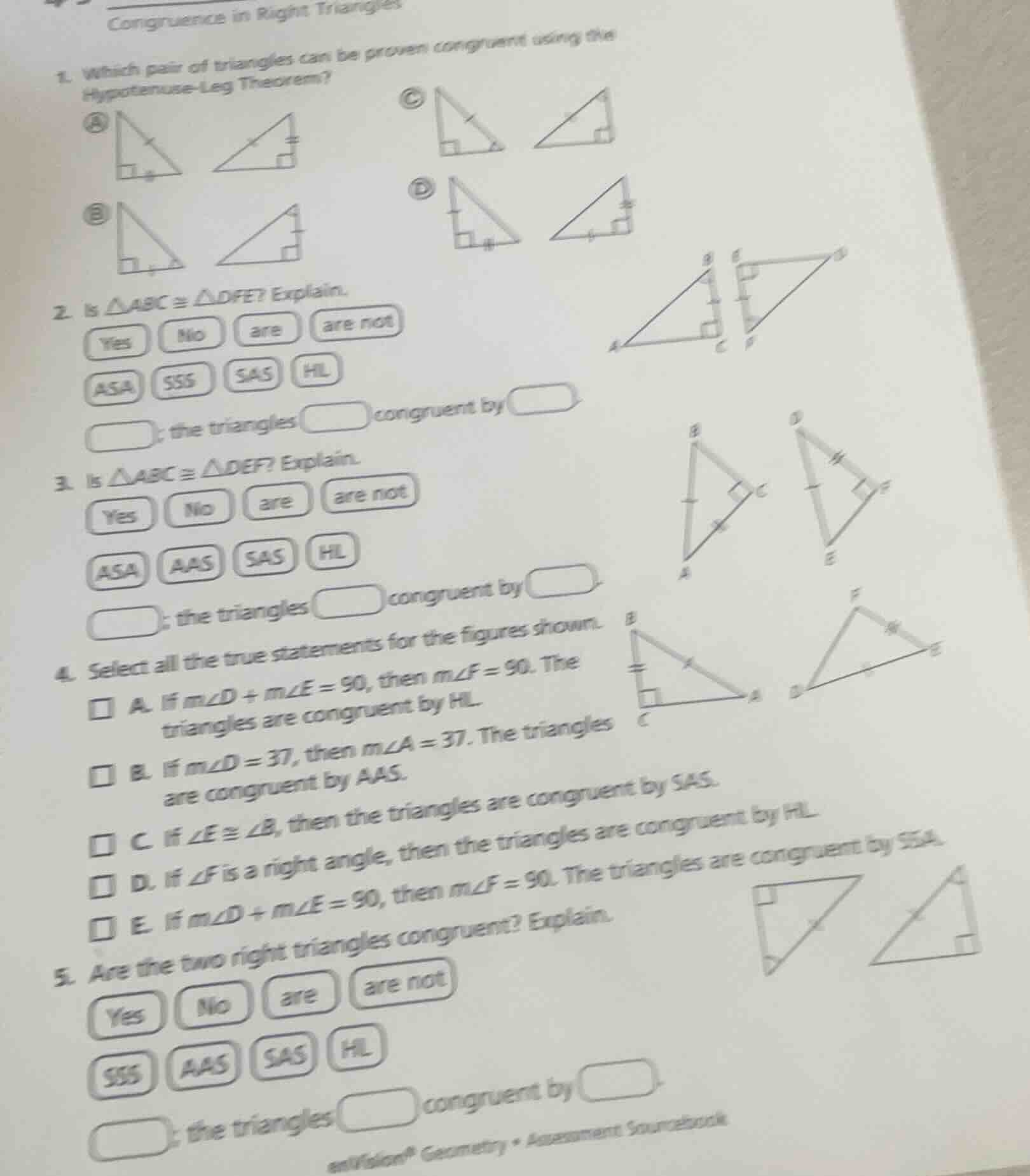
- which pair of triangles can be proven congruent using the hypotenuse - leg theorem?
(there are four options a, b, c, d with triangle figures)
- is $\triangle abc \cong \triangle dfe$? explain.
(options: yes, no, are, are not; asa, sss, sas, hl)
\\(\square\\); the triangles \\(\square\\) congruent by \\(\square\\).
(there is a triangle figure)
- is $\triangle abc \cong \triangle def$? explain.
(options: yes, no, are, are not; asa, aas, sas, hl)
\\(\square\\); the triangles \\(\square\\) congruent by \\(\square\\).
(there are two triangle figures)
- select all the true statements for the figures shown.
\\(\square\\) a. if $m\angle d + m\angle e = 90$, then $m\angle f = 90$. the triangles are congruent by hl.
\\(\square\\) b. if $m\angle d = 37$, then $m\angle a = 37$. the triangles are congruent by aas.
\\(\square\\) c. if $\angle e \cong \angle b$, then the triangles are congruent by sas.
\\(\square\\) d. if $\angle f$ is a right angle, then the triangles are congruent by hl.
\\(\square\\) e. if $m\angle d + m\angle e = 90$, then $m\angle f = 90$. the triangles are congruent by ssa.
(there are two triangle figures)
- are the two right triangles congruent? explain.
(options: yes, no, are, are not; sss, aas, sas, hl)
\\(\square\\); the triangles \\(\square\\) congruent by \\(\square\\).
(there are two right triangle figures)
Step1: Analyze HL Theorem for Q1
The Hypotenuse-Leg (HL) Theorem requires a right triangle, one congruent leg, and one congruent hypotenuse.
- Option A: Congruent hypotenuse, non-corresponding legs.
- Option B: Congruent legs, hypotenuses not marked congruent.
- Option C: Congruent non-hypotenuse sides, hypotenuses not marked congruent.
- Option D: Congruent corresponding legs, congruent hypotenuses, both right triangles.
Step2: Evaluate Q2 congruence
$\triangle ABC$ and $\triangle DFE$ are right triangles. $AC \cong FE$, $BC \cong DF$ (legs), hypotenuses $AB \cong DE$. This fits HL.
Step3: Evaluate Q3 congruence
$\triangle ABC$ and $\triangle DEF$ are right triangles. $AC \cong DF$, $AB \cong DE$ (one leg, one hypotenuse). This fits HL.
Step4: Verify Q4 statements
- A: $m\angle D + m\angle E = 90^\circ$ means $\angle F=90^\circ$, making both right triangles. We have one congruent leg, one congruent hypotenuse → HL applies. True.
- B: $m\angle D=37^\circ$ gives $m\angle A=37^\circ$, but we only have one angle and one non-included side; AAS needs two angles. False.
- C: $\angle E \cong \angle B$, with one congruent leg, this is AAS, not SAS. False.
- D: $\angle F$ is right, making both right triangles, with congruent leg and hypotenuse → HL applies. True.
- E: $m\angle D + m\angle E = 90^\circ$ means $\angle F=90^\circ$, but SSA is not a valid congruence rule. False.
Step5: Evaluate Q5 congruence
The two right triangles have only one congruent hypotenuse; no congruent legs are marked. No valid congruence rule applies.

Snap & solve any problem in the app
Get step-by-step solutions on Sovi AI
Photo-based solutions with guided steps
Explore more problems and detailed explanations
- D
- Yes; the triangles are congruent by HL
- Yes; the triangles are congruent by HL
- A. If $m\angle D + m\angle E = 90$, then $m\angle F = 90$. The triangles are congruent by HL.
D. If $\angle F$ is a right angle, then the triangles are congruent by HL.
- No; the triangles are not congruent (no valid rule applies)