QUESTION IMAGE
Question
7 conjugar
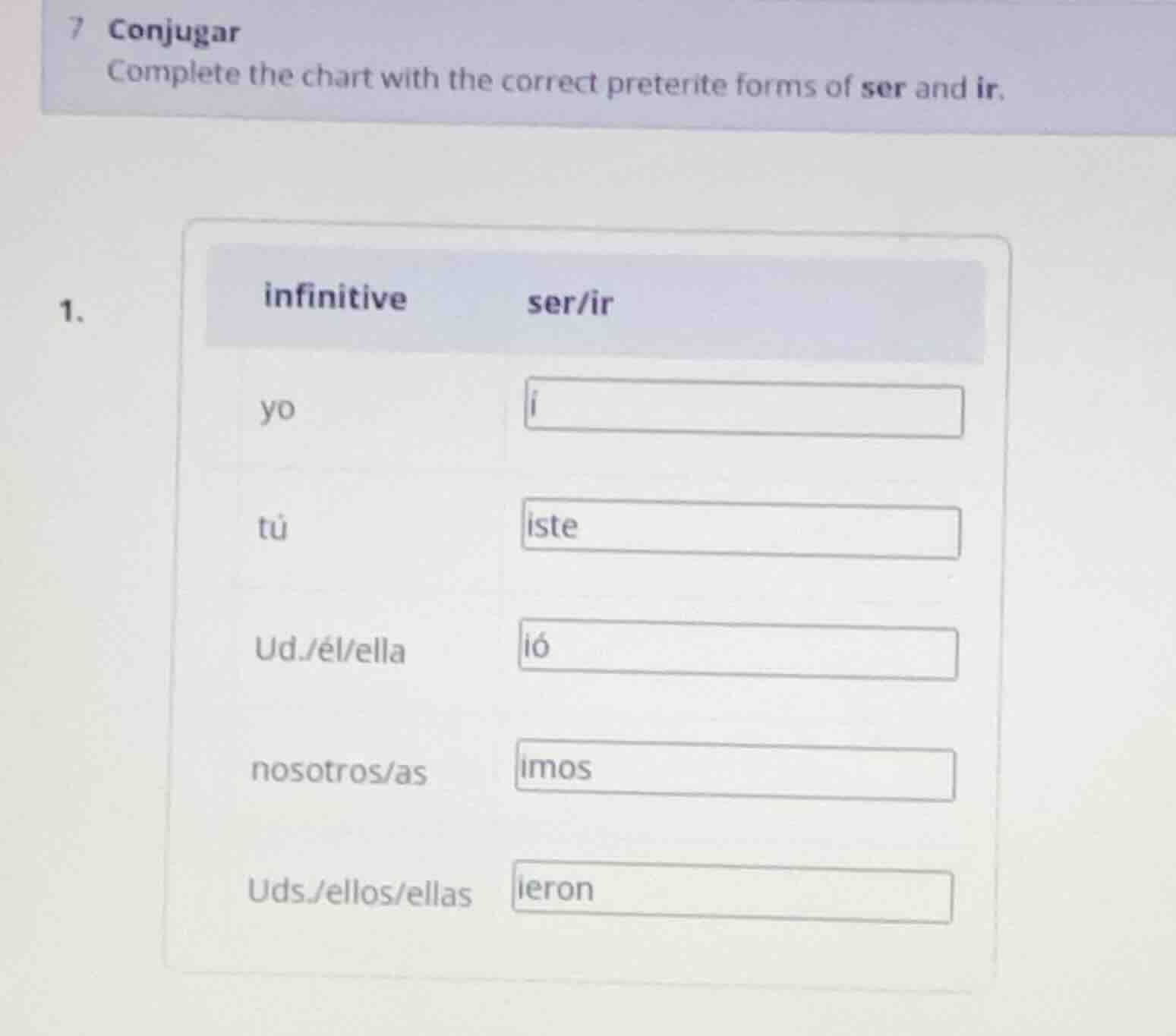
complete the chart with the correct preterite forms of ser and ir.
1.
infinitiveser/ir
yo
tú
ud./él/ella
nosotros/as
uds./ellos/ellas
The problem is about conjugating the Spanish verbs "ser" (to be) and "ir" (to go) in the preterite tense. For the "yo" (I) form, both "ser" and "ir" have the preterite form "fui" (for "ser") or "fui" (wait, no—wait, "ir" in preterite: "yo fui", "tú fuiste", "él/ella/Ud. fue", "nosotros fuimos", "ellos/Uds. fueron". Wait, the given chart has "i" as the start for "yo", "iste" for "tú", "ió" for Ud./él/ella, "imos" for nosotros, "ieron" for Uds./ellos/ellas. Wait, actually, the preterite of "ir" is: yo fui, tú fuiste, él/ella/Ud. fue, nosotros fuimos, ellos/ellas/Uds. fueron. But the chart here has the endings: "i" (yo), "iste" (tú), "ió" (Ud./él/ella), "imos" (nosotros), "ieron" (Uds./ellos/ellas). Wait, maybe it's a typo or maybe it's the verb "ir" with some spelling? Wait, no—wait, the preterite of "ir" is irregular. Wait, maybe the chart is for the verb "ir" but with the correct forms. Wait, the "yo" form for "ir" preterite is "fui", but the chart has "i" as the start. Wait, maybe it's a mistake, but actually, the correct preterite forms for "ir" are: yo fui, tú fuiste, él/ella/Ud. fue, nosotros fuimos, ellos/ellas/Uds. fueron. But the chart here has the endings: "i" (yo), "iste" (tú), "ió" (Ud./él/ella), "imos" (nosotros), "ieron" (Uds./ellos/ellas). Wait, maybe the verb is "ir" and the chart is missing the "f" in "fui", "fuiste", etc. But according to the chart's structure, for "yo", the form should be "fui" (but the chart has "i" as the start, maybe a typo, but the correct preterite of "ir" for "yo" is "fui". Wait, no—wait, maybe the verb is "ser"? No, "ser" preterite is: yo fui, tú fuiste, él/ella/Ud. fue, nosotros fuimos, ellos/ellas/Uds. fueron. Wait, same as "ir"! Oh right, "ser" and "ir" have the same preterite forms. So the "yo" form is "fui", but the chart has "i" as the start. Wait, maybe the chart is using a different spelling, but actually, the correct form for "yo" in preterite of "ser" or "ir" is "fui". But the chart here has "i" in the box for "yo", so maybe it's a typo and the correct form is "fui" (but the "i" is part of it). Wait, no—wait, the problem is to complete the chart with the correct preterite forms of "ser" and "ir". So for "yo", the correct form is "fui". For "tú", "fuiste" (but the chart has "iste", maybe missing "fu"). For "Ud./él/ella", "fue" (but the chart has "ió", missing "fu"). For "nosotros/as", "fuimos" (chart has "imos", missing "fu"). For "Uds./ellos/ellas", "fueron" (chart has "ieron", missing "fu"). But maybe the chart is using the root "f" plus the endings: "i" (yo: f + i = fui), "iste" (tú: f + iste = fuiste), "ió" (Ud./él/ella: f + ió = fue? Wait, no, "fue" is f + ue. Wait, I'm confused. Wait, maybe the chart is incorrect, but the correct preterite forms for "ser" and "ir" are:
- yo: fui
- tú: fuiste
- Ud./él/ella: fue
- nosotros/as: fuimos
- Uds./ellos/ellas: fueron
So for the "yo" box, the correct form is "fui".

Snap & solve any problem in the app
Get step-by-step solutions on Sovi AI
Photo-based solutions with guided steps
Explore more problems and detailed explanations
For the "yo" form of the preterite of "ser" or "ir", the correct form is \boxed{fui} (but based on the chart's structure with "i" as the start, maybe it's a typo, but the correct preterite form for "yo" is "fui"). Wait, but the chart has "i" in the box, so maybe the answer is "fui" (completing the "i" with "f" to make "fui").