QUESTION IMAGE
Question
the conservation of charge
the net charge on an object can change. a neutral object can become positively or negatively charged. the amount of net charge on an object can increase or decrease, and charged objects can even become neutral. when the amount of net charge on an object changes, electric charges are never created or destroyed. instead, negative charges have been transferred between objects.
forces are needed to separate positive and negative charges because opposite charges are attracted to each other. if possible, opposite charges tend to move toward one another, which leads to many objects having a net neutral charge. outside forces or energy can be used to separate opposite charges. for instance, friction between two materials can increase the rate at which charges separate. when you drag your feet across the carpet, the carpet can transfer negative charges to you. you become negatively charged because you gained negative charges. the carpet becomes positively charged because it lost its negative charges and kept its positive charges.
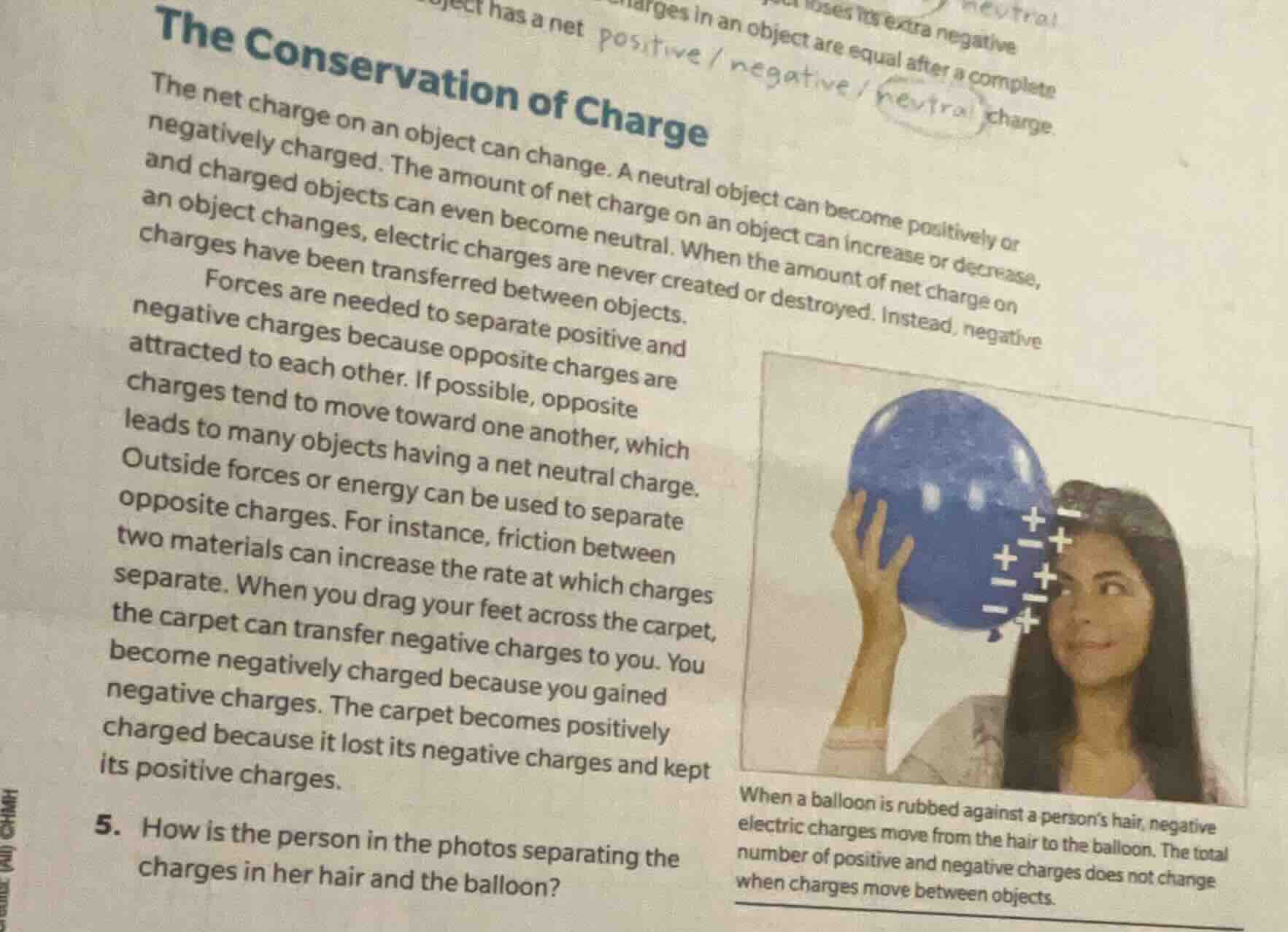
- how is the person in the photos separating the charges in her hair and the balloon?
when a balloon is rubbed against a person’s hair, negative electric charges move from the hair to the balloon. the total number of positive and negative charges does not change when charges move between objects.
The person uses friction by rubbing the balloon against her hair. This friction transfers negative electric charges from her hair to the balloon, separating the charges between the two objects while the total number of charges remains conserved.

Snap & solve any problem in the app
Get step-by-step solutions on Sovi AI
Photo-based solutions with guided steps
Explore more problems and detailed explanations
She is separating charges by using friction: she rubs the balloon against her hair, which causes negative electric charges to move from her hair to the balloon.