QUESTION IMAGE
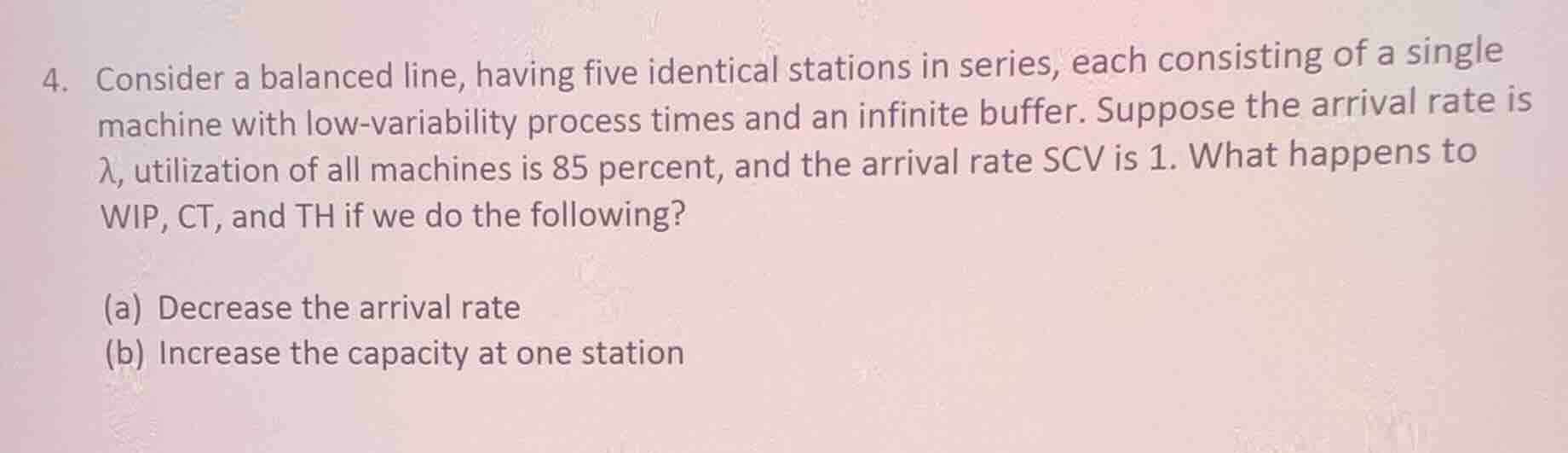
Question
- consider a balanced line, having five identical stations in series, each consisting of a single machine with low - variability process times and an infinite buffer. suppose the arrival rate is λ, utilization of all machines is 85 percent, and the arrival rate scv is 1. what happens to wip, ct, and th if we do the following? (a) decrease the arrival rate (b) increase the capacity at one station
We use queueing theory and Little's Law ($WIP = TH \times CT$) along with utilization formula ($u = \frac{\lambda}{\mu}$) where $\lambda$ = arrival rate, $\mu$ = service rate (capacity), $TH$ = throughput, $CT$ = cycle time, $WIP$ = work-in-process.
---
Part (a): Decrease the arrival rate
Step1: Analyze Throughput (TH)
For a balanced line, $TH$ is limited by the minimum of arrival rate and total capacity. Since we decrease $\lambda$ (arrival rate, which was previously less than total capacity as utilization <1), $TH$ will decrease to match the new lower arrival rate.
Step2: Analyze Utilization
Utilization $u = \frac{\lambda}{\mu}$. As $\lambda$ decreases, $u$ decreases. For low-variability processes, lower utilization reduces queueing delays.
Step3: Analyze Cycle Time (CT)
Using the queueing formula for CT in a series line: $CT = \frac{WIP_0}{TH} + \text{queueing terms}$. With lower utilization, queueing time decreases, so $CT$ decreases.
Step4: Analyze WIP
Using Little's Law $WIP = TH \times CT$. Both $TH$ and $CT$ decrease, so $WIP$ decreases.
---
Part (b): Increase capacity at one station
Step1: Analyze Throughput (TH)
The original line is balanced, so all stations have equal capacity. Increasing capacity at one station makes it no longer the bottleneck. The new bottleneck remains the other four identical stations, so total system capacity does not change. Since arrival rate $\lambda$ is unchanged, $TH$ stays equal to $\lambda$ (still less than system capacity).
Step2: Analyze Utilization
Utilization of the upgraded station: $u_{\text{new}} = \frac{\lambda}{\mu_{\text{new}}}$, where $\mu_{\text{new}} > \mu$. So $u_{\text{new}}$ decreases. Utilization of the other four stations remains 85% (unchanged, as $\lambda$ and their $\mu$ stay the same).
Step3: Analyze Cycle Time (CT)
The upgraded station now has less queueing delay (lower utilization), while the other stations' queueing delay is unchanged. The total system $CT$ decreases slightly due to reduced delay at the upgraded station.
Step4: Analyze WIP
Using Little's Law $WIP = TH \times CT$. $TH$ is unchanged, $CT$ decreases, so $WIP$ decreases.

Snap & solve any problem in the app
Get step-by-step solutions on Sovi AI
Photo-based solutions with guided steps
Explore more problems and detailed explanations
(a)
- TH (Throughput): Decreases (matches the lower arrival rate)
- CT (Cycle Time): Decreases (lower utilization reduces queueing delays)
- WIP (Work-in-Process): Decreases (from Little's Law, as both TH and CT fall)
(b)
- TH (Throughput): Remains unchanged (the bottleneck is still the other four identical stations, so system capacity does not increase beyond the original arrival rate)
- CT (Cycle Time): Decreases slightly (reduced queueing delay at the upgraded station lowers total system cycle time)
- WIP (Work-in-Process): Decreases (from Little's Law, as TH is constant and CT falls)