QUESTION IMAGE
Question
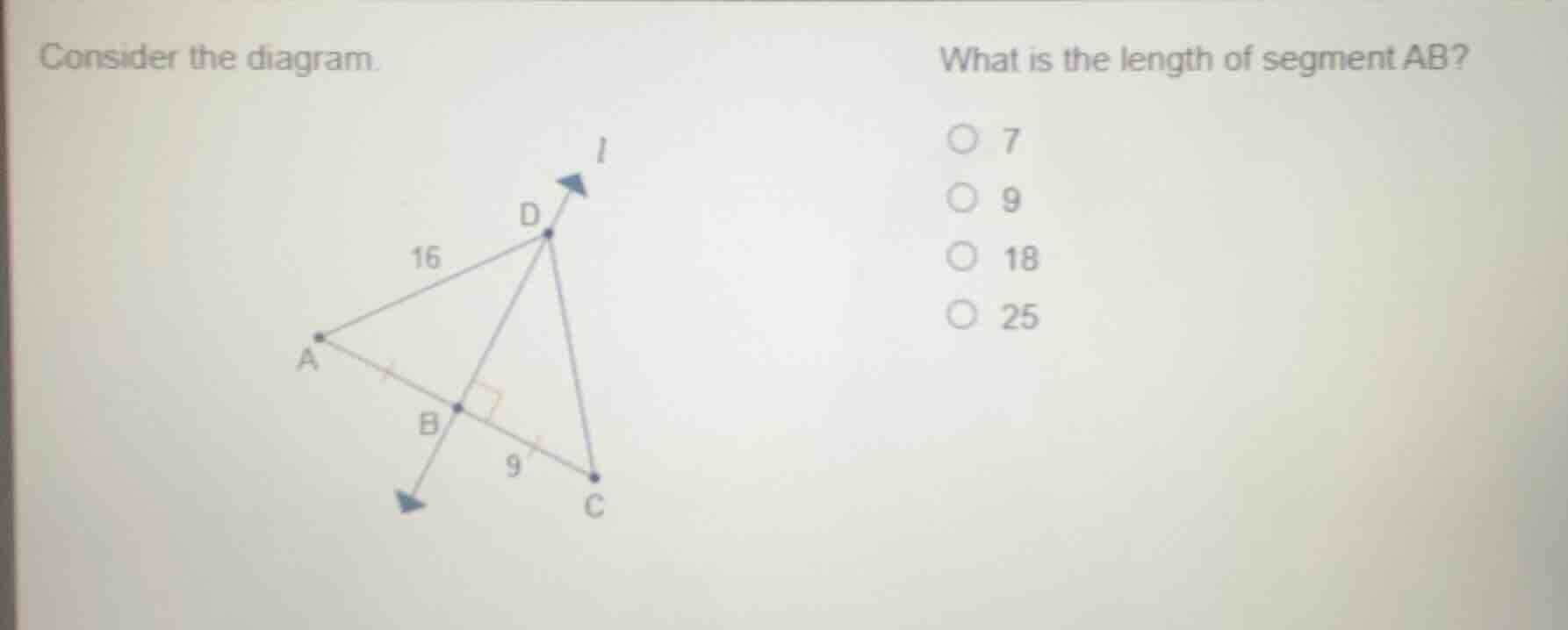
consider the diagram. what is the length of segment ab? 7 9 18 25
Step1: Identify the perpendicular bisector
The diagram shows that line \( l \) is the perpendicular bisector of segment \( AC \) (since \( B \) is the midpoint and \( DB \perp AC \)), and \( DA = DC = 16 \) (given \( DA = 16 \) and \( DC \) should be equal as \( D \) is on the perpendicular bisector? Wait, no, actually, the markings show \( AB = BC \) (since \( B \) is the midpoint, as the segments from \( B \) to \( A \) and \( B \) to \( C \) have the same tick mark) and \( DB \) is perpendicular to \( AC \). Also, we can use the Pythagorean theorem? Wait, no, maybe it's a triangle where \( DC = 16 \)? Wait, no, the length from \( D \) to \( C \) is not given, but the length from \( B \) to \( C \) is 9. Wait, since \( B \) is the midpoint (because \( AB = BC \), as indicated by the tick marks), so \( AB = BC \). Wait, but we need to find \( AB \). Wait, maybe triangle \( DBC \) and \( DBA \) are congruent? Since \( DB \) is common, \( \angle DBA = \angle DBC = 90^\circ \), and \( AB = BC \) (midpoint), so by SAS congruence, \( \triangle DBA \cong \triangle DBC \), so \( DA = DC \). But \( DA = 16 \), so \( DC = 16 \). Then in triangle \( DBC \), we can use Pythagorean theorem: \( DB^2 + BC^2 = DC^2 \). Wait, but we don't know \( DB \). Wait, maybe I misread the diagram. Wait, the length from \( D \) to \( A \) is 16, from \( B \) to \( C \) is 9. Wait, maybe \( AB = 9 \)? No, that doesn't make sense. Wait, no, maybe the diagram has \( BC = 9 \), and since \( B \) is the midpoint, \( AB = BC = 9 \)? But that would be too easy. Wait, no, maybe the length from \( D \) to \( C \) is 16? Wait, no, the label 16 is from \( D \) to \( A \). Wait, maybe it's a typo, and \( DC = 16 \). Then in triangle \( DBC \), \( DC = 16 \), \( BC = 9 \), but that would make \( DB = \sqrt{16^2 - 9^2} \), which is not an integer. Wait, maybe the correct approach is that since \( B \) is the midpoint, \( AB = BC \), and the length of \( BC \) is 9, so \( AB = 9 \). Wait, but the options include 9. So maybe that's the answer.
Step2: Confirm the midpoint
The tick marks on \( AB \) and \( BC \) indicate that \( AB = BC \). The length of \( BC \) is given as 9 (from the diagram, the segment from \( B \) to \( C \) is labeled 9). Therefore, \( AB = BC = 9 \).

Snap & solve any problem in the app
Get step-by-step solutions on Sovi AI
Photo-based solutions with guided steps
Explore more problems and detailed explanations
9