QUESTION IMAGE
Question
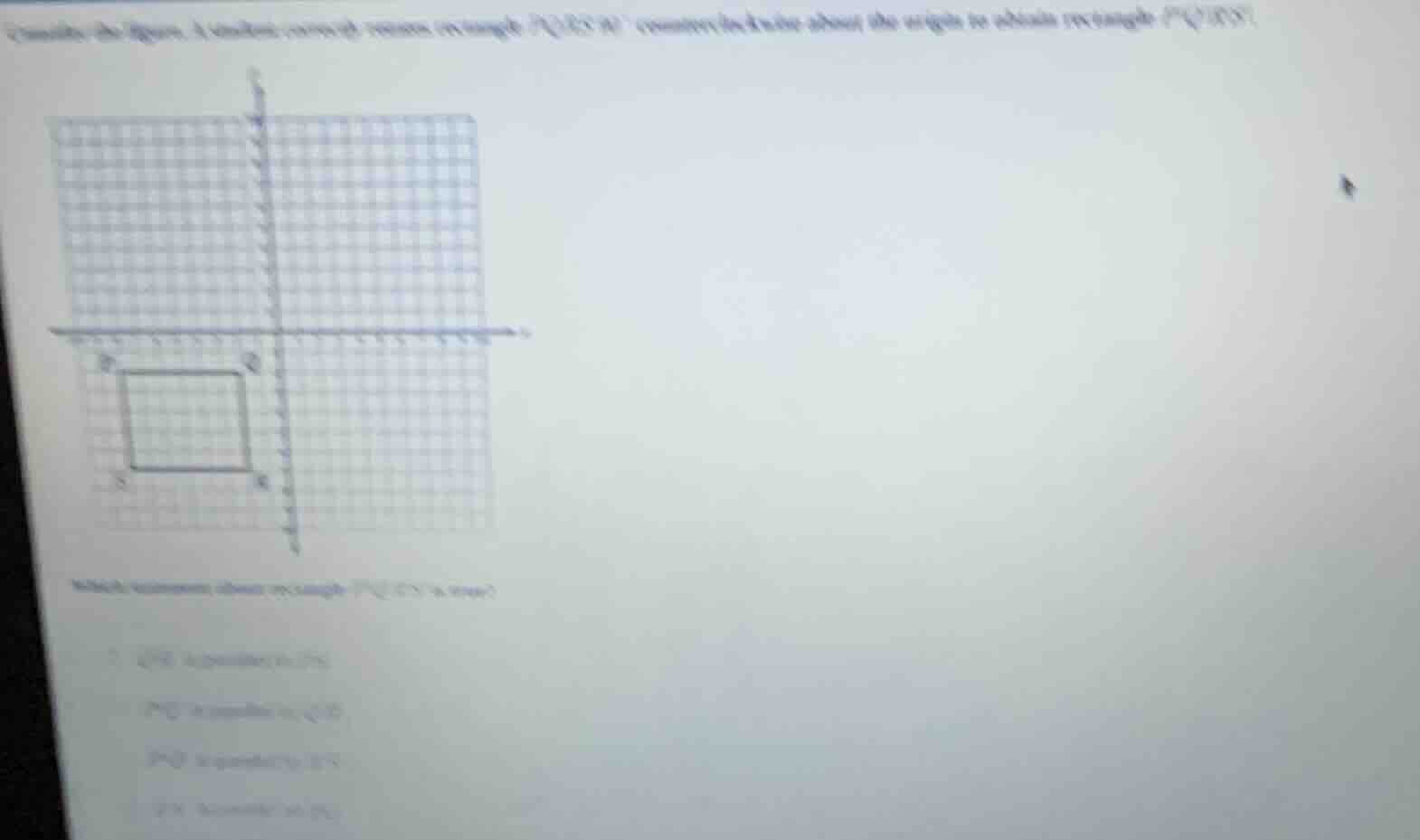
consider the figure. a student correctly rotates rectangle pqrs 90° counterclockwise about the origin to obtain rectangle pqrs.
which statement about rectangle pqrs is true?
a. qr is parallel to ps
b. pq is parallel to qr
c. pq is parallel to rs
d. pr is parallel to pq
To solve this, we use the property of rotation: a rotation preserves the shape and size (isometry), so corresponding sides are equal and parallel, and corresponding angles are equal. Also, in a rectangle, adjacent sides are perpendicular, and opposite sides are parallel.
Analyzing Each Option:
- Option 1: \( Q'R' \) is parallel to \( P'S' \)
In a rectangle, opposite sides are parallel. After a \( 90^\circ \) counterclockwise rotation, \( Q'R' \) and \( P'S' \) remain opposite sides of the rectangle (since rotation preserves the rectangle’s structure). Thus, \( Q'R' \parallel P'S' \).
- Option 2: \( P'Q' \) is parallel to \( Q'R' \)
In a rectangle, adjacent sides are perpendicular (not parallel). \( P'Q' \) and \( Q'R' \) are adjacent sides, so they are perpendicular, not parallel.
- Option 3: \( P'Q' \) is parallel to \( R'S' \)
\( P'Q' \) and \( R'S' \) are not opposite or corresponding sides. After a \( 90^\circ \) rotation, their slopes would be perpendicular, not parallel.
- Option 4: \( P'R' \) is parallel to \( P'S' \)
\( P'R' \) and \( P'S' \) meet at \( P' \), so they are not parallel (they form an angle at the vertex).

Snap & solve any problem in the app
Get step-by-step solutions on Sovi AI
Photo-based solutions with guided steps
Explore more problems and detailed explanations
The true statement is: \( Q'R' \) is parallel to \( P'S' \) (select the option corresponding to this, e.g., if it’s option A, write "A. \( Q'R' \) is parallel to \( P'S' \)").