QUESTION IMAGE
Question
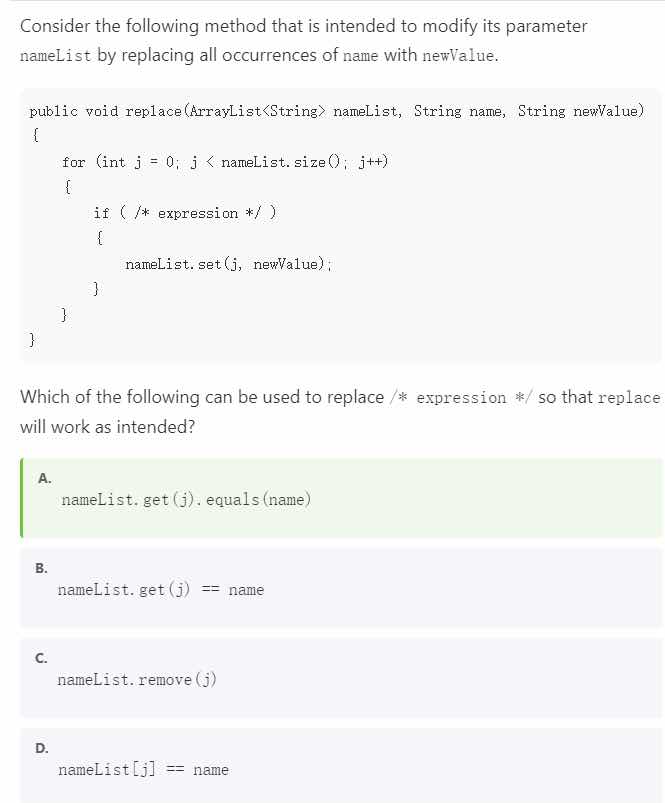
consider the following method that is intended to modify its parameter namelist by replacing all occurrences of name with newvalue.
public void replace(arraylist<string> namelist, string name, string newvalue)
{
for (int j = 0; j < namelist.size(); j++)
{
if ( / expression / )
{
namelist.set(j, newvalue);
}
}
}
which of the following can be used to replace / expression / so that replace will work as intended?
a.
namelist.get(j).equals(name)
b.
namelist.get(j) == name
c.
namelist.remove(j)
d.
namelistj == name
To determine the correct expression for the if condition in the replace method, we analyze each option:
- Option A: In Java, to compare the content of two
Stringobjects, we use theequals()method (since==compares object references, not content).nameList.get(j).equals(name)checks if theStringat indexjinnameListhas the same content as thenameparameter. This is correct for replacing all occurrences ofnamewithnewValue.
- Option B: The
==operator compares object references (memory addresses) forStringobjects, not their content. SonameList.get(j) == namewill not reliably check if theStringvalues are equal.
- Option C:
nameList.remove(j)is a method to delete an element, not a boolean expression for comparison. It does not check if the element matchesname, so it is invalid here.
- Option D:
nameList[j]is invalid syntax for anArrayListin Java (arrays use[], butArrayListuses methods likeget()/set()). Additionally,==is still incorrect forStringcontent comparison.

Snap & solve any problem in the app
Get step-by-step solutions on Sovi AI
Photo-based solutions with guided steps
Explore more problems and detailed explanations
A. nameList.get(j).equals(name)