QUESTION IMAGE
Question
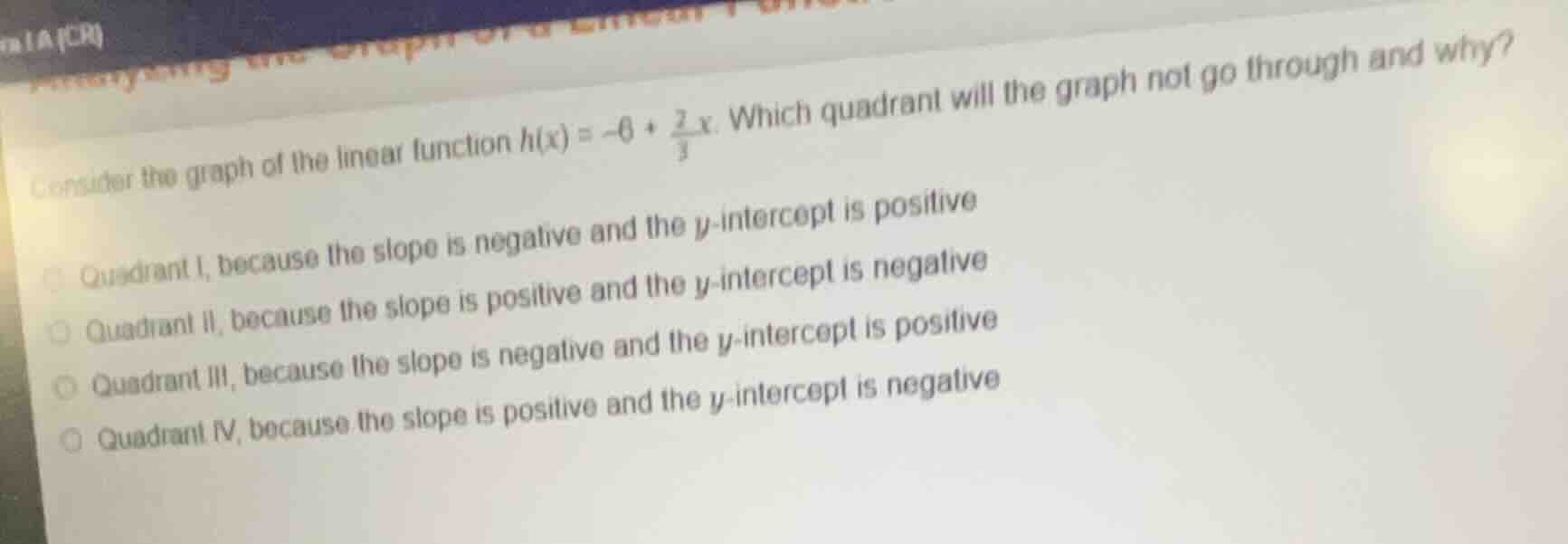
consider the graph of the linear function ( h(x) = -6 + \frac{2}{3}x ). which quadrant will the graph not go through and why?
- quadrant i, because the slope is negative and the ( y )-intercept is positive
- quadrant ii, because the slope is positive and the ( y )-intercept is negative
- quadrant iii, because the slope is negative and the ( y )-intercept is positive
- quadrant iv, because the slope is positive and the ( y )-intercept is negative
Step1: Identify slope and intercept
The linear function is $h(x) = -6 + \frac{2}{3}x$, which matches the form $y = mx + b$, where $m$ (slope) $=\frac{2}{3}$ and $b$ (y-intercept) $=-6$.
Step2: Analyze quadrant behavior
A positive slope means the line rises from left to right. A negative y-intercept means the line crosses the y-axis below the origin. Starting from the y-intercept (Quadrant IV), rising right goes into Quadrant I, and extending left from the y-intercept goes into Quadrant III. The line never enters Quadrant II.
Step3: Match to correct option
This matches the reasoning that the slope is positive, y-intercept is negative, so the line does not go through Quadrant II.

Snap & solve any problem in the app
Get step-by-step solutions on Sovi AI
Photo-based solutions with guided steps
Explore more problems and detailed explanations
Quadrant II, because the slope is positive and the y-intercept is negative