QUESTION IMAGE
Question
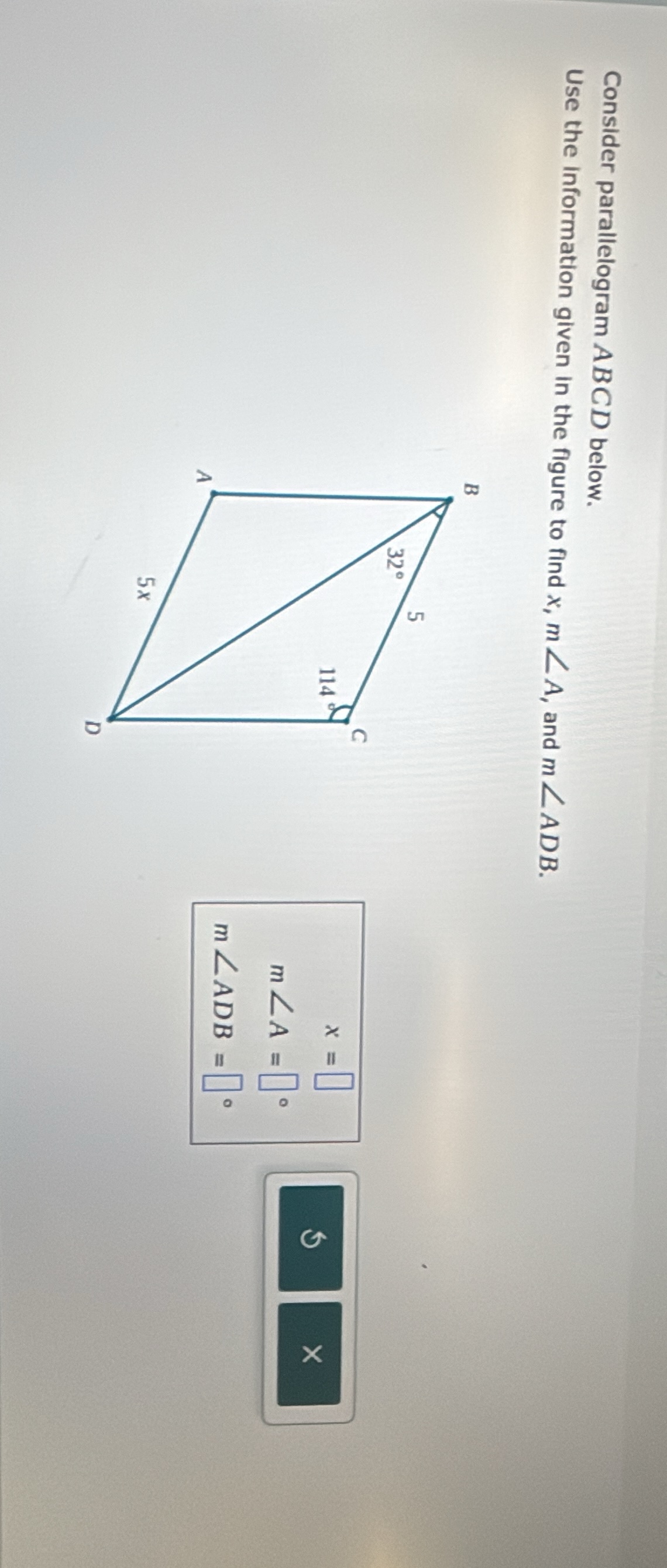
consider parallelogram abcd below. use the information given in the figure to find x, m∠a, and m∠adb.
Step1: Find \( x \)
In a parallelogram, opposite sides are equal. So \( AD = BC \). Given \( AD = 5x \) and \( BC = 5 \), we set up the equation \( 5x = 5 \). Dividing both sides by 5, we get \( x = \frac{5}{5}=1 \).
Step2: Find \( m\angle A \)
In a parallelogram, consecutive angles are supplementary. So \( \angle A + \angle C = 180^\circ \). Given \( m\angle C = 114^\circ \), then \( m\angle A = 180^\circ - 114^\circ = 66^\circ \). Wait, no, wait. Wait, in the parallelogram \( ABCD \), \( AB \parallel CD \) and \( AD \parallel BC \). Wait, actually, \( \angle A \) and \( \angle C \) are opposite angles? No, no. Wait, consecutive angles: \( \angle A \) and \( \angle B \) are consecutive? Wait, no, let's correct. In parallelogram \( ABCD \), \( \angle A \) and \( \angle C \) are opposite angles? No, no, opposite angles are equal, consecutive angles are supplementary. Wait, \( AB \parallel CD \), so \( \angle A + \angle D = 180^\circ \), and \( \angle A = \angle C \)? Wait, no, I made a mistake. Wait, the figure: \( ABCD \) is a parallelogram, so \( AD \parallel BC \), \( AB \parallel CD \). So \( \angle A \) and \( \angle C \): are they opposite? Wait, vertices are \( A, B, C, D \) in order, so \( AB \) is adjacent to \( BC \), \( BC \) to \( CD \), \( CD \) to \( DA \), \( DA \) to \( AB \). So opposite angles: \( \angle A \) and \( \angle C \), \( \angle B \) and \( \angle D \). Consecutive angles: \( \angle A \) and \( \angle B \), \( \angle B \) and \( \angle C \), \( \angle C \) and \( \angle D \), \( \angle D \) and \( \angle A \). So consecutive angles are supplementary. So \( \angle B + \angle C = 180^\circ \)? Wait, no, let's look at the triangle \( BCD \). Wait, in the parallelogram, \( AD = BC = 5 \) (since we found \( x = 1 \), so \( AD = 5x = 5 \), so \( AD = BC = 5 \)). Now, in triangle \( BCD \), we have \( BC = 5 \), \( \angle CBD = 32^\circ \), \( \angle C = 114^\circ \). Wait, maybe we need to use the triangle. Wait, no, first, \( x \): \( AD = BC \), \( AD = 5x \), \( BC = 5 \), so \( 5x = 5 \), so \( x = 1 \). Then, \( m\angle A \): in parallelogram, \( \angle A = \angle C \)? Wait, no, opposite angles are equal. Wait, \( \angle C = 114^\circ \), so \( \angle A = 114^\circ \)? But that contradicts the triangle. Wait, no, the triangle \( BCD \): \( BC = 5 \), \( CD \) is equal to \( AB \), \( AD = 5 \). Wait, maybe I messed up the angle. Wait, let's look at triangle \( BCD \). In triangle \( BCD \), angles sum to \( 180^\circ \). So \( \angle CBD = 32^\circ \), \( \angle C = 114^\circ \), so \( \angle CDB = 180^\circ - 32^\circ - 114^\circ = 34^\circ \). Then, since \( AD \parallel BC \), \( \angle ADB = \angle CBD = 32^\circ \)? Wait, no, \( AD \parallel BC \), and \( BD \) is a transversal, so alternate interior angles: \( \angle ADB = \angle CBD = 32^\circ \). Wait, let's redo:
- Find \( x \):
In parallelogram \( ABCD \), \( AD = BC \) (opposite sides of parallelogram are equal). Given \( AD = 5x \) and \( BC = 5 \), so:
\[
5x = 5 \implies x = 1
\]
- Find \( m\angle A \):
In parallelogram \( ABCD \), consecutive angles are supplementary. \( \angle A \) and \( \angle C \) are not consecutive. Wait, \( \angle A \) and \( \angle B \) are consecutive? No, \( \angle A \) and \( \angle D \) are consecutive? Wait, vertices: \( A, B, C, D \), so \( AB \parallel CD \), \( AD \parallel BC \). So \( \angle A + \angle B = 180^\circ \), \( \angle B + \angle C = 180^\circ \), so \( \angle A = \angle C \)? No, that's opposite angles. Wait, opposite angles in parallelogram are equal. So \( \angle A = \angle C \), \( \a…

Snap & solve any problem in the app
Get step-by-step solutions on Sovi AI
Photo-based solutions with guided steps
Explore more problems and detailed explanations
\( x = 1 \), \( m\angle A = 114^\circ \), \( m\angle ADB = 32^\circ \)
So filling in the boxes:
\( x = \boxed{1} \)
\( m\angle A = \boxed{114} \)
\( m\angle ADB = \boxed{32} \)