QUESTION IMAGE
Question
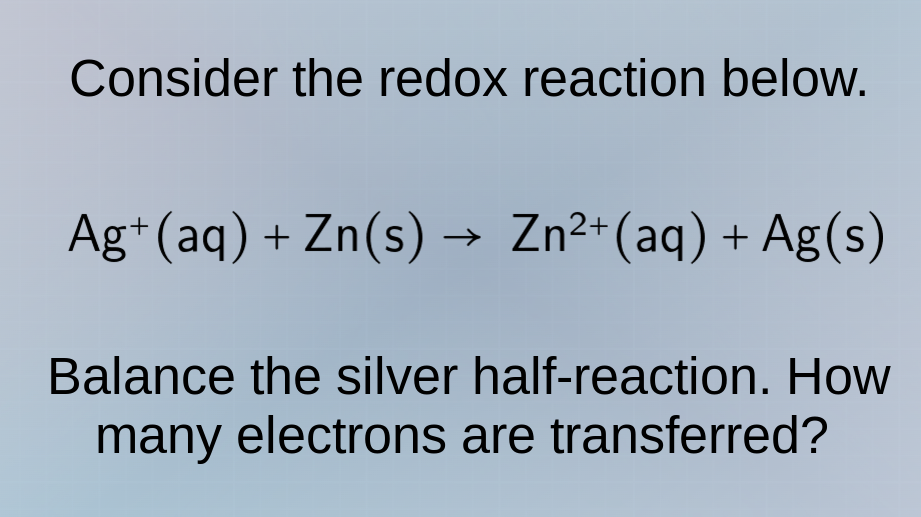
consider the redox reaction below.
ag⁺(aq) + zn(s) → zn²⁺(aq) + ag(s)
balance the silver half - reaction. how many electrons are transferred?
Step1: Identify the silver half - reaction
The silver - containing species in the reaction is \(Ag^+(aq)\) and \(Ag(s)\). The half - reaction for silver is the reduction half - reaction (since \(Ag^+\) is gaining electrons to form \(Ag\) with an oxidation state of 0 from + 1). The unbalanced half - reaction is \(Ag^+(aq)\to Ag(s)\).
Step2: Balance the atoms
First, we balance the number of silver atoms. There is 1 silver atom on the left (\(Ag^+\)) and 1 silver atom on the right (\(Ag\)), so the atom balance for silver is already done.
Step3: Balance the charge
The charge on the left side of the half - reaction (\(Ag^+(aq)\)) is \(+ 1\), and the charge on the right side (\(Ag(s)\)) is \(0\). To balance the charge, we need to add electrons to the left - hand side (since reduction involves gain of electrons). The number of electrons needed to balance the charge is equal to the difference in charge. Let the number of electrons be \(n\). So, we have the equation: \(Charge_{left}+(-n\times charge\ of\ electron)=Charge_{right}\). The charge of an electron is \(- 1\). So, \(+1 - n\times( - 1)=0\)? Wait, no. Actually, for reduction, the gain of electrons. The oxidation state of \(Ag\) in \(Ag^+\) is + 1, and in \(Ag\) is 0. The change in oxidation state per \(Ag\) atom is \(0-( + 1)=- 1\), which means each \(Ag^+\) ion gains 1 electron. So the balanced half - reaction is \(Ag^+(aq)+e^-\to Ag(s)\). So the number of electrons transferred (gained) in the silver half - reaction is 1.

Snap & solve any problem in the app
Get step-by-step solutions on Sovi AI
Photo-based solutions with guided steps
Explore more problems and detailed explanations
The balanced silver half - reaction is \(Ag^+(aq)+e^-\to Ag(s)\), and the number of electrons transferred is 1.