QUESTION IMAGE
Question
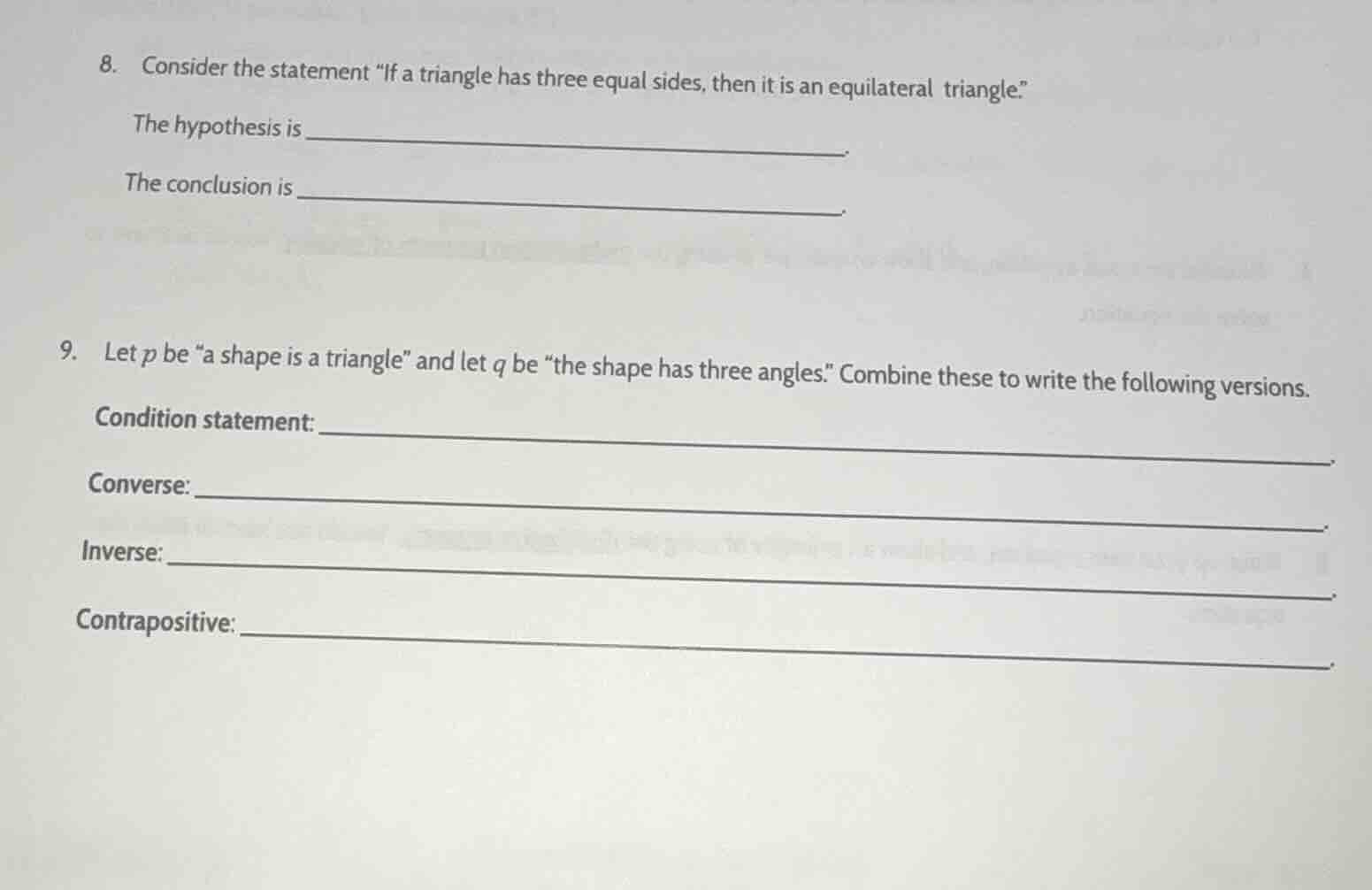
- consider the statement \if a triangle has three equal sides, then it is an equilateral triangle.\
the hypothesis is ______________________________.
the conclusion is ______________________________.
- let ( p ) be \a shape is a triangle\ and let ( q ) be \the shape has three angles.\ combine these to write the following versions.
condition statement: ____________________________________________________.
converse: ____________________________________________________.
inverse: ____________________________________________________.
contrapositive: ____________________________________________________.
Step1: Identify hypothesis (If-clause)
In an "If-then" statement, the hypothesis is the part following "If".
Step2: Identify conclusion (Then-clause)
In an "If-then" statement, the conclusion is the part following "then".
Step3: Write conditional statement (If p, then q)
Combine p and q into the standard conditional structure.
Step4: Write converse (If q, then p)
Swap the positions of p and q in the conditional.
Step5: Write inverse (If not p, then not q)
Negate both p and q in the conditional.
Step6: Write contrapositive (If not q, then not p)
Negate both p and q, then swap their positions.

Snap & solve any problem in the app
Get step-by-step solutions on Sovi AI
Photo-based solutions with guided steps
Explore more problems and detailed explanations
For Question 8:
The hypothesis is: a triangle has three equal sides
The conclusion is: it is an equilateral triangle
For Question 9:
Condition statement: If a shape is a triangle, then the shape has three angles.
Converse: If a shape has three angles, then the shape is a triangle.
Inverse: If a shape is not a triangle, then the shape does not have three angles.
Contrapositive: If a shape does not have three angles, then the shape is not a triangle.