QUESTION IMAGE
Question
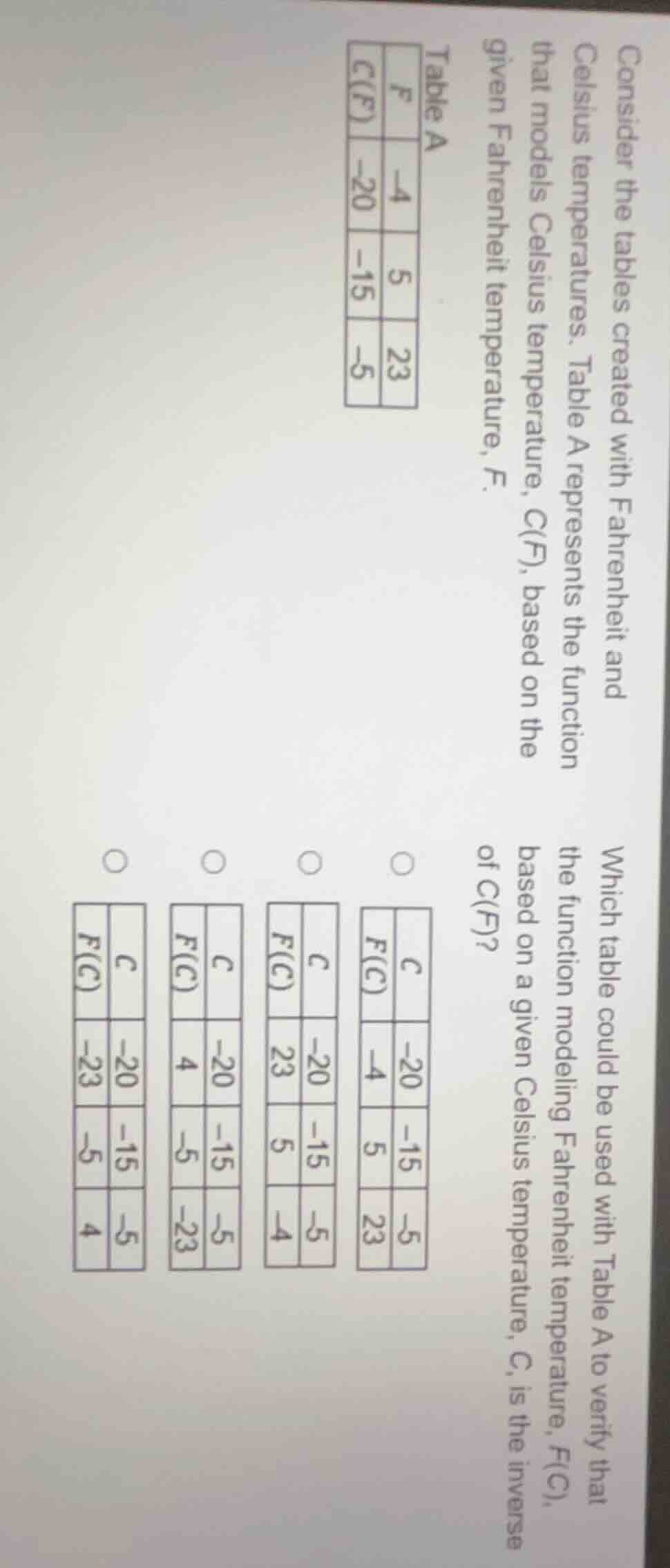
consider the tables created with fahrenheit and celsius temperatures. table a represents the function that models celsius temperature, ( c(f) ), based on the given fahrenheit temperature, ( f ).
table a
| ( f ) | ( c(f) ) |
|---|---|
| ( 5 ) | ( -15 ) |
| ( 23 ) | ( -5 ) |
which table could be used with table a to verify that the function modeling fahrenheit temperature, ( f(c) ), based on a given celsius temperature, ( c ), is the inverse of ( c(f) )?
four multiple - choice tables are provided, each with columns ( c ) and ( f(c) ), with different values in the rows:
- ( c=-20, f(c)=-4 ); ( c = - 15, f(c)=5 ); ( c=-5, f(c)=23 )
- ( c=-20, f(c)=4 ); ( c = - 15, f(c)=-5 ); ( c=-5, f(c)=-23 )
- ( c=-20, f(c)=23 ); ( c = - 15, f(c)=5 ); ( c=-5, f(c)=-4 )
- ( c=-20, f(c)=-23 ); ( c = - 15, f(c)=-5 ); ( c=-5, f(c)=4 )
To solve this, we need to find the inverse function of \( C(F) \), which is \( F(C) \). The inverse function swaps the input and output values. Let's analyze Table A:
- For \( F = -4 \), \( C(F) = -20 \). So in \( F(C) \), when \( C = -20 \), \( F(C) = -4 \).
- For \( F = 5 \), \( C(F) = -15 \). So in \( F(C) \), when \( C = -15 \), \( F(C) = 5 \).
- For \( F = 23 \), \( C(F) = -5 \). So in \( F(C) \), when \( C = -5 \), \( F(C) = 23 \).
Now let's check the options:
- First option:
- \( C = -20 \), \( F(C) = -4 \) (matches)
- \( C = -15 \), \( F(C) = 5 \) (matches)
- \( C = -5 \), \( F(C) = 23 \) (matches)
Let's verify the other options to be sure:
- Second option:
- \( C = -20 \), \( F(C) = 4 \) (does not match, should be -4)
- So this is incorrect.
- Third option:
- \( C = -20 \), \( F(C) = 23 \) (does not match, should be -4)
- Incorrect.
- Fourth option:
- \( C = -20 \), \( F(C) = -23 \) (does not match, should be -4)
- Incorrect.
To determine the table for \( F(C) \) (the inverse of \( C(F) \)), we swap the input (\( F \)) and output (\( C \)) values from Table A. For each pair \((F, C(F))\) in Table A, the inverse function \( F(C) \) will have the pair \((C, F)\). Checking the options, the first table matches these swapped values.

Snap & solve any problem in the app
Get step-by-step solutions on Sovi AI
Photo-based solutions with guided steps
Explore more problems and detailed explanations
The first table (with \( C = -20 \) corresponding to \( F(C) = -4 \), \( C = -15 \) corresponding to \( F(C) = 5 \), and \( C = -5 \) corresponding to \( F(C) = 23 \)) is the correct one. (The first option among the given tables, likely labeled as the first choice with \( C \) and \( F(C) \) columns matching the swapped values from Table A.)