QUESTION IMAGE
Question
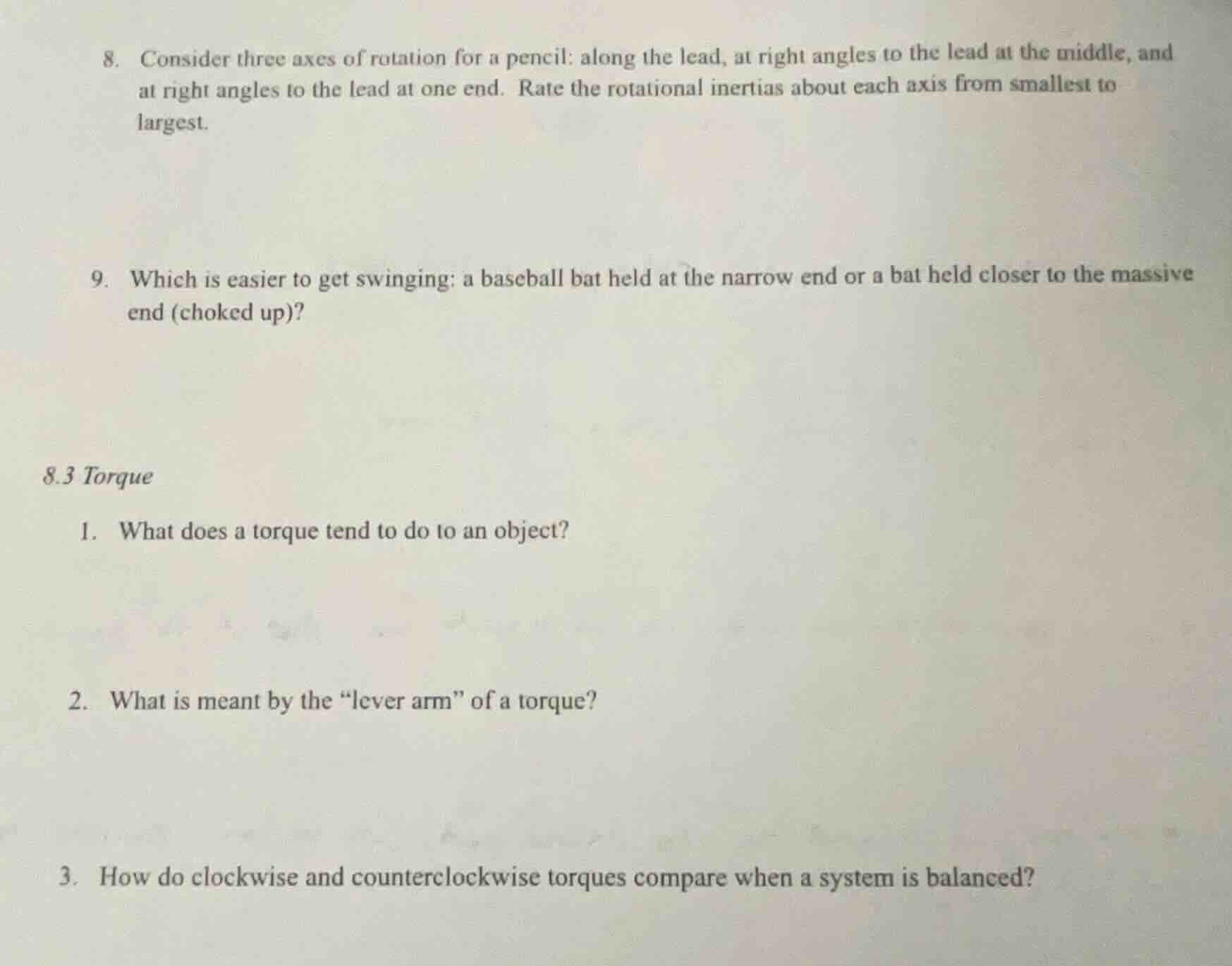
- consider three axes of rotation for a pencil: along the lead, at right angles to the lead at the middle, and at right angles to the lead at one end. rate the rotational inertias about each axis from smallest to largest.
- which is easier to get swinging: a baseball bat held at the narrow end or a bat held closer to the massive end (choked up)?
8.3 torque
- what does a torque tend to do to an object?
- what is meant by the \lever arm\ of a torque?
- how do clockwise and counterclockwise torques compare when a system is balanced?
Question 8
Step1: Recall Rotational Inertia Formula
The rotational inertia \( I \) of a rigid body is given by \( I = \sum m_i r_i^2 \), where \( m_i \) is the mass of each particle and \( r_i \) is the perpendicular distance from the particle to the axis of rotation. For a continuous object, this becomes \( I=\int r^2 dm \).
Step2: Analyze Each Axis for Pencil
- Axis along the lead: For a pencil (approximated as a long thin rod), when rotating about an axis along its length (the lead), the perpendicular distance \( r \) from most of the mass elements to the axis is very small (close to zero for a thin rod). So the rotational inertia \( I_{along} \) will be very small.
- Axis at right angles to lead at middle: For a rod rotating about an axis perpendicular to its length through its center (the middle), the formula is \( I_{middle}=\frac{1}{12}ML^2 \), where \( M \) is the mass and \( L \) is the length of the rod.
- Axis at right angles to lead at one end: For a rod rotating about an axis perpendicular to its length through one end, the formula is \( I_{end}=\frac{1}{3}ML^2 \).
Step3: Compare the Inertias
We know that \( \frac{1}{12}ML^2<\frac{1}{3}ML^2 \), and \( I_{along} \) is much smaller than both (since for the axis along the length, the \( r_i \) values are negligible). So the order from smallest to largest is: axis along the lead, axis at right angles to lead at middle, axis at right angles to lead at one end.
Step1: Recall Rotational Inertia and Torque
The ease of swinging depends on the rotational inertia (moment of inertia) about the axis of rotation (the hand). Torque \( \tau = I\alpha \), where \( \alpha \) is the angular acceleration. For a given torque (applied by the hand), a smaller \( I \) gives a larger \( \alpha \) (easier to get swinging).
Step2: Analyze Rotational Inertia for Bat
- When holding the bat at the narrow end (far from the massive end), the axis of rotation is at the narrow end. The rotational inertia \( I_{narrow} \) about this axis is larger (since more mass is farther from the axis, using \( I = \sum m_i r_i^2 \), the \( r_i \) values for the massive end are large).
- When holding the bat closer to the massive end (choked up), the axis of rotation is closer to the massive end. So the distance \( r_i \) from the mass elements to the axis is smaller, leading to a smaller rotational inertia \( I_{choked} \).
Step3: Determine Ease of Swinging
Since \( I_{choked}
Torque is a rotational analog of force. From the formula \( \tau = rF\sin\theta \) (where \( r \) is the distance from the axis, \( F \) is the force, and \( \theta \) is the angle between \( r \) and \( F \)), torque tends to produce an angular acceleration in an object, i.e., it tends to rotate the object (change its rotational motion, similar to how force changes translational motion).

Snap & solve any problem in the app
Get step-by-step solutions on Sovi AI
Photo-based solutions with guided steps
Explore more problems and detailed explanations
Axis along the lead < Axis at right angles to lead at middle < Axis at right angles to lead at one end