QUESTION IMAGE
Question
constitution packet
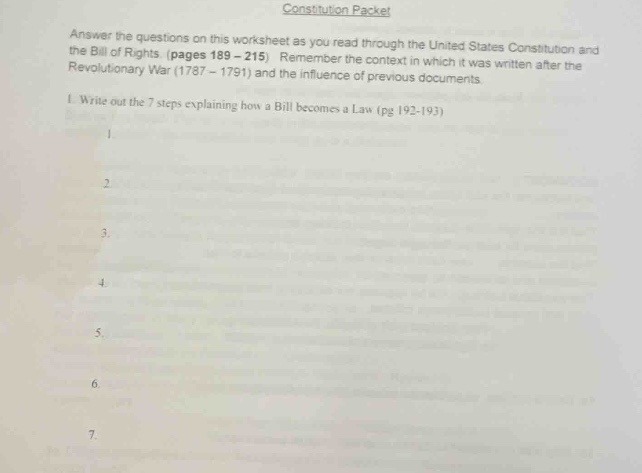
answer the questions on this worksheet as you read through the united states constitution and
the bill of rights (pages 189 - 215) remember the context in which it was written after the
revolutionary war (1787 - 1791) and the influence of previous documents.
- write out the 7 steps explaining how a bill becomes a law (pg 192-193)
1
2
3.
4.
5.
6.
7.
Brief Explanations
To determine the 7 steps of how a Bill becomes a Law in the US legislative process:
- Idea Generation: A member of Congress (Senator or Representative) has an idea for a law, often based on constituent needs, policy goals, or issues.
- Drafting the Bill: The idea is turned into a written bill, with legal and policy language. It's then introduced in either the House of Representatives or the Senate.
- Introduction and First Reading: The bill is introduced, given a number, and read aloud (first reading). In the House, it's sent to a committee; in the Senate, similar committee referral happens.
- Committee Action: The bill is sent to a relevant standing committee (e.g., House Committee on Education, Senate Committee on Finance). The committee holds hearings (to get expert/constituent input), marks up (amends) the bill, and votes on whether to send it to the full chamber (report it out) or kill it.
- Floor Debate and Vote (First Chamber): If the committee approves, the bill goes to the full House or Senate floor. Members debate the bill, propose amendments, and then vote. If it passes (simple majority, usually), it moves to the other chamber.
- Second Chamber Process: The bill goes to the other chamber (House to Senate or vice versa). It undergoes the same process: committee action, floor debate, amendments, and a vote. If the second chamber passes it with amendments, a conference committee (made of members from both chambers) is formed to reconcile differences.
- Presidential Action: If both chambers pass an identical version of the bill, it's sent to the President. The President can sign it (becomes law), veto it (sends back to Congress with objections), or let it become law without signing (if not vetoed within 10 days while Congress is in session; if Congress adjourns, it's a pocket veto). If vetoed, Congress can override with a 2/3 majority vote in both chambers.

Snap & solve any problem in the app
Get step-by-step solutions on Sovi AI
Photo-based solutions with guided steps
Explore more problems and detailed explanations
- A member of Congress has an idea for a bill and drafts it.
- The bill is introduced in either the House or Senate and given a first reading.
- The bill is referred to a standing committee, which holds hearings, amends, and votes on it.
- If the committee approves, the bill goes to the full chamber (House or Senate) for floor debate, amendments, and a vote. If it passes, it moves to the other chamber.
- The other chamber (Senate or House) repeats the committee and floor process. If amendments differ, a conference committee reconciles them.
- Both chambers pass the final version of the bill.
- The bill is sent to the President, who signs it (becomes law), vetoes it (Congress may override), or allows it to become law without signing.