QUESTION IMAGE
Question
constitution
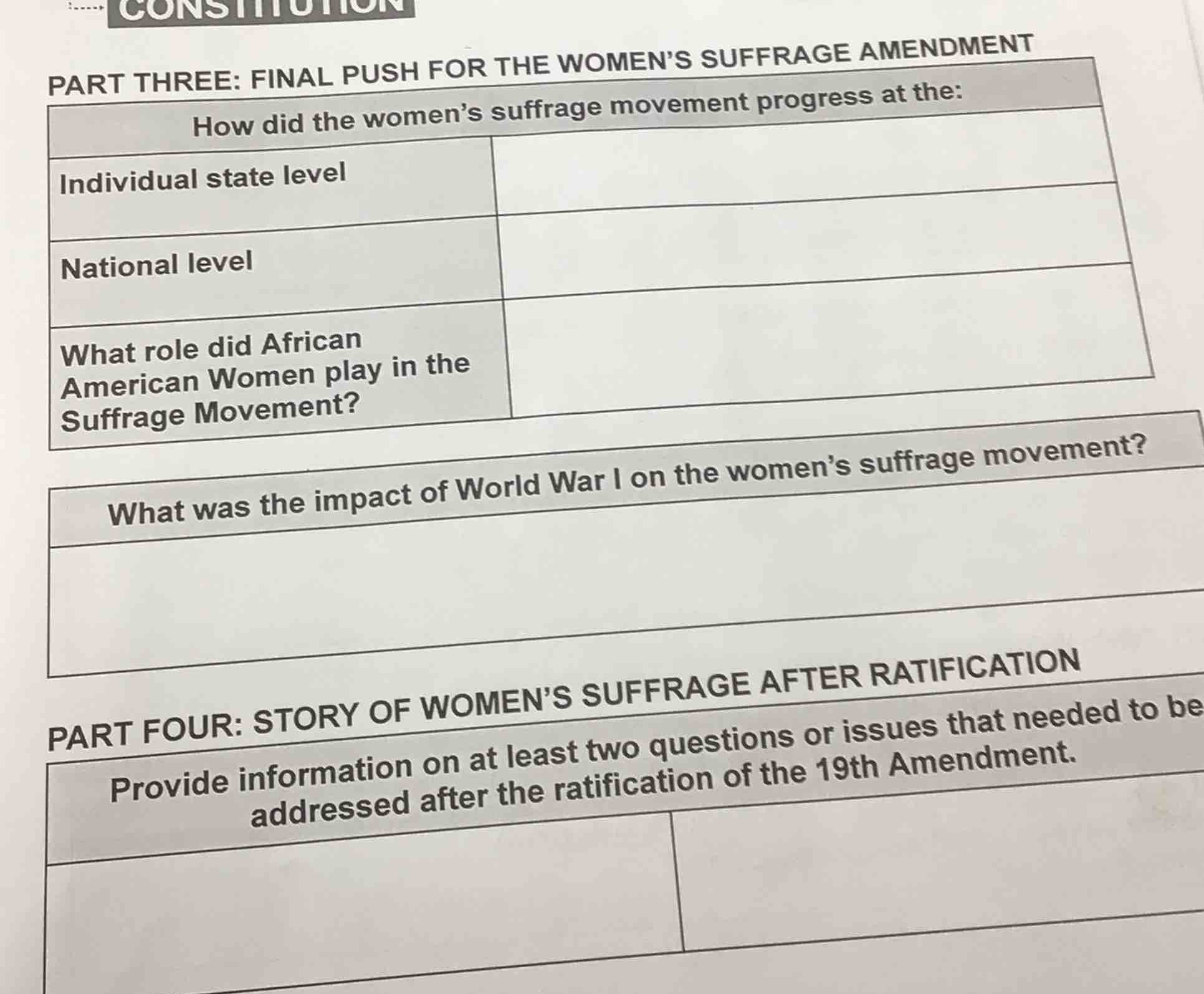
part three: final push for the womens suffrage amendment
how did the womens suffrage movement progress at the:
individual state level
national level
what role did african american women play in the suffrage movement?
what was the impact of world war i on the womens suffrage movement?
part four: story of womens suffrage after ratification
provide information on at least two questions or issues that needed to be addressed after the ratification of the 19th amendment.
Brief Explanations
- Individual state level: Suffrage groups campaigned state-by-state; Western states (e.g., Wyoming, Utah) granted women's voting rights first, starting in 1869, building momentum for national change.
- National level: Suffragists pushed for a federal amendment. After decades of lobbying, protests, and congressional debates, the 19th Amendment was proposed in 1919 and ratified in 1920.
- Role of African American Women: They organized their own groups (e.g., National Association of Colored Women), advocated for suffrage alongside racial justice, and mobilized Black communities, though many were excluded from white-led suffrage organizations.
- Impact of World War I: Women took on factory, agricultural, and war support jobs, demonstrating their civic value. This shifted public opinion, and President Wilson backed the suffrage amendment as a reward for their wartime service.
- Post-19th Amendment issues:
- Racial Disenfranchisement: Black women (and men) faced poll taxes, literacy tests, and violence that blocked access to voting, which was not fully addressed until the Voting Rights Act of 1965.
- Intersectional Inequities: Working-class, immigrant, and Indigenous women still faced barriers to voting and broader gender-based economic and social discrimination.

Snap & solve any problem in the app
Get step-by-step solutions on Sovi AI
Photo-based solutions with guided steps
Explore more problems and detailed explanations
- Individual state level: Western states first granted women's suffrage, starting with Wyoming in 1869, with other states gradually following, building grassroots momentum.
- National level: Suffragists lobbied Congress, organized national protests, and secured the proposal of the 19th Amendment in 1919, which was ratified in 1920.
- Role of African American Women: They formed independent advocacy groups, mobilized Black communities, and fought for suffrage alongside racial equality, despite exclusion from many white suffrage organizations.
- Impact of World War I: Women's wartime labor in essential jobs changed public perception, leading to increased support for suffrage, and President Wilson formally endorsed the 19th Amendment.
- Post-19th Amendment issues:
- Racial disenfranchisement of Black women via poll taxes, literacy tests, and intimidation, which persisted until the 1960s.
- Ongoing economic and social inequalities for working-class, immigrant, and Indigenous women, who still faced systemic barriers beyond voting access.