QUESTION IMAGE
Question
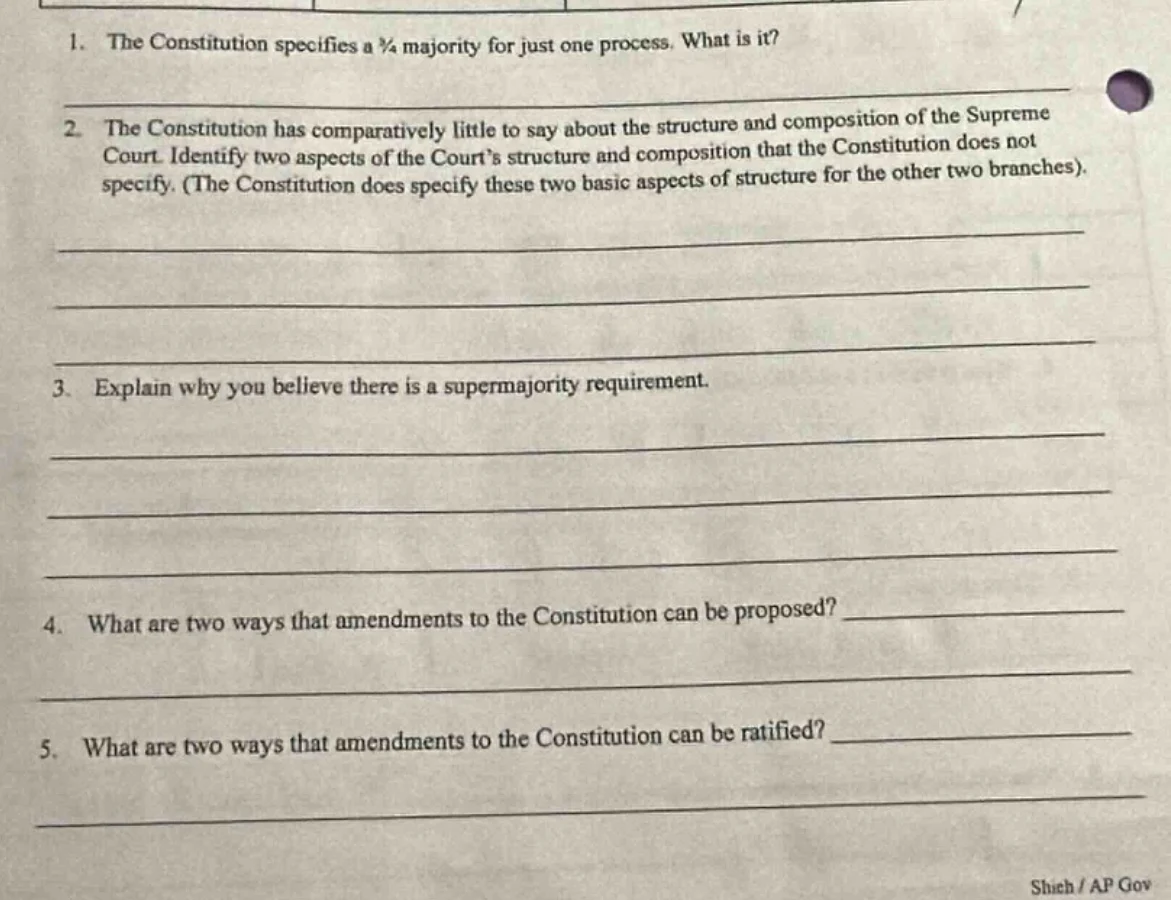
- the constitution specifies a ¾ majority for just one process. what is it?
- the constitution has comparatively little to say about the structure and composition of the supreme court. identify two aspects of the court’s structure and composition that the constitution does not specify. (the constitution does specify these two basic aspects of structure for the other two branches).
- explain why you believe there is a supermajority requirement.
- what are two ways that amendments to the constitution can be proposed?
- what are two ways that amendments to the constitution can be ratified?
shieh / ap gov
Question 1
The U.S. Constitution requires a ¾ majority (of states) for the ratification of amendments. So the process is the ratification of constitutional amendments.
- Number of Justices: The Constitution doesn't specify how many justices are on the Supreme Court (Congress has set the number, e.g., 9 currently, but it has changed over time). For Congress (legislative) it specifies the structure of the two chambers and for the President (executive) it outlines the election and term, but no fixed number for SCOTUS.
- Term Length of Justices: The Constitution doesn't specify the term length of Supreme Court justices (they serve for life "during good behavior" but no set years like the President's 4 - year term or Senators' 6 - year terms).
A supermajority (like ¾ for amendment ratification) is required to ensure that constitutional changes are not made lightly. It acts as a safeguard against hasty or partisan changes to the fundamental law of the land. It ensures broad consensus across the states (or within Congress for proposal) so that amendments reflect a widely - shared vision and are not just the will of a simple majority, protecting the stability of the constitutional system. Also, it balances the need for the Constitution to be adaptable over time with the need to preserve its core principles from transient political majorities.

Snap & solve any problem in the app
Get step-by-step solutions on Sovi AI
Photo-based solutions with guided steps
Explore more problems and detailed explanations
The process is the ratification of constitutional amendments (where ¾ of the states must approve an amendment after it's proposed).