QUESTION IMAGE
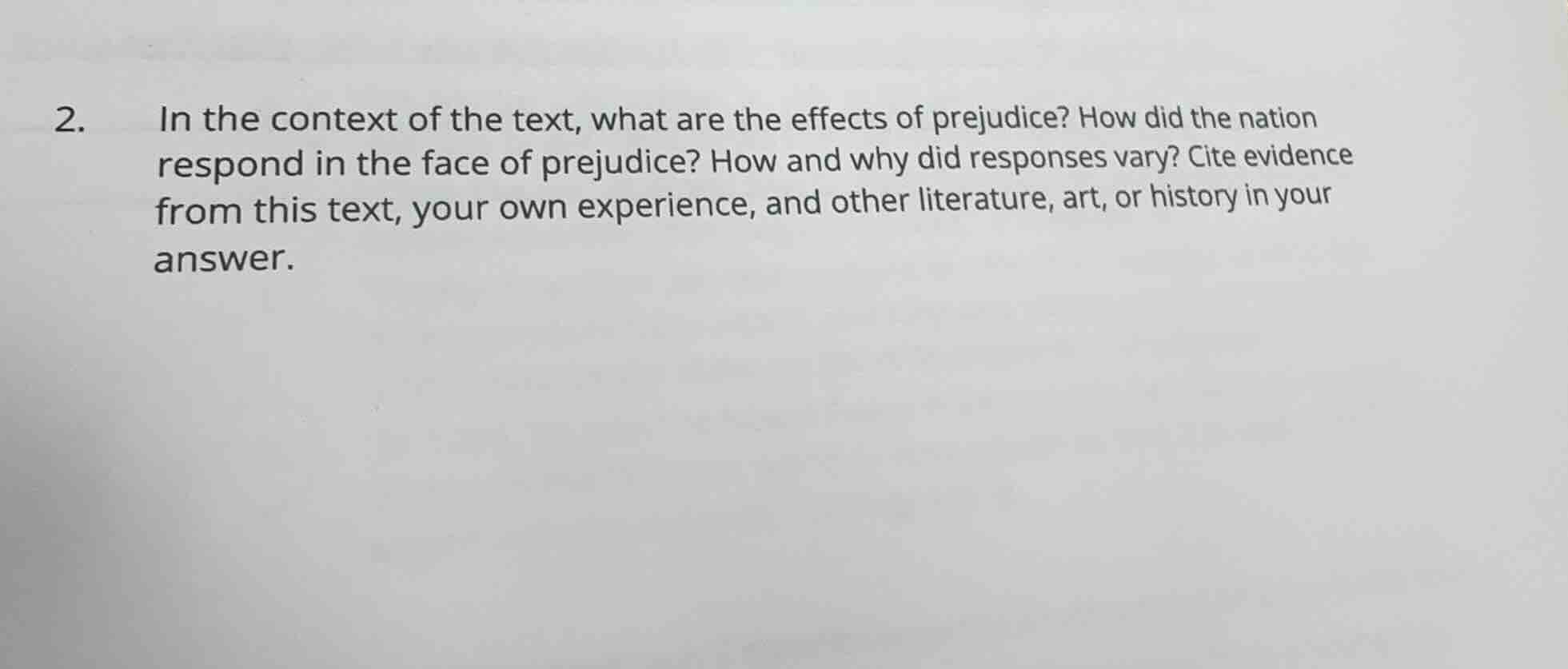
Question
- in the context of the text, what are the effects of prejudice? how did the nation respond in the face of prejudice? how and why did responses vary? cite evidence from this text, your own experience, and other literature, art, or history in your answer.
Response
To answer this question, we would need the specific text that the question is referring to (since it asks to "cite evidence from this text"). Without the text, we can provide a general framework for how to approach such a question:
Brief Explanations
- Effects of Prejudice: Prejudice (preconceived opinions not based on reason or experience) typically has negative effects such as social division, discrimination, harm to mental/physical health of targeted groups, and hindrance to societal progress. For example, racial prejudice has led to systemic racism, unequal access to resources, and violence against minority groups.
- National Response to Prejudice: Nations have responded in various ways. Some have implemented laws to combat discrimination (e.g., Civil Rights Act in the US), promoted diversity and inclusion initiatives, or engaged in public education campaigns. However, responses have also included denial, perpetuation of prejudice through policies (e.g., segregation laws in the past), or slow/ineffective action due to societal resistance.
- Variation in Responses: Responses vary due to factors like cultural norms, political climate, economic interests, and the strength of advocacy groups. For instance, in the US, the response to racial prejudice has evolved over time—from widespread acceptance of segregation to legal challenges and social movements (like the Civil Rights Movement) driven by the efforts of activists, which led to changes in laws and social attitudes. But even today, prejudice persists in different forms, showing that change is gradual and uneven.
- Citing Evidence: If we had the text, we would look for examples of how prejudice is depicted (e.g., against a particular group), how the nation/community reacted (e.g., protests, policy changes, or apathy), and analyze the reasons for varying responses (e.g., differing political ideologies, economic stakes). From personal experience, one might observe prejudice in daily interactions or institutional settings. From literature/art/history, works like "To Kill a Mockingbird" (exploring racial prejudice) or the history of the Women's Suffrage Movement (gender prejudice) can provide examples of prejudice and responses to it.
Since the specific text is not provided, we can't give a detailed answer with text - specific evidence, but the above is a general approach to structuring the response.

Snap & solve any problem in the app
Get step-by-step solutions on Sovi AI
Photo-based solutions with guided steps
Explore more problems and detailed explanations
(Response will be fully developed once the relevant text is provided. The above is a guide to constructing the answer based on the general understanding of prejudice and its societal impacts.)