QUESTION IMAGE
Question
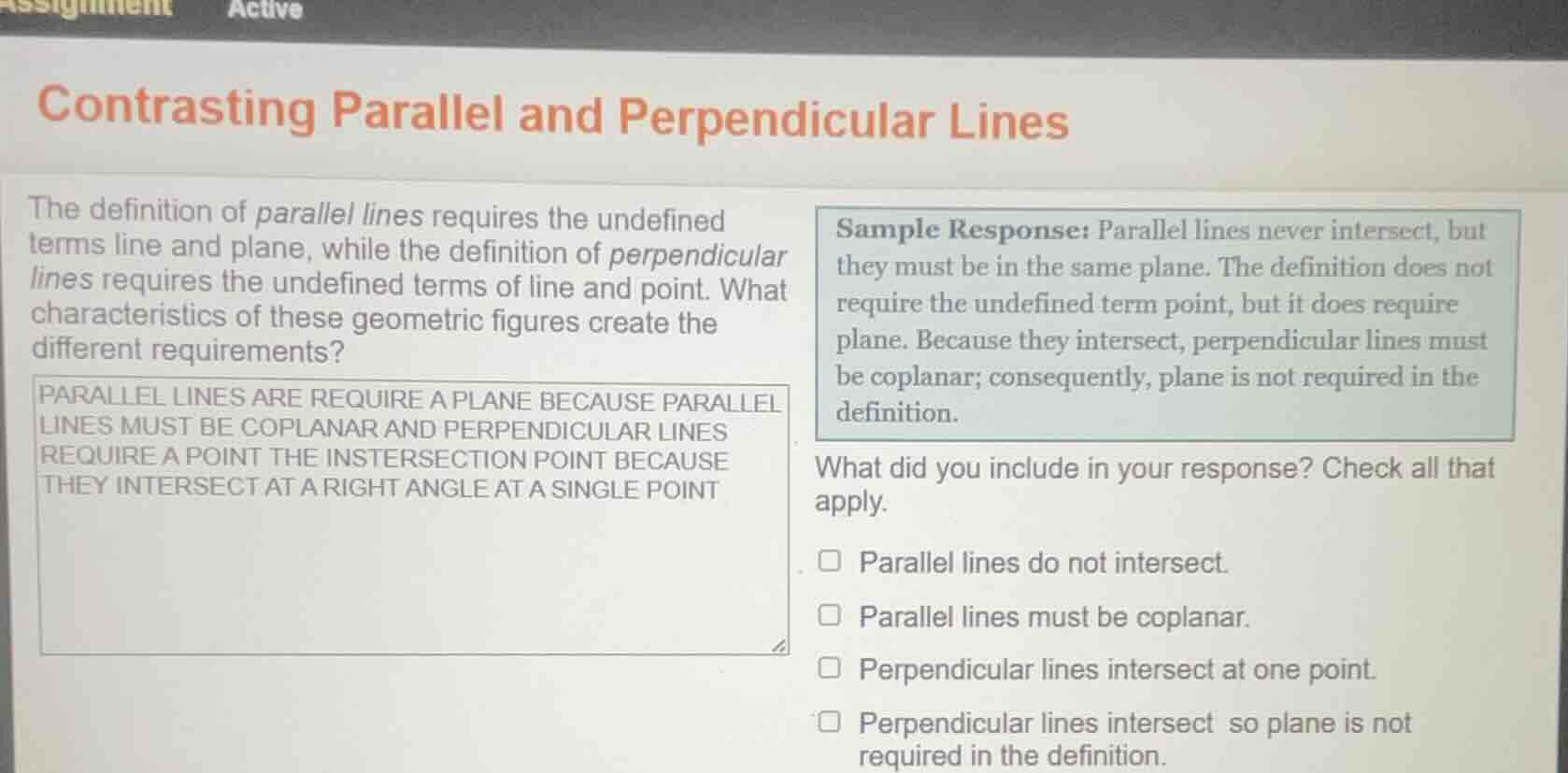
contrasting parallel and perpendicular lines the definition of parallel lines requires the undefined terms line and plane, while the definition of perpendicular lines requires the undefined terms of line and point. what characteristics of these geometric figures create the different requirements? parallel lines are require a plane because parallel lines must be coplanar and perpendicular lines require a point the instersection point because they intersect at a right angle at a single point sample response: parallel lines never intersect, but they must be in the same plane. the definition does not require the undefined term point, but it does require plane. because they intersect, perpendicular lines must be coplanar; consequently, plane is not required in the definition. what did you include in your response? check all that apply. ☐ parallel lines do not intersect. ☐ parallel lines must be coplanar. ☐ perpendicular lines intersect at one point. ☐ perpendicular lines intersect so plane is not required in the definition.
- For "Parallel lines do not intersect": By definition, parallel lines are lines in a plane that never meet, so they don't intersect. This should be included.
- For "Parallel lines must be coplanar": The definition of parallel lines (in the context of Euclidean geometry here) requires them to be in the same plane (coplanar); non - coplanar non - intersecting lines are skew lines, not parallel in the basic definition used here. So this should be included.
- For "Perpendicular lines intersect at one point": Perpendicular lines are lines that intersect at a right angle, and they intersect at exactly one point. So this should be included.
- For "Perpendicular lines intersect so plane is not required in the definition": Since perpendicular lines intersect, they must be coplanar (as intersecting lines are coplanar), but the key point is that their definition doesn't require the undefined term "plane" (unlike parallel lines) because their intersection (at a point) defines their coplanarity implicitly. So this should be included.

Snap & solve any problem in the app
Get step-by-step solutions on Sovi AI
Photo-based solutions with guided steps
Explore more problems and detailed explanations
A. Parallel lines do not intersect.
B. Parallel lines must be coplanar.
C. Perpendicular lines intersect at one point.
D. Perpendicular lines intersect so plane is not required in the definition.