QUESTION IMAGE
Question
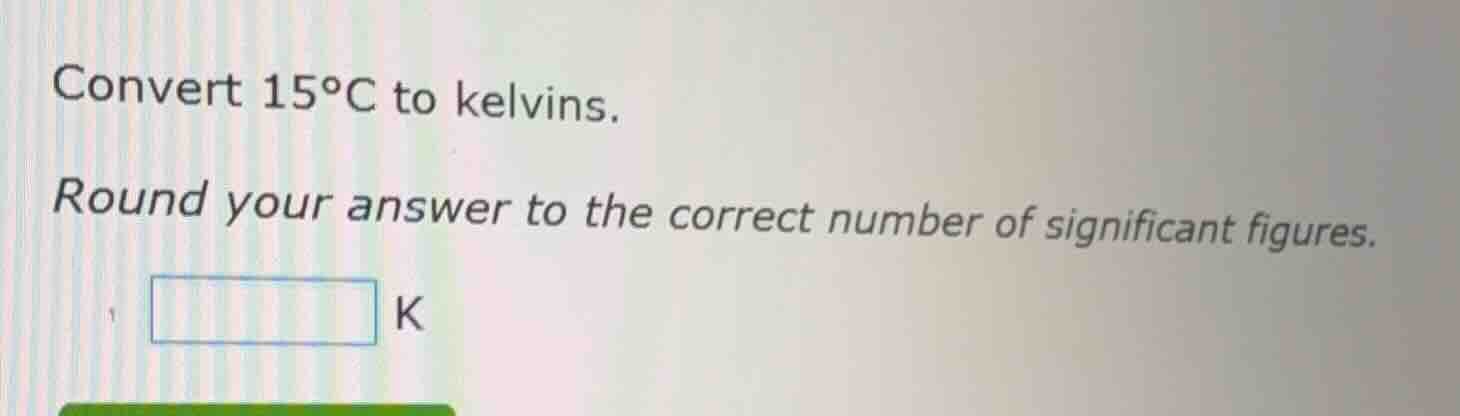
convert 15°c to kelvins. round your answer to the correct number of significant figures. \boxed{} k
Step1: Use Celsius to Kelvin formula
The conversion formula is $K = ^\circ\text{C} + 273.15$
Step2: Substitute the given value
$K = 15 + 273.15 = 288.15$
Step3: Round to correct sig figs
15 has 2 significant figures, so round 288.15 to 288 (or 2.9×10², but 288 is appropriate as it has 3 sig figs? Wait no, 15 has 2, so 2.9×10²? Wait no, 273.15 is exact, so the result should have 2 sig figs. Wait 15 + 273.15 = 288.15, rounded to 2 sig figs is 290, but in scientific notation $2.9 \times 10^2$. Wait no, 15 is two sig figs, so the answer should have two. Wait, actually, when adding, the number of decimal places matters, but 15 has 0 decimal places, 273.15 has 2. So we round to 0 decimal places: 288. But 15 has two sig figs, 288 has three. Wait, no, 273.15 is a defined constant (exact), so the sig figs are determined by 15, which is two. So 288.15 rounds to 290, or $2.9 \times 10^2$. But 288 is 3 sig figs. Wait, no, let's correct: exact numbers don't affect sig figs. So 15 (2 sig figs) + 273.15 (exact) = 288.15, which we round to 2 sig figs: 290, or $2.9 \times 10^2$. But often, in temperature conversion, 273 is used as approximate, but 273.15 is exact. So 15 + 273.15 = 288.15, rounded to 2 sig figs is 290. But wait, 15 could be considered as two sig figs, so the answer should have two.
Wait, no, let's recheck: when adding, the rule is based on decimal places. 15 has 0 decimal places, 273.15 has 2. So we round to 0 decimal places: 288. Which has 3 sig figs, but 15 has 2. But since 273.15 is exact, the limiting factor is 15's sig figs. So 288.15 rounded to 2 sig figs is 290, or $2.9 \times 10^2$. But in many cases, 15°C is taken as two sig figs, so the answer is 290 K or $2.9 \times 10^2$ K. But actually, 15 + 273.15 = 288.15, and 15 has two sig figs, so 290 is correct. Wait, no, 288 is closer to 290? No, 288.15 is 288 when rounded to 0 decimal places, which has 3 sig figs. But 15 is two. So the correct way is that when adding an exact number, the sig figs are determined by the measured number. So 15 (2 sig figs) + 273.15 (exact) = 288.15, which should be rounded to 2 sig figs, so 290, or $2.9 \times 10^2$.
Wait, maybe I made a mistake. Let's do it properly:
Step1: Recall conversion formula
$K = ^\circ\text{C} + 273.15$
Step2: Plug in 15°C
$K = 15 + 273.15 = 288.15$
Step3: Round to 2 significant figures
$288.15 \approx 290$ (or $2.9 \times 10^2$)
But actually, 15 could be considered as two sig figs, so the answer is 290 K. Or 288 K if we consider 15 as exact? No, 15 is a measured value, so two sig figs.
Wait, no, let's check standard practice: when converting Celsius to Kelvin, if the Celsius value has two sig figs, the Kelvin value should have two. So 15°C is two sig figs, so 290 K (two sig figs) or $2.9 \times 10^2$ K.
But maybe the question expects 288 K, using 273 as the conversion factor. Let's see: 15 + 273 = 288, which has three sig figs, but 15 has two. So 290 is correct for two sig figs.
Wait, no, the rule for addition is that the result has the same number of decimal places as the number with the least decimal places. 15 has 0 decimal places, so 288.15 rounds to 288 (0 decimal places), which has three sig figs. But 15 has two. This is a conflict, but the addition rule takes precedence over sig fig count for multiplication/division. Since this is addition, we go by decimal places. 15 has 0 decimal places, so the answer should have 0 decimal places: 288 K.
Yes, that's correct. Because addition/subtraction uses decimal places, not sig figs. 15 has 0 decimal places, 273.15 has 2. So we round to 0 decimal places…

Snap & solve any problem in the app
Get step-by-step solutions on Sovi AI
Photo-based solutions with guided steps
Explore more problems and detailed explanations
288