QUESTION IMAGE
Question
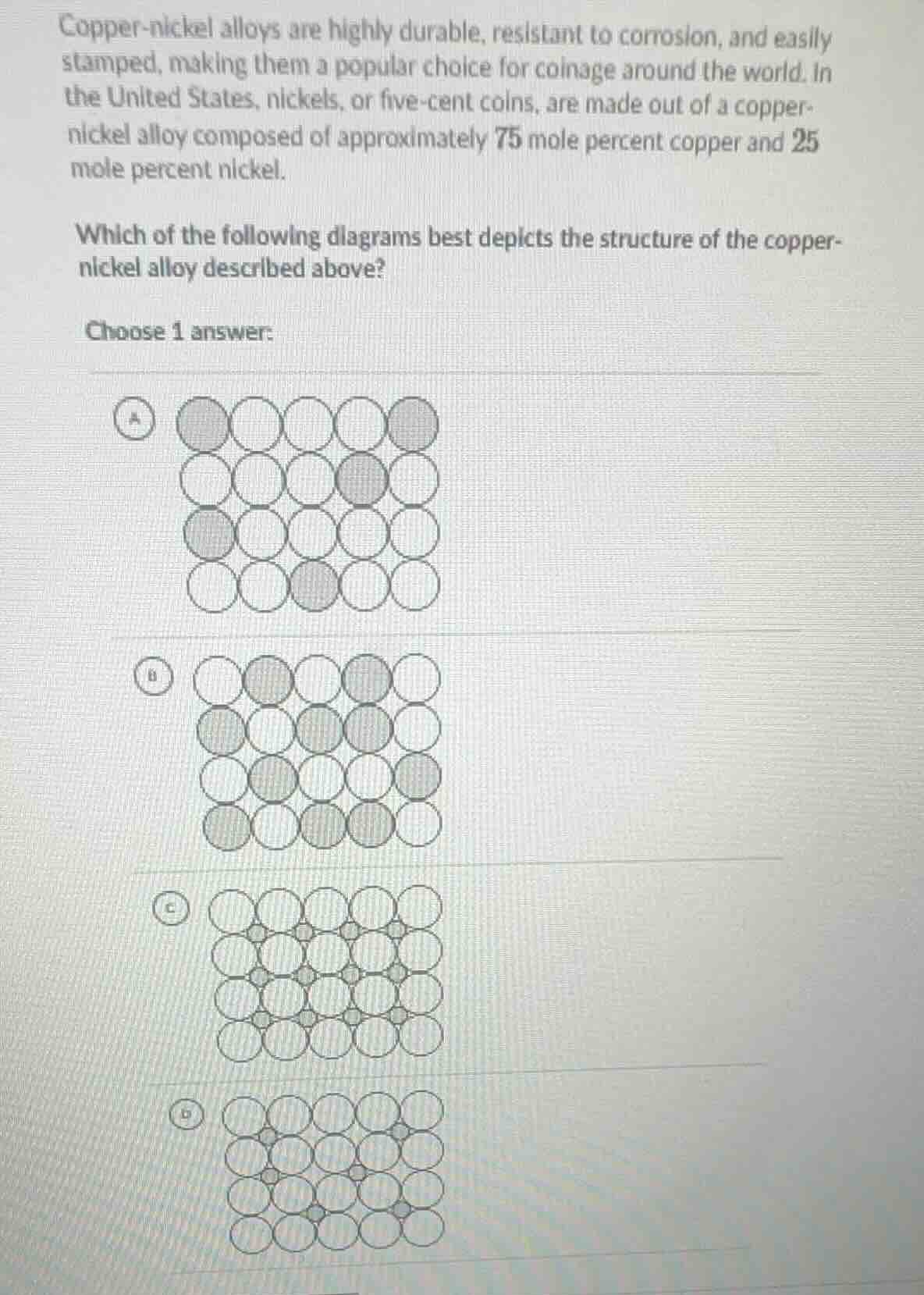
copper-nickel alloys are highly durable, resistant to corrosion, and easily stamped, making them a popular choice for coinage around the world. in the united states, nickels, or five-cent coins, are made out of a copper-nickel alloy composed of approximately 75 mole percent copper and 25 mole percent nickel. which of the following diagrams best depicts the structure of the copper-nickel alloy described above? choose 1 answer:
- First, calculate the ratio of copper to nickel. The mole percent of copper is 75% and nickel is 25%, so the ratio of copper (let's say the white circles) to nickel (gray circles) should be 3:1 (since 75/25 = 3).
- Now, count the number of white and gray circles in each option:
- Option A: Let's count. Total circles: 4 rows × 5 columns = 20. Gray (nickel) circles: Let's see, first row: 2, second row:1, third row:1, fourth row:1. Total gray: 2 + 1+1 +1 = 5. White circles: 20 - 5 = 15. Ratio of white to gray: 15:5 = 3:1. This matches the 75:25 (3:1) ratio.
- Option B: Gray circles seem more. Let's count, but just from the visual, it's not 3:1.
- Option C: The small circles are probably interstitial, but copper - nickel alloy is a substitutional alloy (since Cu and Ni have similar atomic sizes), so C is not correct as it shows interstitial (small circles in gaps), but Cu and Ni are similar in size, so substitutional.
- Option D: Also interstitial - like, not substitutional. And the ratio of the main circles (assuming large are one metal, small another) doesn't match 3:1.
So the correct diagram should have a substitutional structure (atoms of similar size replacing each other) with a 3:1 ratio of copper (white) to nickel (gray), which is option A.

Snap & solve any problem in the app
Get step-by-step solutions on Sovi AI
Photo-based solutions with guided steps
Explore more problems and detailed explanations
A. The diagram with 15 white (copper) circles and 5 gray (nickel) circles (ratio 3:1)