QUESTION IMAGE
Question
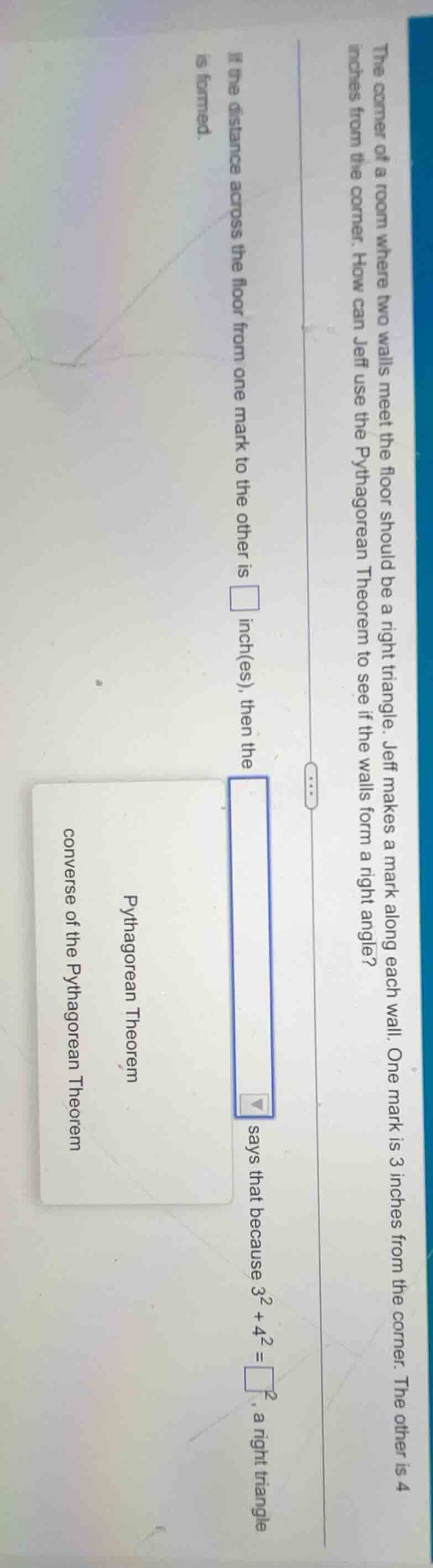
the corner of a room where two walls meet the floor should be a right triangle. jeff makes a mark along each wall. one mark is 3 inches from the corner. the other is 4 inches from the corner. how can jeff use the pythagorean theorem to see if the walls form a right angle?
if the distance across the floor from one mark to the other is \\(\square\\) inch(es), then the \\(\square\\) says that because \\(3^2 + 4^2 = \square^2\\), a right triangle is formed.
options: pythagorean theorem, converse of the pythagorean theorem
Step1: Recall the Converse of Pythagorean Theorem
The converse of the Pythagorean Theorem states that if \(a^2 + b^2 = c^2\) for a triangle with side lengths \(a\), \(b\), and \(c\) (where \(c\) is the longest side), then the triangle is a right triangle. Here, the two legs of the right triangle (if it is a right triangle) are \(a = 3\) inches and \(b = 4\) inches.
Step2: Calculate \(c\) using the Pythagorean Theorem
We know that for a right triangle, \(a^2 + b^2 = c^2\). Substituting \(a = 3\) and \(b = 4\), we get:
\[
\]
Taking the square root of both sides, we find \(c = \sqrt{25}= 5\) inches.
Step3: Determine the Theorem Used
Since we are using the fact that if \(3^2 + 4^2 = 5^2\), then the triangle is a right triangle, we are using the converse of the Pythagorean Theorem. The distance across the floor (the hypotenuse) should be \(5\) inches if a right angle is formed.

Snap & solve any problem in the app
Get step-by-step solutions on Sovi AI
Photo-based solutions with guided steps
Explore more problems and detailed explanations
The distance across the floor from one mark to the other is \(\boldsymbol{5}\) inches. The theorem used is the converse of the Pythagorean Theorem because \(3^2 + 4^2 = 5^2\), so a right triangle is formed.