QUESTION IMAGE
Question
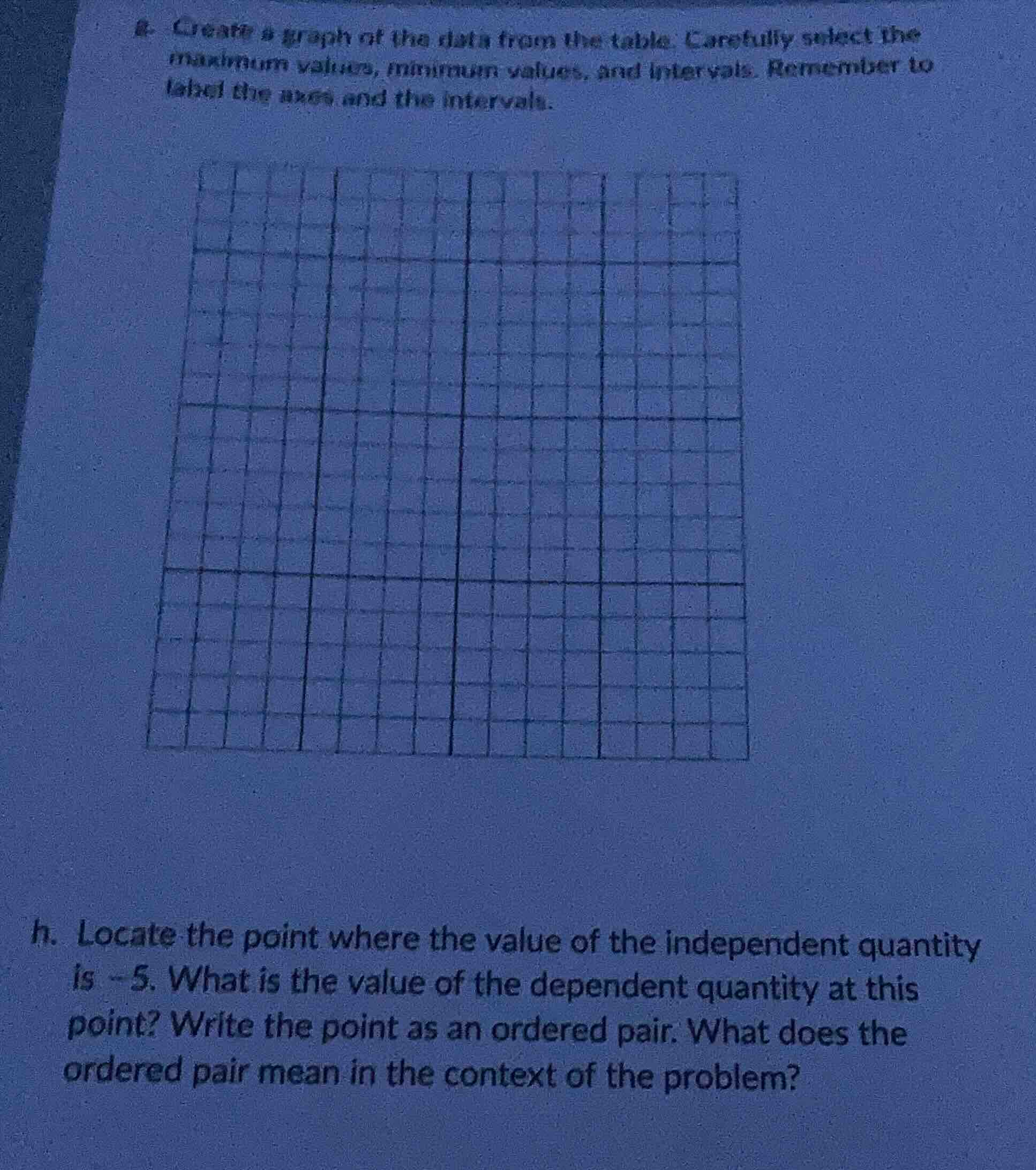
g. create a graph of the data from the table. carefully select the maximum values, minimum values, and intervals. remember to label the axes and the intervals.
h. locate the point where the value of the independent quantity is -5. what is the value of the dependent quantity at this point? write the point as an ordered pair. what does the ordered pair mean in the context of the problem?
To solve this problem, we need to assume we have a graph (or a table of data that can be graphed) where we can locate the independent variable value of \(-5\) and find the corresponding dependent variable value. Since the specific data from the table is not provided, we'll outline the general steps:
Step 1: Identify the Axes
- The independent variable is typically plotted on the \(x\)-axis, and the dependent variable is plotted on the \(y\)-axis.
Step 2: Locate \(x = -5\) on the \(x\)-axis
- Find the position on the \(x\)-axis where the value is \(-5\).
Step 3: Find the Corresponding \(y\)-value
- From the point \(x = -5\) on the \(x\)-axis, move vertically (up or down) until you intersect the graph (or the data point). The \(y\)-value at this intersection is the value of the dependent quantity.
Step 4: Write the Ordered Pair
- An ordered pair is written as \((x, y)\). Here, \(x = -5\), so the ordered pair will be \((-5, y)\), where \(y\) is the dependent quantity value found in Step 3.
Step 5: Interpret the Ordered Pair
- The ordered pair \((-5, y)\) means that when the independent quantity (represented by \(x\)) has a value of \(-5\), the dependent quantity (represented by \(y\)) has a value of \(y\). The specific interpretation depends on the context of the problem (e.g., if \(x\) represents time and \(y\) represents distance, it would mean at time \(-5\) units, the distance is \(y\) units).
Since the specific data is not provided, we can't give a numerical answer for the dependent quantity or the ordered pair. However, if we assume a hypothetical example where at \(x = -5\), the \(y\)-value is \(3\) (for illustration purposes), the ordered pair would be \((-5, 3)\), meaning when the independent quantity is \(-5\), the dependent quantity is \(3\).
If you provide the table of data or more context about the variables, we can give a more specific answer.

Snap & solve any problem in the app
Get step-by-step solutions on Sovi AI
Photo-based solutions with guided steps
Explore more problems and detailed explanations
To solve this problem, we need to assume we have a graph (or a table of data that can be graphed) where we can locate the independent variable value of \(-5\) and find the corresponding dependent variable value. Since the specific data from the table is not provided, we'll outline the general steps:
Step 1: Identify the Axes
- The independent variable is typically plotted on the \(x\)-axis, and the dependent variable is plotted on the \(y\)-axis.
Step 2: Locate \(x = -5\) on the \(x\)-axis
- Find the position on the \(x\)-axis where the value is \(-5\).
Step 3: Find the Corresponding \(y\)-value
- From the point \(x = -5\) on the \(x\)-axis, move vertically (up or down) until you intersect the graph (or the data point). The \(y\)-value at this intersection is the value of the dependent quantity.
Step 4: Write the Ordered Pair
- An ordered pair is written as \((x, y)\). Here, \(x = -5\), so the ordered pair will be \((-5, y)\), where \(y\) is the dependent quantity value found in Step 3.
Step 5: Interpret the Ordered Pair
- The ordered pair \((-5, y)\) means that when the independent quantity (represented by \(x\)) has a value of \(-5\), the dependent quantity (represented by \(y\)) has a value of \(y\). The specific interpretation depends on the context of the problem (e.g., if \(x\) represents time and \(y\) represents distance, it would mean at time \(-5\) units, the distance is \(y\) units).
Since the specific data is not provided, we can't give a numerical answer for the dependent quantity or the ordered pair. However, if we assume a hypothetical example where at \(x = -5\), the \(y\)-value is \(3\) (for illustration purposes), the ordered pair would be \((-5, 3)\), meaning when the independent quantity is \(-5\), the dependent quantity is \(3\).
If you provide the table of data or more context about the variables, we can give a more specific answer.