QUESTION IMAGE
Question
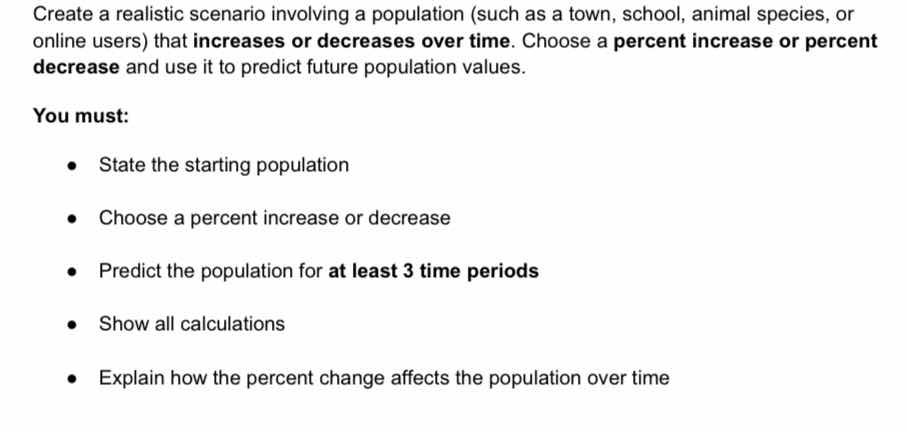
create a realistic scenario involving a population (such as a town, school, animal species, or online users) that increases or decreases over time. choose a percent increase or percent decrease and use it to predict future population values. you must: - state the starting population - choose a percent increase or decrease - predict the population for at least 3 time periods - show all calculations - explain how the percent change affects the population over time
Step1: Define the scenario
Let's consider a small town with a starting population of 1000 people. We'll choose a 5% annual increase in population.
Step2: Calculate population after 1 year
The formula for population growth with a percent increase is \( P_n = P_0(1 + r)^n \), where \( P_0 \) is the initial population, \( r \) is the rate of increase (as a decimal), and \( n \) is the number of time periods.
For \( n = 1 \), \( P_0 = 1000 \), \( r = 0.05 \)
\( P_1 = 1000(1 + 0.05)^1 = 1000\times1.05 = 1050 \)
Step3: Calculate population after 2 years
For \( n = 2 \)
\( P_2 = 1000(1 + 0.05)^2 = 1000\times1.05^2 = 1000\times1.1025 = 1102.5 \approx 1103 \) (we can round to the nearest whole number for a population)
Step4: Calculate population after 3 years
For \( n = 3 \)
\( P_3 = 1000(1 + 0.05)^3 = 1000\times1.05^3 = 1000\times1.157625 = 1157.625 \approx 1158 \)
Step5: Explain the effect of percent change
The 5% increase means that each year, the population is 1.05 times the previous year's population. As time goes on, the population grows exponentially. The growth is compounded, so the amount of increase each year gets larger. For example, in the first year, the increase is 50 people (1050 - 1000), in the second year, the increase is 52.5 (1102.5 - 1050) or 53 people, and in the third year, the increase is about 55.125 (1157.625 - 1102.5) or 55 people. So the percent increase leads to a larger absolute increase in population with each passing year.

Snap & solve any problem in the app
Get step-by-step solutions on Sovi AI
Photo-based solutions with guided steps
Explore more problems and detailed explanations
- Starting population (\( P_0 \)): 1000
- Percent increase: 5% (or 0.05 as a decimal)
- Population after 1 year (\( P_1 \)): 1050
- Population after 2 years (\( P_2 \)): 1103 (rounded)
- Population after 3 years (\( P_3 \)): 1158 (rounded)
The 5% annual increase causes the population to grow exponentially. Each year, the population is multiplied by 1.05, leading to a larger absolute growth (in terms of the number of people added) with each successive year.