QUESTION IMAGE
Question
creating equivalent fractions
your turn questions
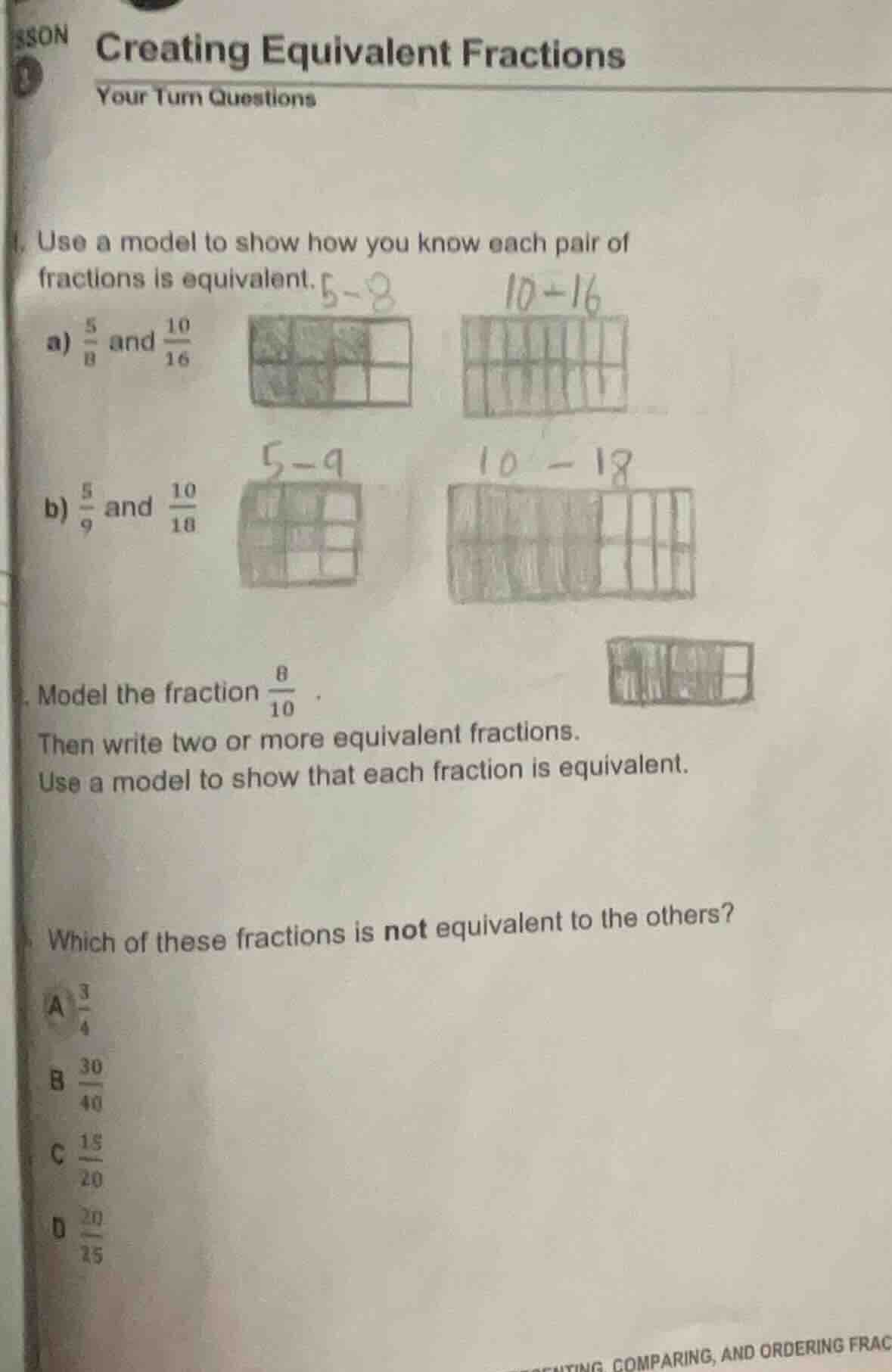
- use a model to show how you know each pair of
fractions is equivalent.
a) \\(\frac{5}{8}\\) and \\(\frac{10}{16}\\)
b) \\(\frac{5}{9}\\) and \\(\frac{10}{18}\\)
. model the fraction \\(\frac{8}{10}\\) .
then write two or more equivalent fractions.
use a model to show that each fraction is equivalent.
which of these fractions is not equivalent to the others?
a \\(\frac{3}{4}\\)
b \\(\frac{30}{40}\\)
c \\(\frac{15}{20}\\)
d \\(\frac{20}{25}\\)
Part a) $\boldsymbol{\frac{5}{8}}$ and $\boldsymbol{\frac{10}{16}}$
Step 1: Recall Equivalent Fraction Rule
To check if two fractions are equivalent, we can use the rule that multiplying the numerator and denominator of a fraction by the same non - zero number gives an equivalent fraction. For $\frac{5}{8}$, if we multiply the numerator and denominator by 2:
$$\frac{5\times2}{8\times2}=\frac{10}{16}$$
Step 2: Visual Model (Rectangle Model)
- For $\frac{5}{8}$: Draw a rectangle and divide it into 8 equal parts. Shade 5 of those parts.
- For $\frac{10}{16}$: Draw another rectangle of the same size and divide it into 16 equal parts. Since $\frac{5}{8}=\frac{10}{16}$, when we shade 10 out of 16 parts, we will see that the shaded area is the same as the shaded area of the rectangle divided into 8 parts with 5 shaded. This is because dividing the rectangle into more parts (from 8 to 16) and increasing the number of shaded parts proportionally (from 5 to 10) keeps the relative amount of the shaded region the same.
Part b) $\boldsymbol{\frac{5}{9}}$ and $\boldsymbol{\frac{10}{18}}$
Step 1: Apply Equivalent Fraction Rule
Using the rule of equivalent fractions, multiply the numerator and denominator of $\frac{5}{9}$ by 2:
$$\frac{5\times2}{9\times2}=\frac{10}{18}$$
Step 2: Visual Model (Rectangle Model)
- For $\frac{5}{9}$: Draw a rectangle and divide it into 9 equal parts. Shade 5 of the parts.
- For $\frac{10}{18}$: Draw a rectangle of the same size and divide it into 18 equal parts. Shade 10 of the parts. We will observe that the shaded area of the two rectangles is the same. This is because we have scaled the fraction $\frac{5}{9}$ by a factor of 2 (both numerator and denominator) to get $\frac{10}{18}$, so the relative amount of the shaded region remains unchanged.
Modeling $\boldsymbol{\frac{8}{10}}$ and Finding Equivalent Fractions
Step 1: Model $\frac{8}{10}$
Draw a rectangle and divide it into 10 equal parts. Shade 8 of those parts.
Step 2: Find Equivalent Fractions
- First Equivalent Fraction: Divide the numerator and denominator of $\frac{8}{10}$ by 2.
$$\frac{8\div2}{10\div2}=\frac{4}{5}$$
- Second Equivalent Fraction: Multiply the numerator and denominator of $\frac{8}{10}$ by 2.
$$\frac{8\times2}{10\times2}=\frac{16}{20}$$
Step 3: Verify with Models
- For $\frac{4}{5}$: Draw a rectangle of the same size as the one for $\frac{8}{10}$, divide it into 5 equal parts. Shade 4 parts. The shaded area will be the same as the shaded area of $\frac{8}{10}$ because $\frac{8}{10}$ simplifies to $\frac{4}{5}$.
- For $\frac{16}{20}$: Draw a rectangle of the same size, divide it into 20 equal parts. Shade 16 parts. The shaded area will match the shaded area of $\frac{8}{10}$ (and $\frac{4}{5}$) since we are scaling the fraction $\frac{8}{10}$ by a factor of 2.
Which Fraction is Not Equivalent?
We need to check which of the fractions $\frac{3}{4}$, $\frac{30}{40}$, $\frac{15}{20}$, $\frac{20}{25}$ is not equivalent to the others.
Step 1: Simplify Each Fraction
- For $\frac{3}{4}$: It is already in simplest form.
- For $\frac{30}{40}$: Divide numerator and denominator by 10: $\frac{30\div10}{40\div10}=\frac{3}{4}$
- For $\frac{15}{20}$: Divide numerator and denominator by 5: $\frac{15\div5}{20\div5}=\frac{3}{4}$
- For $\frac{20}{25}$: Divide numerator and denominator by 5: $\frac{20\div5}{25\div5}=\frac{4}{5}$
Since $\frac{3}{4}$, $\frac{30}{40}$, and $\frac{15}{20}$ are all equal to $\frac{3}{4}$, and $\frac{20}{25}=\frac{4}{5}$ which is different from $\frac{3}{4}$, the fractio…

Snap & solve any problem in the app
Get step-by-step solutions on Sovi AI
Photo-based solutions with guided steps
Explore more problems and detailed explanations
Part a) $\boldsymbol{\frac{5}{8}}$ and $\boldsymbol{\frac{10}{16}}$
Step 1: Recall Equivalent Fraction Rule
To check if two fractions are equivalent, we can use the rule that multiplying the numerator and denominator of a fraction by the same non - zero number gives an equivalent fraction. For $\frac{5}{8}$, if we multiply the numerator and denominator by 2:
$$\frac{5\times2}{8\times2}=\frac{10}{16}$$
Step 2: Visual Model (Rectangle Model)
- For $\frac{5}{8}$: Draw a rectangle and divide it into 8 equal parts. Shade 5 of those parts.
- For $\frac{10}{16}$: Draw another rectangle of the same size and divide it into 16 equal parts. Since $\frac{5}{8}=\frac{10}{16}$, when we shade 10 out of 16 parts, we will see that the shaded area is the same as the shaded area of the rectangle divided into 8 parts with 5 shaded. This is because dividing the rectangle into more parts (from 8 to 16) and increasing the number of shaded parts proportionally (from 5 to 10) keeps the relative amount of the shaded region the same.
Part b) $\boldsymbol{\frac{5}{9}}$ and $\boldsymbol{\frac{10}{18}}$
Step 1: Apply Equivalent Fraction Rule
Using the rule of equivalent fractions, multiply the numerator and denominator of $\frac{5}{9}$ by 2:
$$\frac{5\times2}{9\times2}=\frac{10}{18}$$
Step 2: Visual Model (Rectangle Model)
- For $\frac{5}{9}$: Draw a rectangle and divide it into 9 equal parts. Shade 5 of the parts.
- For $\frac{10}{18}$: Draw a rectangle of the same size and divide it into 18 equal parts. Shade 10 of the parts. We will observe that the shaded area of the two rectangles is the same. This is because we have scaled the fraction $\frac{5}{9}$ by a factor of 2 (both numerator and denominator) to get $\frac{10}{18}$, so the relative amount of the shaded region remains unchanged.
Modeling $\boldsymbol{\frac{8}{10}}$ and Finding Equivalent Fractions
Step 1: Model $\frac{8}{10}$
Draw a rectangle and divide it into 10 equal parts. Shade 8 of those parts.
Step 2: Find Equivalent Fractions
- First Equivalent Fraction: Divide the numerator and denominator of $\frac{8}{10}$ by 2.
$$\frac{8\div2}{10\div2}=\frac{4}{5}$$
- Second Equivalent Fraction: Multiply the numerator and denominator of $\frac{8}{10}$ by 2.
$$\frac{8\times2}{10\times2}=\frac{16}{20}$$
Step 3: Verify with Models
- For $\frac{4}{5}$: Draw a rectangle of the same size as the one for $\frac{8}{10}$, divide it into 5 equal parts. Shade 4 parts. The shaded area will be the same as the shaded area of $\frac{8}{10}$ because $\frac{8}{10}$ simplifies to $\frac{4}{5}$.
- For $\frac{16}{20}$: Draw a rectangle of the same size, divide it into 20 equal parts. Shade 16 parts. The shaded area will match the shaded area of $\frac{8}{10}$ (and $\frac{4}{5}$) since we are scaling the fraction $\frac{8}{10}$ by a factor of 2.
Which Fraction is Not Equivalent?
We need to check which of the fractions $\frac{3}{4}$, $\frac{30}{40}$, $\frac{15}{20}$, $\frac{20}{25}$ is not equivalent to the others.
Step 1: Simplify Each Fraction
- For $\frac{3}{4}$: It is already in simplest form.
- For $\frac{30}{40}$: Divide numerator and denominator by 10: $\frac{30\div10}{40\div10}=\frac{3}{4}$
- For $\frac{15}{20}$: Divide numerator and denominator by 5: $\frac{15\div5}{20\div5}=\frac{3}{4}$
- For $\frac{20}{25}$: Divide numerator and denominator by 5: $\frac{20\div5}{25\div5}=\frac{4}{5}$
Since $\frac{3}{4}$, $\frac{30}{40}$, and $\frac{15}{20}$ are all equal to $\frac{3}{4}$, and $\frac{20}{25}=\frac{4}{5}$ which is different from $\frac{3}{4}$, the fraction that is not equivalent is $\frac{20}{25}$ (Option D).