QUESTION IMAGE
Question
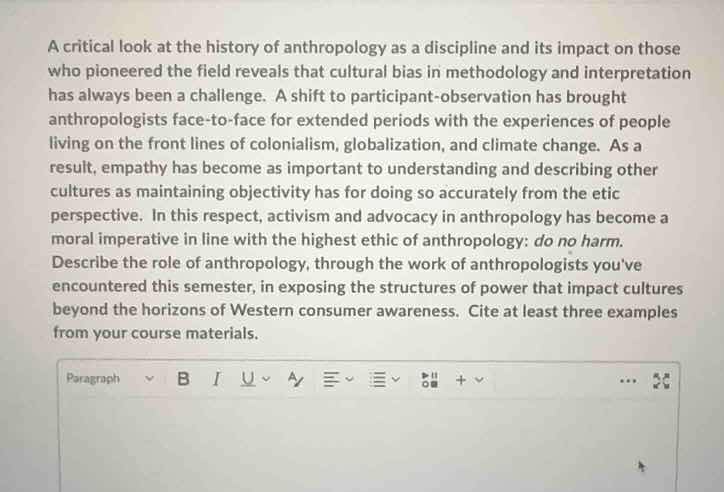
a critical look at the history of anthropology as a discipline and its impact on those who pioneered the field reveals that cultural bias in methodology and interpretation has always been a challenge. a shift to participant-observation has brought anthropologists face-to-face for extended periods with the experiences of people living on the front lines of colonialism, globalization, and climate change. as a result, empathy has become as important to understanding and describing other cultures as maintaining objectivity has for doing so accurately from the etic perspective. in this respect, activism and advocacy in anthropology has become a moral imperative in line with the highest ethic of anthropology: do no harm.
describe the role of anthropology, through the work of anthropologists youve encountered this semester, in exposing the structures of power that impact cultures beyond the horizons of western consumer awareness. cite at least three examples from your course materials.
- Marvin Harris (Cultural Materialism): Harris analyzed how global capitalist power structures shape consumption patterns. His work on the sacred cow in India showed that Western consumer-centric views dismissed the ecological and economic logic of cattle preservation, exposing how Western consumer norms frame non-Western practices as "irrational" to maintain global resource extraction hierarchies.
- Anna Lowenhaupt Tsing (Anthropology of Globalization): Tsing's Friction: An Ethnography of Global Connection examined how Western consumer demand for tropical hardwoods and exotic commodities enforces neocolonial power structures. She documented how marginalized forest communities in Indonesia are displaced and exploited to supply Western markets, revealing how consumer awareness (or lack thereof) perpetuates unequal power dynamics tied to climate change and resource theft.
- Setha Low (Urban Anthropology): Low's research on gentrification in New York City demonstrated how Western consumer-driven urban development displaces low-income, non-Western immigrant communities. She showed that "luxury" consumer spaces (boutiques, high-rise apartments) are built on the erasure of cultural neighborhoods, exposing how capitalist power structures prioritize Western consumer desires over the cultural survival of marginalized groups.

Snap & solve any problem in the app
Get step-by-step solutions on Sovi AI
Photo-based solutions with guided steps
Explore more problems and detailed explanations
Anthropology exposes power structures shaping cultures beyond Western consumer awareness through critical ethnographic work:
- Marvin Harris used cultural materialism to show Western consumer biases dismiss non-Western ecological/economic systems (e.g., Indian sacred cows), masking global resource extraction hierarchies.
- Anna Lowenhaupt Tsing documented how Western consumer demand for exotic commodities enforces neocolonial exploitation of Indonesian forest communities, linking consumer ignorance to climate injustice and displacement.
- Setha Low's urban ethnography revealed Western consumer-driven gentrification in NYC displaces immigrant communities, prioritizing capitalist consumer spaces over cultural survival.