QUESTION IMAGE
Question
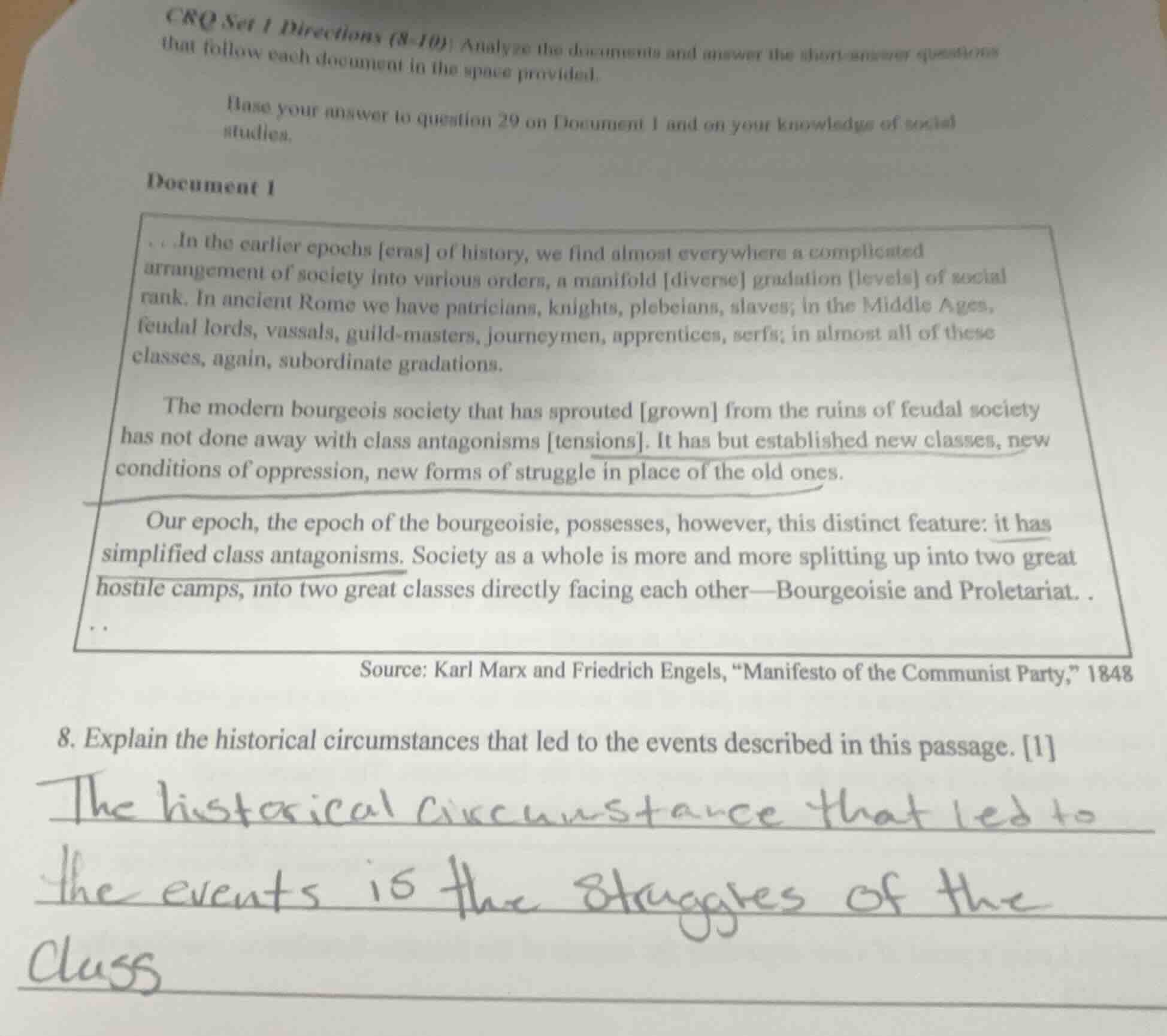
crq set 1 directions (8 - 10): analyze the documents and answer the short - answer questions that follow each document in the space provided.
base your answer to question 29 on document 1 and on your knowledge of social studies.
document 1
... in the earlier epochs eras of history, we find almost everywhere a complicated arrangement of society into various orders, a manifold diverse graduation levels of social rank. in ancient rome we have patricians, knights, plebeians, slaves; in the middle ages, feudal lords, vassals, guild - masters, journeymen, apprentices, serfs; in almost all of these classes, again, subordinate gradations.
the modern bourgeois society that has sprouted grown from the ruins of feudal society has not done away with class antagonisms tensions. it has but established new classes, new conditions of oppression, new forms of struggle in place of the old ones.
our epoch, the epoch of the bourgeoisie, possesses, however, this distinct feature: it has simplified class antagonisms. society as a whole is more and more splitting up into two great hostile camps, into two great classes directly facing each other—bourgeoisie and proletariat..
source: karl marx and friedrich engels, “manifesto of the communist party,” 1848
- explain the historical circumstances that led to the events described in this passage. 1
the historical circumstance that led to
the events is the struggles of the
class
The passage is from the Communist Manifesto (1848), written amid the Industrial Revolution. This era saw the collapse of feudalism, rise of capitalist bourgeoisie who owned factories, and the creation of a new working class (proletariat) forced to sell their labor. Industrialization simplified old multi-tiered feudal social structures into two opposing classes, with the proletariat facing exploitation by the bourgeoisie, creating new class tensions.

Snap & solve any problem in the app
Get step-by-step solutions on Sovi AI
Photo-based solutions with guided steps
Explore more problems and detailed explanations
The key historical circumstance is the Industrial Revolution, which replaced feudalism with capitalist bourgeois society. This process simplified complex pre-existing social hierarchies into two hostile, opposing classes: the bourgeoisie (factory-owning elite) and the proletariat (exploited working class), creating new class antagonisms and struggles.